
Green Mediterranean diet: what the studies show and what you can take from it as an athlete
General information, not medical advice. If you have a medical condition, take medication, are pregnant or want to lose a lot of weight while training hard, talk to your GP or a dietitian.
The green Mediterranean diet is a Mediterranean eating pattern with extra green plant foods and less meat, tested in the Israeli DIRECT PLUS study. What does that study really show, and what can you take from it as a recreational athlete?
What participants ate on the green Mediterranean diet
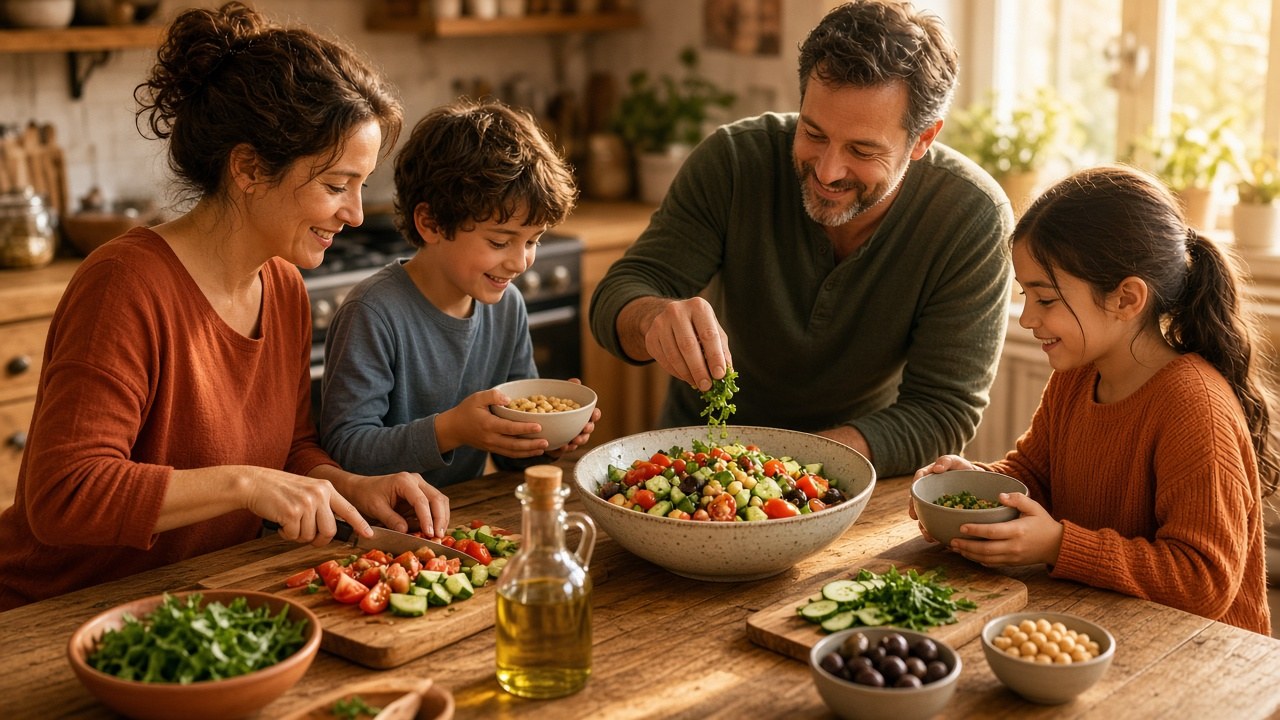
DIRECT PLUS followed 294 people with abdominal obesity or raised blood fats for 18 months. They were 51 years old on average and 88% were men. They received standard healthy eating advice, a Mediterranean diet or a green Mediterranean diet, each combined with a physical activity programme. Both Mediterranean groups followed the same weight loss diet with 28 grams of walnuts a day. On top of that, the green group drank 3 to 4 cups of green tea a day, ate less meat and had a shake with 100 grams of Mankai, a type of duckweed that replaced part of the animal protein (Tsaban and colleagues, 2021). This gave them more polyphenols, plant substances found in tea, nuts, vegetables and fruit, among other foods.
What was measured, and in whom
After 6 months, both Mediterranean groups had lost about the same amount of weight: 6.2 kilograms in the green group and 5.4 kilograms in the standard Mediterranean group, compared with 1.5 kilograms on the standard advice (Tsaban and colleagues, 2021). After 18 months, visceral fat, the belly fat around the organs, had fallen by 14.1% in the green group, compared with 6.0% and 4.2% (Zelicha and colleagues, 2022). At the start, 62% of participants had fatty liver, too much fat stored in the liver. After 18 months this was down to 31.5% in the green group, compared with 47.9% and 54.8% (Yaskolka Meir and colleagues, 2021).
These are intermediate outcomes. Heart attacks, deaths and sports performance were not measured, and the participants were not athletes. The lead researcher advises the company that produces Mankai, and the belly fat study was supported by a Californian walnut industry body, which according to the authors had no role in the analysis.
Where the stories about years younger and ten extra years come from
In 256 participants, biological age was estimated with methylation clocks, tests that derive an age from chemical marks on DNA. The three groups did not differ on this. Those who stuck more closely to the green diet had a smaller increase on two of the clocks, and the two Mediterranean groups together came out about 8.9 months better than expected on one clock (Yaskolka Meir and colleagues, 2023). That is an association, not proof that the diet turns your biological clock back by years.
The figures of up to ten extra years of life do not come from DIRECT PLUS. They come from modelling studies on healthier eating in general (Fadnes and colleagues, 2022 and 2023). According to the authors of the 2022 study, they are not a forecast for any one person. How to read them is explained in five levers for more healthy years.
How to translate it to the Belgian guidelines
Much of it is already in the 2025 dietary guidelines of the Belgian Superior Health Council (SHC), the federal scientific advisory body on health: more than 125 grams of whole grains, more than 300 grams of vegetables and 20 to 30 grams of nuts and seeds a day, legumes several times a week, less than 300 grams of unprocessed red meat and less than 30 grams of processed meat a week, and as little ultra-processed food as possible. If you eat few legumes so far, build them up gradually.
Green tea as a drink fits in. According to EFSA, the European Food Safety Authority, catechins, the polyphenols in regularly brewed green tea, are generally safe. As a supplement, 800 milligrams of catechins or more a day may come with early signs of liver damage (EFSA, 2018). Capsules are therefore not a way to copy the study. You do not need Mankai either: the idea is more green plant foods. The SHC advises against alcohol. If you do drink, keep it to a maximum of 10 standard drinks a week, spread over several days.
What to keep an eye on as an athlete
DIRECT PLUS was a weight loss diet. If you train a lot while eating much less, you risk getting too little energy. According to the International Olympic Committee, an energy intake that is too low for what your training burns harms the health and performance of both women and men (Mountjoy and colleagues, 2023). If you eat less meat, check how much protein you need when you train.
Sources
- Tsaban G, Yaskolka Meir A, Rinott E et al. (2021). The effect of green Mediterranean diet on cardiometabolic risk; a randomised controlled trial. Heart, 107(13), 1054–1061.
- Zelicha H, Kloting N, Kaplan A et al. (2022). The effect of high-polyphenol Mediterranean diet on visceral adiposity: the DIRECT PLUS randomized controlled trial. BMC Medicine, 20, 327.
- Yaskolka Meir A, Rinott E, Tsaban G et al. (2021). Effect of green-Mediterranean diet on intrahepatic fat: the DIRECT PLUS randomised controlled trial. Gut, 70(11), 2085–2095.
- Yaskolka Meir A, Keller M, Hoffmann A et al. (2023). The effect of polyphenols on DNA methylation-assessed biological age attenuation: the DIRECT PLUS randomized controlled trial. BMC Medicine, 21, 364.
- Fadnes LT, Økland JM, Haaland ØA, Johansson KA (2022). Estimating impact of food choices on life expectancy: A modeling study. PLoS Medicine, 19(2), e1003889.
- Fadnes LT, Celis-Morales C, Økland JM et al. (2023). Life expectancy can increase by up to 10 years following sustained shifts towards healthier diets in the United Kingdom. Nature Food, 4(11), 961–965.
- Belgian Superior Health Council (Hoge Gezondheidsraad) (2025). Voedingsaanbevelingen voor de Belgische bevolking 2025 (advice 9805-9807, in Dutch; also available in French).
- Vlaams Instituut Gezond Leven, the Flemish health institute. Aanbevelingen van de Hoge Gezondheidsraad met focus op voedingsmiddelen (in Dutch). Accessed 17 October 2026.
- EFSA Panel on Food Additives and Nutrient Sources added to Food (ANS) (2018). Scientific opinion on the safety of green tea catechins. EFSA Journal, 16(4), 5239.
- Mountjoy M, Ackerman KE, Bailey DM et al. (2023). 2023 International Olympic Committee’s (IOC) consensus statement on Relative Energy Deficiency in Sport (REDs). British Journal of Sports Medicine, 57(17), 1073–1097.


3 Comments