Asbestos at home: what to know before you start a DIY job
TLDR
- Homes built before 2001 may contain asbestos: in corrugated sheets, roof slates, floor tiles, adhesive, pipe insulation or an old electric storage heater.
- Asbestos is mainly a problem when fibres are released and you breathe them in. Intact material in good condition that you leave alone is far less risky.
- The diseases linked to it often appear only 20 to 40 years later. What you do in your garage today matters for your long-term health.
- Not sure? Don’t grind, drill or break anything. Have it checked first and follow your region’s rules.
It’s DIY season. Everywhere I look, neighbours are pulling down a garden shed, stripping a bathroom or fixing up an old garage. I have my own list too. But when I looked at the roof of our shed, those grey corrugated sheets, a question popped up: is that asbestos? And what if I just went at it with an angle grinder?
So I looked into it. Not to scare anyone, but because this is one of those topics where a little knowledge up front makes a big difference.
Why asbestos is a long-term story
Asbestos is a natural fibre that was used in construction for years because it was strong, cheap and fire-resistant. The International Agency for Research on Cancer (IARC) classifies all forms of asbestos as carcinogenic to humans. The World Health Organization points to lung cancer, mesothelioma (a cancer of the lining of the lungs or abdomen) and asbestosis.
What makes it treacherous: you notice nothing at the time. The diseases usually show up decades after exposure. When we think about ageing well, we think about food and movement. But avoiding what damages your lungs belongs on that list just as much, like testing your home for radon.
Where it can be hiding
In Belgium, asbestos was used until the late 1990s. For a home built before 2001, it’s well worth checking. Typical places:
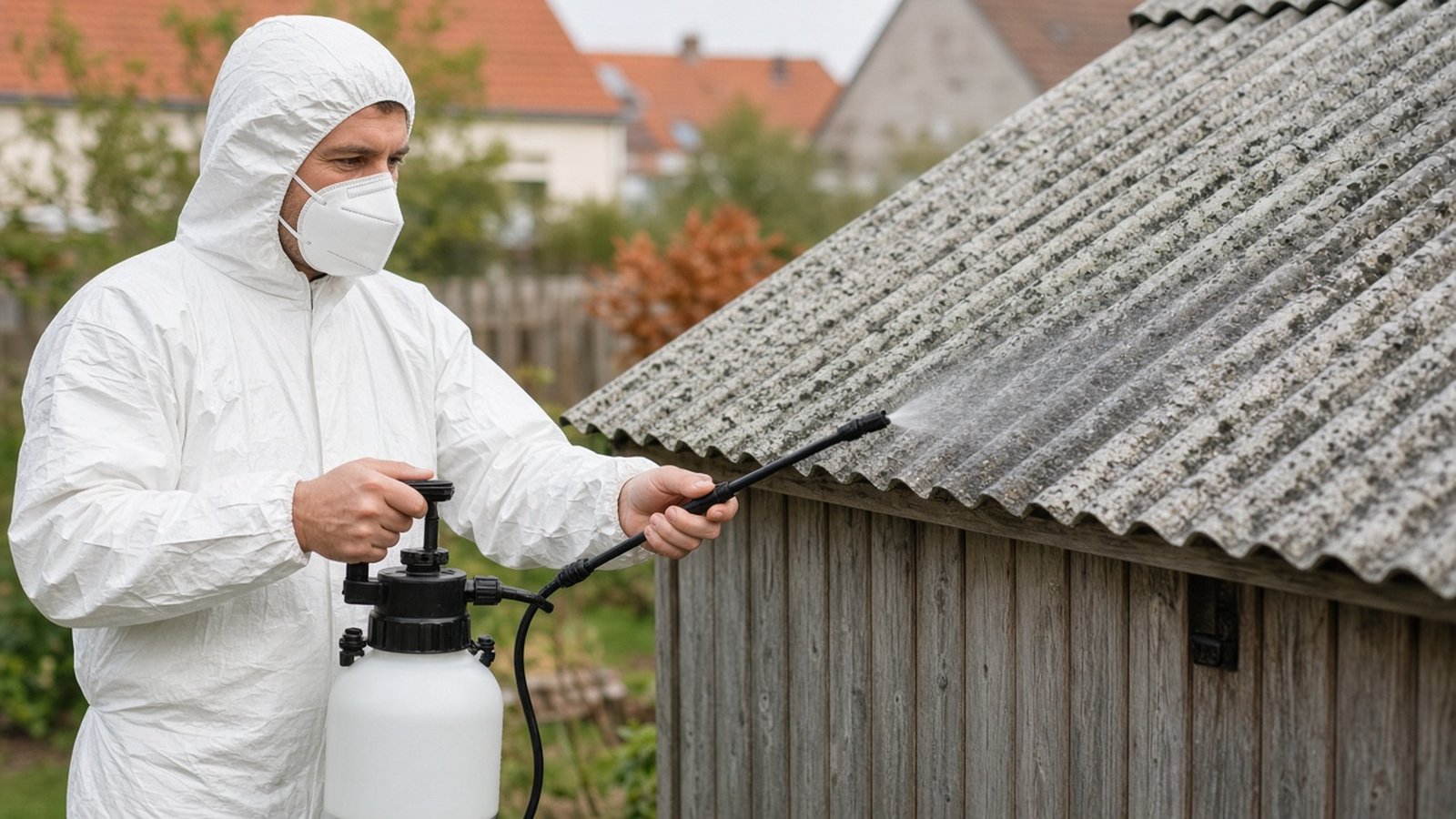
- Corrugated sheets on a garden shed, garage or carport
- Slates or panels on roofs and façades
- Old vinyl floor tiles and the adhesive underneath
- Planters, window sills and drainpipes made of fibre cement
- Insulation around pipes and boilers
- Old electric storage heaters
There’s an important distinction. Bonded asbestos, such as fibre cement, holds its fibres firmly as long as it’s intact. Friable asbestos, such as some insulation, releases fibres much more easily. The latter is always a job for a licensed contractor.
What I wouldn’t do anymore
Most exposure in private homes comes from what we ourselves do to the material. So:
- Don’t grind, drill, saw or sand material you’re not sure about.
- No pressure washer on an old corrugated roof.
- Don’t break sheets or throw them off the roof.
- Don’t vacuum the dust with an ordinary vacuum cleaner.
The rules: check your region
In Flanders, an asbestos certificate has been mandatory since late 2022 when selling a home built before 2001, and the region aims to be asbestos-safe by 2040. Private individuals there may remove limited amounts of bonded asbestos themselves under conditions: wetting it, not breaking it, wearing an FFP3 mask and a disposable coverall, and taking it away well wrapped to the recycling centre or the municipal collection. OVAM’s website lists the exact conditions.
Brussels and Wallonia have different rules, so check with Brussels Environment or the Walloon public service. And everywhere, when in doubt: have it checked by an asbestos expert first.
Engy’s practical tip
- Before you start, walk around your house and garden and note any suspicious materials.
- If in doubt, have a sample analysed or an inventory made. It costs less than you might think, especially compared with a contaminated garage.
- Only then plan your job. Asbestos-safe DIY is, for me, part of a long, healthy life, just like a solid baseline week.
This article is for information only and does not replace advice from an asbestos expert or a doctor. If you worked a lot with asbestos in the past and you’re worried, talk to your GP.
Sources (selection)
- World Health Organization. Asbestos: elimination of asbestos-related diseases (fact sheet).
- IARC (2012). Arsenic, metals, fibres, and dusts. IARC Monographs on the Evaluation of Carcinogenic Risks to Humans, Volume 100C: Asbestos.
- OVAM. Asbestattest en asbest veilig verwijderen als particulier (ovam.vlaanderen.be).
- FPS Employment, Labour and Social Dialogue. Asbestos: risks and prevention.