

Sugary drinks: why water is still the best choice
General information, not medical advice.
Soft drinks, energy drinks and sports drinks sit, according to the Flemish Institute Gezond Leven, outside the food triangle. In that triangle, products you take as little as possible sit in the red zone, also called the remainder group. You get no useful nutrients from them, but plenty of sugar and therefore plenty of energy. That is why Gezond Leven advises drinking those drinks as little as possible and mainly choosing tap water. That message builds on the recommendations of the World Health Organization (WHO) and the Superior Health Council (SHC).
What counts as free sugars?
The WHO talks about free sugars: sugars added by the manufacturer, the cook or you yourself, and sugars that occur naturally in honey, syrups, fruit juice and fruit-juice concentrate. The organisation strongly advises keeping those free sugars under 10 per cent of your total energy intake. A further drop under 5 per cent can, according to the WHO, bring extra benefits, especially for your teeth. For an adult with about 2000 kilocalories a day, 5 per cent comes to about 25 grams or six teaspoons of free sugars. That stricter limit is a conditional recommendation, because the evidence for it is thinner.
A can of sugary soft drink can, according to the WHO, contain up to 40 grams of free sugars, about ten teaspoons. Gezond Leven counts for soft and sports drinks about 1.5 sugar cubes per 100 millilitres and mentions about 4.5 cubes per glass and about 6 per can; that cube measure is their own presentation, not the same unit as the WHO teaspoon. Fruit juice also counts as free sugars: one glass equals about 5 sugar cubes according to Gezond Leven, because the sugars are no longer locked in the structure of whole fruit.
The WHO bases the 10 per cent limit on research in which a higher intake of free sugars goes together with more weight gain and more tooth decay. In Europe, intake among adults ranges, according to the same WHO text, from about 7 to 8 per cent in some countries to 16 to 17 per cent in others.
What does the Superior Health Council say?
According to Gezond Leven’s summary, the SHC in 2025 advises limiting sugary drinks as much as possible and preferring drinks without added sugars. In that summary, sugary drinks appear as the sixth point of attention in the ranked dietary recommendations for adults. The SHC’s primary advice (no. 9805-9807) confirms the line of the food triangle: water, tea and coffee without sugar get preference.
What about diet soft drinks?
Diet soft drinks, with sweeteners instead of sugar, contain no sugar, but artificial sweeteners and no useful nutrients. Gezond Leven puts those drinks in a separate grey zone: that means they are not a recommended alternative to water. Children and pregnant women, according to Gezond Leven, are better off not drinking them at all. Acids such as citric acid and phosphoric acid in regular and diet soft drinks can, according to Gezond Leven, damage tooth enamel; wait therefore at least half an hour before you brush. Carbonation itself is, according to Gezond Leven, not a problem for the teeth.
Sports drinks also belong, for recreational athletes, in the red zone according to Gezond Leven. Only for intensive, long efforts can a sports drink with carbohydrates and salts make sense according to them; for most recreational training they point to water. At meals, water fits just as well next to, for example, eggs as a quick protein source or a bowl of vegetable soup.
Cutting back on soft drinks step by step
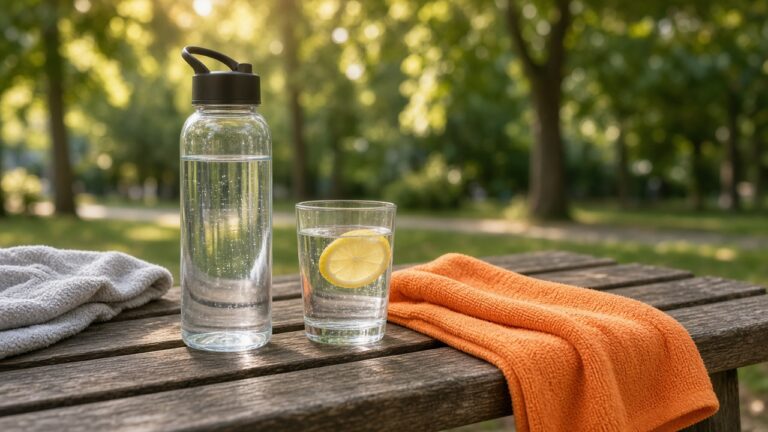
Gezond Leven suggests diluting fruit juice with water and choosing water more often. Put a carafe of tap water in sight, so you top up sooner. The colour of your urine is, according to Gezond Leven, a simple check: light yellow usually points to enough fluid. If you also want to eat less salt, the same label habit helps: look at sugar and salt per 100 millilitres or 100 grams, not only per serving.
Also watch ready-made iced tea, iced coffee or sweetened milk drinks. They do not always feel like soft drinks, but they count as soon as they contain sugar or fruit-juice concentrate. Cut back in steps you can stick to: first fewer cans per week, then smaller portions, then water as the default at meals.
When to see a doctor or dietitian?
If you have diabetes, follow a strict diet or struggle with your weight, ask your GP or dietitian which drinking pattern suits you. Gezond Leven notes that diet drinks can sometimes add variety with diabetes or an energy-restricted diet, but they remain no replacement for water.
Sources
- Vlaams Instituut Gezond Leven. (Light)–frisdrank, energie– en sportdrank en alcohol. gezondleven.be, year not stated on the page, accessed 15 October 2026.
- Vlaams Instituut Gezond Leven. Aanbevelingen van de Hoge gezondheidsraad met focus op voedingsmiddelen. gezondleven.be, 2025.
- Superior Health Council. Voedingsaanbevelingen voor de Belgische bevolking – 2025. Advice no. 9805-9807, 2025.
- World Health Organization. WHO calls on countries to reduce sugars intake among adults and children. News release, 4 March 2015.
- World Health Organization. Guideline: sugars intake for adults and children. 2015.
- Vlaams Instituut Gezond Leven. Hoeveel suikers zitten er in jouw dag verstopt?. gezondleven.be, year not stated on the page, accessed 15 October 2026.


2 Comments