
How much protein do you need when you train?
General information, not medical advice. If you have health concerns, discuss them with your GP or a dietitian.
In short
- The European Food Safety Authority (EFSA) recommends 0.83 g of protein per kilogram of body weight per day for healthy adults.
- If you train regularly, the sports nutrition society ISSN advises aiming for 1.4 to 2.0 g per kilogram.
- Spread that over three or four meals.
Your daily protein needs depend on your body weight and on how much you train. Here is how to work them out and turn them into ordinary meals.
Why protein matters when you train
Protein supplies amino acids, the building blocks your body uses to repair and build muscle. According to the ISSN (International Society of Sports Nutrition), strength training and eating protein each switch on the production of new muscle protein, and they work together when you eat protein shortly before or after training (Jäger et al., 2017). Protein therefore works alongside strength training, not instead of it. For a calm start, see our strength training start plan.
How much protein per day?
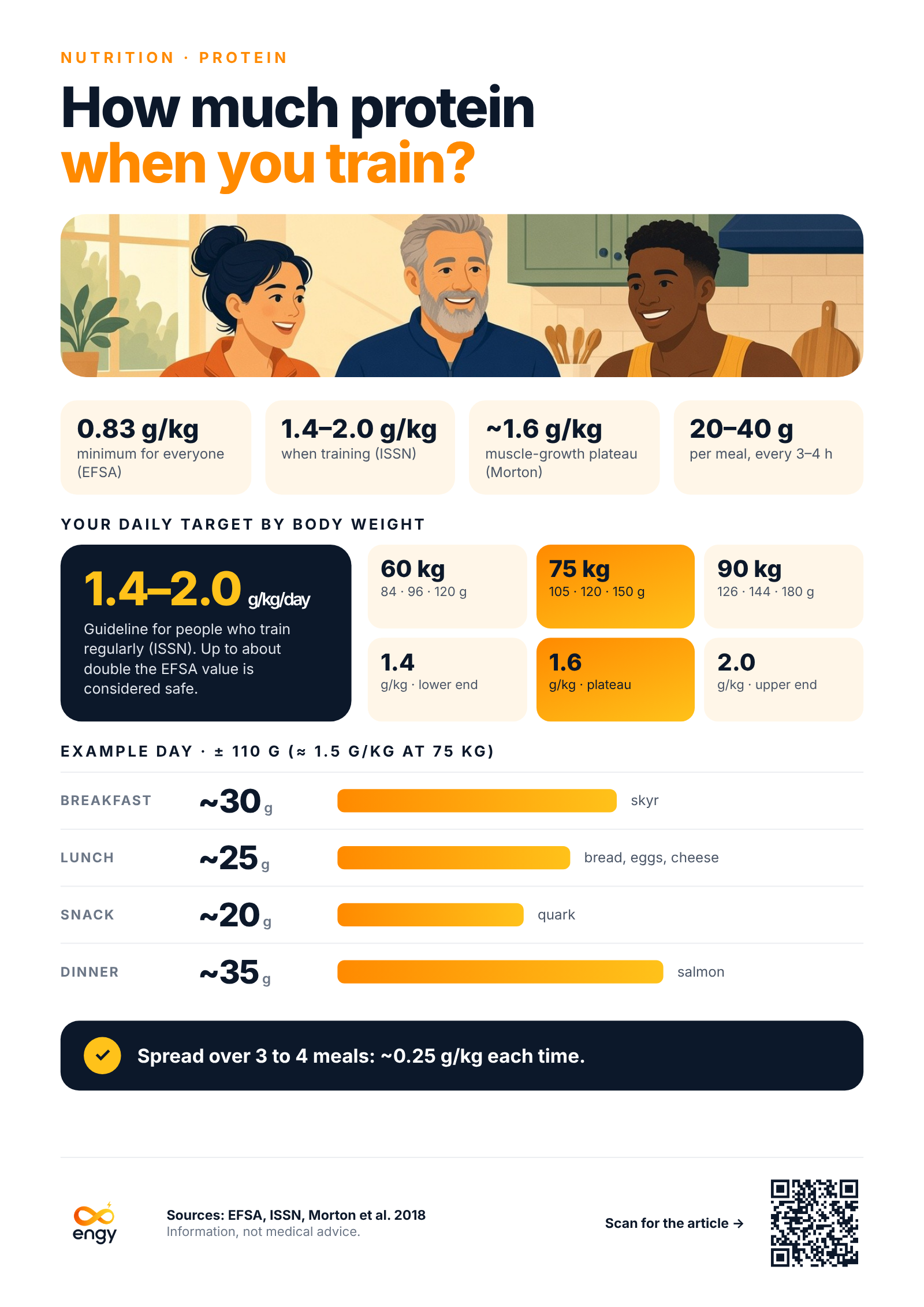
EFSA establishes a reference intake for healthy adults of 0.83 g of protein per kilogram of body weight per day (EFSA, 2012). Someone who weighs 70 kg therefore needs about 58 g. That is enough for almost everyone, but it is not a target for athletes. EFSA considers an intake of up to about twice that amount safe.
For people who train regularly, the ISSN considers 1.4 to 2.0 g per kilogram per day sufficient to build or maintain muscle mass (Jäger et al., 2017). A meta-analysis of 49 studies on protein supplements combined with strength training (Morton et al., 2018) found that extra gains in fat-free mass, your weight without fat, including muscle, levelled off at around 1.6 g per kilogram. The uncertainty range of that estimate runs from about 1.0 to 2.2 g. Extra protein had less effect in older participants and more in people who were already trained.
An example: someone weighing 75 kg who does strength training three times a week and cycles twice in zone 2, an easy pace at which you can still talk comfortably, aims for about 105 to 150 g a day. According to the ISSN, ordinary food can cover that; a supplement is mainly a practical addition.
Spreading protein over the day
The ISSN advises about 0.25 g of good-quality protein per kilogram of body weight per meal, or 20 to 40 g, spread every three to four hours (Jäger et al., 2017). For 75 kg, that is roughly 19 g per meal. Three or four protein-rich meals therefore fit better than one large portion of meat in the evening. If you practise intermittent fasting, for example 16:8 (eating within eight hours a day and not for sixteen), you need to spread the same amount of protein over fewer meals.
Animal or plant protein sources
Dairy, eggs, meat and fish contain all essential amino acids, which your body cannot make itself, and relatively much leucine, an amino acid that helps drive the production of muscle protein. Plant sources usually contain less leucine, but according to the ISSN a well-planned vegetarian diet can still provide complete protein (Jäger et al., 2017). Combine legumes with grains and allow for larger portions.
A sample day
Below is a day for someone weighing 75 kg. The protein values are rounded estimates; the label gives the exact amount.
That is almost 1.5 g per kilogram, within the ISSN guide values. If you eat plant-based, replace dairy and fish with soy, tofu, tempeh or legumes and check that each meal provides 20 to 40 g.
Download the protein overview
Your daily target by body weight and a sample day on one page, also as an A4.
When to see a doctor or dietitian?
Talk to your GP or a dietitian if you have kidney disease or another chronic condition, are pregnant or breastfeeding, have a history of eating disorders, are losing weight unintentionally or feel persistently tired. If you want to train a lot while losing weight, get guidance.
Sources
- EFSA Panel on Dietetic Products, Nutrition and Allergies (NDA) (2012). Scientific Opinion on Dietary Reference Values for protein. EFSA Journal, 10(2), 2557.
- Jäger R et al. (2017). International Society of Sports Nutrition Position Stand: protein and exercise. Journal of the International Society of Sports Nutrition, 14, 20.
- Morton RW et al. (2018). A systematic review, meta-analysis and meta-regression of the effect of protein supplementation on resistance training-induced gains in muscle mass and strength in healthy adults. British Journal of Sports Medicine, 52(6), 376–384.






9 Comments