
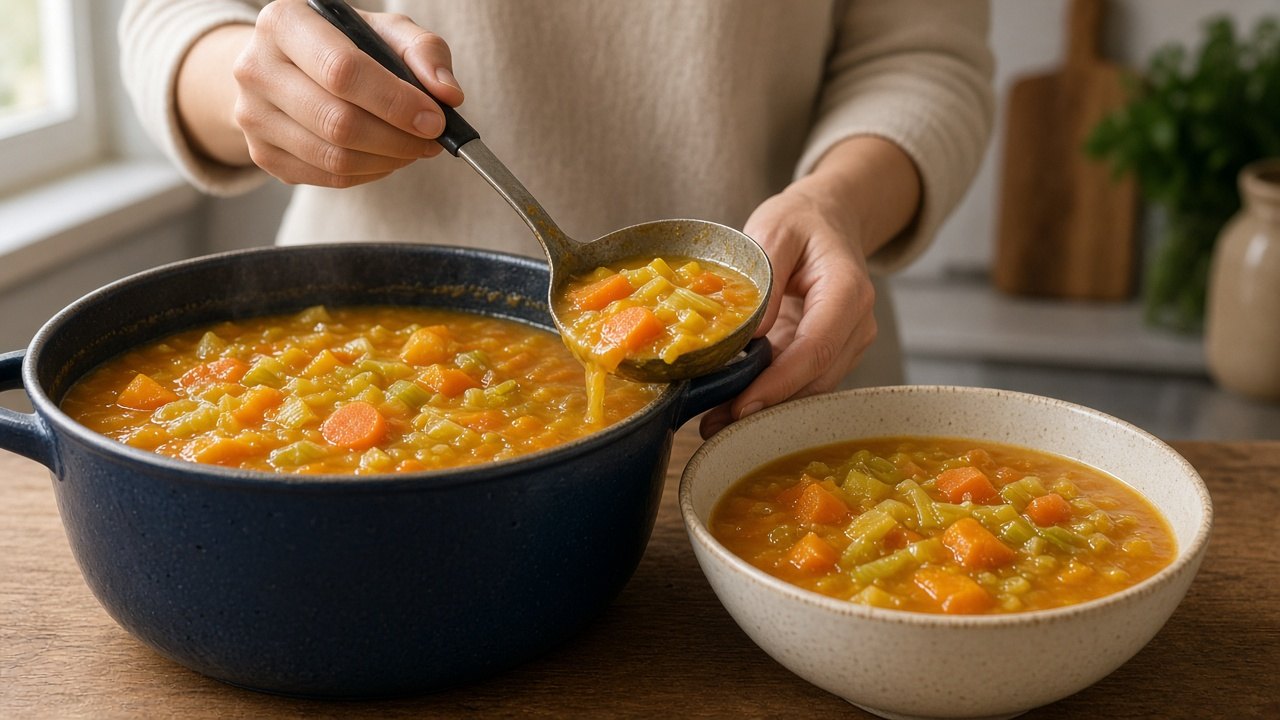
A bowl of vegetable soup a day: the easiest vegetable win I know
For information only, not medical advice.
TLDR
- Belgium’s Superior Health Council recommends that adults eat at least 300 grams of vegetables a day. On average, people in Flanders eat about half of that.
- A 200 ml bowl of homemade vegetable soup with at least 80 grams of vegetables covers roughly a quarter of that daily amount.
- The catch is salt: Gezond Leven, the Flemish health promotion institute, uses a maximum of one stock cube or 5 grams of salt per litre, ideally without cream or meat.
- Soup before a meal can help you eat less, but soup on its own is not a complete meal.
At our place, from October to March, there is almost always a pot of soup on the stove. For a long time I saw it as something from my grandmother’s kitchen: cosy, but not really “healthy eating”. Until I worked out how many vegetables I actually eat on an ordinary weekday. It was disappointing. The soup turned out to be what saved my day.
How many vegetables should we eat?
In 2025 the Superior Health Council updated its dietary recommendations for adults and kept the advice of at least 300 grams of vegetables a day. Gezond Leven advises spreading that over at least two moments. According to Gezond Leven, people in Flanders eat too few vegetables on average: portions are often too small, and on average we should eat about twice as much as we do now.
With just one portion of vegetables at dinner, you often won’t reach those 300 grams. A bowl of soup at lunchtime does make the difference.
What counts as “good” soup?
In the Flemish food triangle, vegetable soup sits in the dark green zone, provided that it:
- contains at least 40 grams of vegetables per 100 ml (about 400 grams per litre);
- is moderately salted: at most one stock cube or 5 grams of salt per litre;
- contains no cream or meat.
Soup in a carton or tin is fine too, with the same salt limit. According to Gezond Leven, instant soup from a sachet is no alternative to vegetables: it is high in salt and low in vegetables.
That salt limit is not a detail. The Superior Health Council advises less than 5 grams of salt per day in total. A litre of soup made with three stock cubes already comes close on its own.
Soup before your meal
In 2007 a research team around nutrition scientist Barbara Rolls (Penn State University, USA) tested what happens when people eat a bowl of low-calorie vegetable soup before lunch. Across the whole meal, soup included, they ate about 20 percent fewer calories than without soup. Whether the soup was blended or chunky made no difference.
A nuance: this was a short lab study of a single meal. It says nothing about long-term weight loss, and not everyone benefits from eating less. If you train a lot, soup is mainly a way to get your vegetables in, not to save on energy.
Where soup falls short
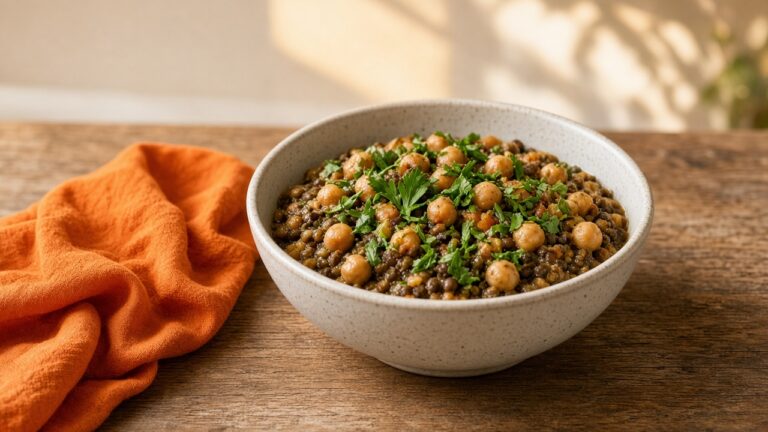
A bowl of vegetable soup contains little protein. As a lunch on its own, it doesn’t keep me full for even an hour. So I often make a heartier version with lentils, chickpeas or white beans. How I build up legumes gently, you can read in legumes without gut drama.
Cooking losses play a role too: vitamins are sensitive to heat. Part of them does stay in the cooking liquid, and with soup you simply eat that. Adding raw vegetables or a piece of fruit is still a good idea.
My soup routine
- One big pot on Sunday, frozen in portions. Frozen vegetables can go straight in, see frozen vegetables vs fresh.
- About half a kilo of vegetables per litre of water as a rule of thumb.
- At most one stock cube per litre; the rest of the flavour comes from onion, garlic, herbs, pepper or a dash of vinegar.
- With shop-bought soup, I check the salt per litre and the vegetable share on the label.
- At lunch, soup plus a slice of bread with a protein-rich topping, or a soup with legumes as the main dish. It fits nicely into a green Mediterranean way of eating.
This article is for information only and is not medical advice. If you need to watch your salt intake for your blood pressure or follow a specific diet, talk to your doctor or dietitian.
Sources (selection)
- Vlaams Instituut Gezond Leven. Groenten (voedingsdriehoek), including the recommendations of the Superior Health Council (2025). gezondleven.be.
- Vlaams Instituut Gezond Leven. Aanbevelingen van de Hoge Gezondheidsraad met focus op voedingsmiddelen. gezondleven.be.
- NICE Voedingsinfo (2021). Verse groentesoep is een gezonde keuze. Waarom? nice-info.be.
- Flood JE, Rolls BJ (2007). Soup preloads in a variety of forms reduce meal energy intake. Appetite, 49(3), 626–634.




3 Comments