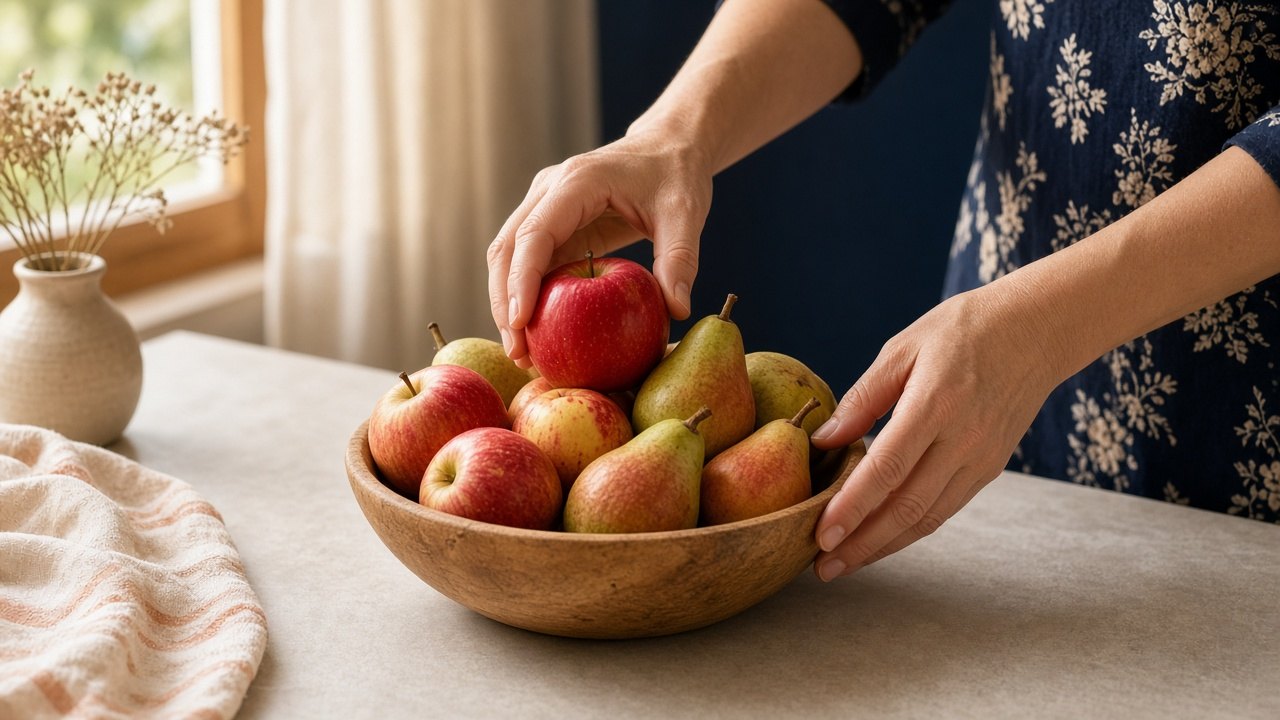
Seasonal fruit in October: why I choose apples and pears
Informational, not medical advice.
TLDR
- Gezond Leven, Flanders’ health-promotion institute, places fruit at the base of the food triangle: for adults the guidance is at least two pieces of fruit a day.
- In October, apples and pears are fully in season on Belgian seasonal calendars; they keep well and combine easily.
- I mainly choose local, firm varieties and eat them whole or sliced — not as juice or smoothie as the default.
- Fruit does not replace vegetables; it complements nuts, vegetables and a steady meal structure.
October at my place smells like apples. Not a juice in a plastic bottle, but a bowl of Jonagold or Conference on the counter. For years I ate fruit mostly in summer, and in autumn it stopped. Until I put the seasonal calendar next to my weekly menu and noticed that the simplest choice is right there now.
What Gezond Leven says about fruit
Gezond Leven puts fruit in the dark-green zone of the food triangle. Typical adult guidance is at least two pieces of fruit a day (about 250 grams), preferably fresh or lightly processed. Fruit juice does not count as a fruit portion: it delivers sugars without the structure of the whole fruit.
Belgium’s Superior Health Council stays in the same line: fruit belongs in a varied pattern, alongside enough vegetables. I use those numbers as orientation, not as a scoreboard.
Why October means apples and pears
On Gezond Leven’s seasonal calendar and on Brussels Environment’s, apple and pear are clearly in season in October. That means: ample supply, often a shorter chain, and fruit you can keep for weeks without quality collapsing.
In practice I notice three things. First: an apple or pear needs no prep. Second: they fit a lunchbox, after training or as a second breakfast. Third: I snack less randomly when fruit is visible.
Whole fruit versus juice and smoothie
I rarely drink fruit juice. Not because juice is “bad”, but because it is easy to press several pieces into one glass without noticing. With a whole apple I feel “enough” sooner. Smoothies I use sometimes with vegetables and a handful of nuts, but as a daily fruit form I stick to chewing.
A handful of nuts beside a pear keeps me fuller longer than fruit alone. Extra virgin olive oil belongs with hot meals; I do not mix fruit and oil — see extra virgin olive oil daily.
How I fit apples and pears in
- A bowl of 4–6 pieces visible on the counter or in the fridge, not hidden.
- One piece at breakfast or as a snack; the second later in the day.
- Pear a bit soft? Sliced into yoghurt or oats.
- Apple with skin, unless the skin really bothers — the fibre sits mostly there.
- Cutting leftovers into a hot meal or vegetable soup is optional; fruit mostly stays separate from the soup.
Limits
More fruit is not automatically better. Anyone who must track glucose closely, or who gets stomach issues from raw fruit, checks with a doctor or dietitian. And: local seasonal fruit is convenient, but imported fruit is not a moral failure — I choose local where it fits, without stress.
This article is informational and not medical advice. If you follow a prescribed diet or have an intolerance, talk to a professional.
Sources (selection)
- Vlaams Instituut Gezond Leven. Fruit (food triangle) and seasonal calendar. gezondleven.be.
- Brussels Environment. Seasonal calendar for fruit and vegetables. leefmilieu.brussels.
- Superior Health Council of Belgium. Dietary recommendations (via Gezond Leven). gezondleven.be.