Warming up before exercise: why a structured warm-up meant 39 percent fewer injuries in football studies
General information, not medical advice. If you have an injury, chest pain or other complaints during exercise, discuss them with your GP, a sports physician or your physiotherapist.
On a cold pitch or in a draughty sports hall, warming up before exercise sometimes gets skipped. Yet in football studies, a structured warm-up cut the number of injuries by 39 percent. That figure comes from research in footballers, so it does not tell the whole story for running, indoor sports or racket sports. For the cold months, Sportieq, a Flemish organisation for healthy and safe sport, recommends a warm-up of 10 to 15 minutes.
Warming up is part of injury prevention
Sportieq calls a good warm-up part of primary injury prevention, which means preventing injuries from happening in the first place. According to Sportieq, this kind of prevention often lies in small things, such as a good warm-up, attention to technique and posture and suitable sports equipment.
Get Fit 2 Sport, a digital exercise library from Sportieq supported by Sport Vlaanderen, lists ten injury prevention strategies. Warming up comes first on the list. It is followed by technique, training progression (building up your effort gradually), balance, core stability (the strength of the muscles around your stomach and lower back), strength and a cool-down, a calm wind-down after your session. So a warm-up is not a miracle cure, but one part of a bigger whole.
What research on FIFA 11+ shows
FIFA 11+ is a structured warm-up with running, strength, balance and jumping exercises. A meta-analysis, a study that combines the results of several studies, looked at six cluster-randomised trials in recreational and sub-elite footballers. Cluster-randomised means that whole clubs or teams were assigned by drawing lots: one group did the programme and the other did not.
In the four studies on FIFA 11+, the number of injuries was 39 percent lower. That corresponds to a ratio of 0.61 between the two groups, where 1 would mean no difference. The older FIFA 11 programme, tested in two studies, showed no effect (0.99).
A Norwegian cluster-randomised trial in 1,892 female footballers aged 13 to 17 from 125 clubs followed a warm-up programme for one eight-month season. The risk of injuries overall was lower (0.68). The same was true for overuse injuries (0.47) and severe injuries (0.55). Overuse injuries are caused by repeated strain rather than by a single fall or collision.
The main aim of that study was fewer injuries to the lower limbs, from hip to foot. That difference was not significant (0.71), which means it was not statistically strong enough to rule out chance. So the evidence is clearer for injuries overall than for that one main outcome.
What this means for your sport
The evidence comes from football. For indoor sports, running or racket sports it is a reasonable translation, not a proven figure. So do not apply the 39 percent to your own sport. If you have a teenager in a football team, the Norwegian study is the most relevant, because it looked at girls aged 13 to 17.
According to Sportieq, 10 to 15 minutes of warming up makes your muscles supple and improves blood flow, which lowers the risk of injury. For the cold months, Sportieq also advises letting your body get used to the cold slowly and building up the intensity gradually.
How to warm up yourself
These tips are a general guideline that builds on Sportieq’s advice to start calmly:
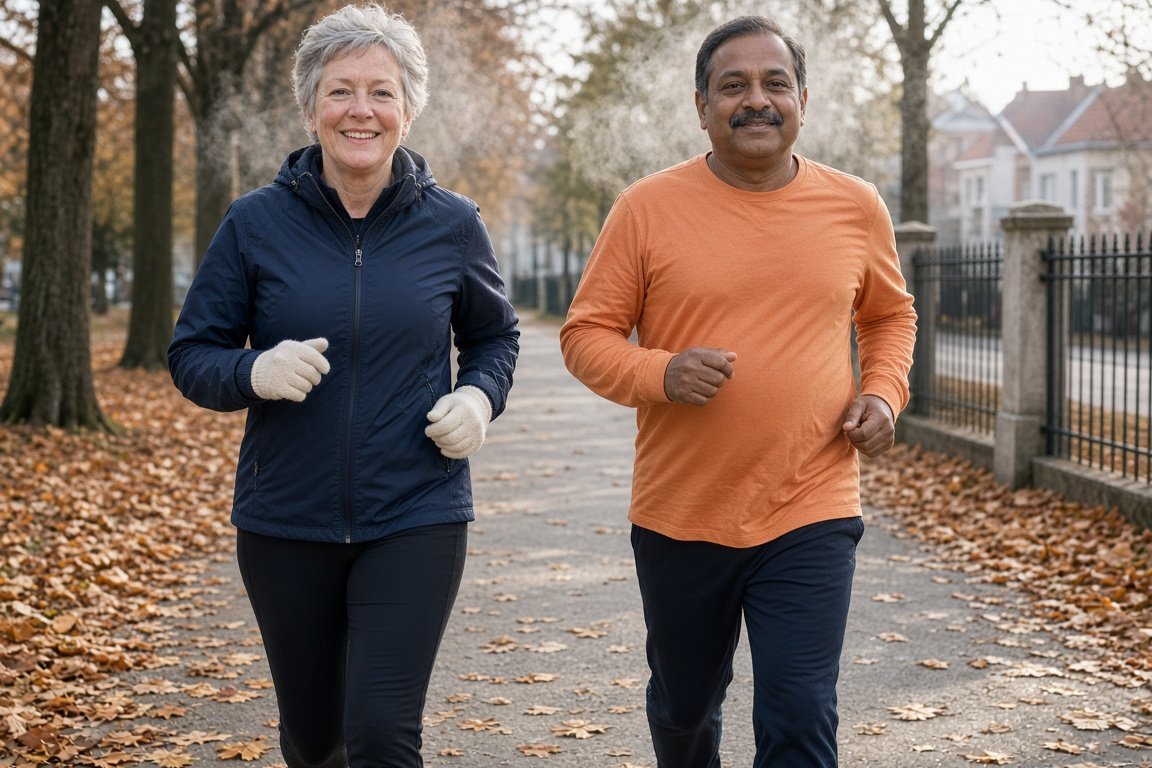
- start easy, for example by walking or jogging very lightly, and speed up gradually;
- choose dynamic movements that resemble your sport, meaning movements in which your joints and muscles actively move through their range instead of holding one position for a long time;
- finish with a few short accelerations, so your body gets used to a faster effort;
- take a little more time in the cold and wear layers you can take off as soon as you are warm.
If you quickly get short of breath in the cold, read what exercise-induced asthma in winter involves. The start of your warm-up resembles zone 2, a calm endurance pace at which you can still talk easily. If you exercise outdoors in the cold months, you will find more tips on exercising outdoors in autumn and winter. Just starting to run? Build up calmly as explained in starting to run.
Sources
- Sportieq. Blessurepreventie (injury prevention, in Dutch). Accessed November 2026.
- Sportieq. Sporten in de koude (exercising in the cold, in Dutch). Accessed November 2026.
- Get Fit 2 Sport (Sportieq, supported by Sport Vlaanderen). Oefenbibliotheek (exercise library, in Dutch). Accessed November 2026.
- Thorborg K, Krommes KK, Esteve E et al. Effect of specific exercise-based football injury prevention programmes on the overall injury rate in football: a systematic review and meta-analysis of the FIFA 11 and 11+ programmes. British Journal of Sports Medicine, 2017 (systematic review and meta-analysis).
- Soligard T, Myklebust G, Steffen K et al. Comprehensive warm-up programme to prevent injuries in young female footballers: cluster randomised controlled trial. BMJ, 2008 (cluster-randomised trial).