
Start running this autumn: how to build up gradually
General information, not medical advice. If you have symptoms or a medical condition, talk to your GP or physiotherapist.
If you want to start running this autumn, you are probably asking yourself two things: what does it give you, and how do you build up without getting injured? Here is what research says, including about the well-known 10% rule.
What running gives you, even in small amounts
Pedisic and colleagues pooled 14 studies with a total of 232,149 participants. People who ran had a 27% lower risk of death, a 30% lower risk of death from cardiovascular disease and a 23% lower risk of death from cancer than people who did not run. Running more was not clearly linked to any extra benefit. According to the researchers, any amount of running, even just once a week, is better than no running.
Lee and colleagues followed 55,137 American adults for an average of 15 years. Runners had a 30% lower risk of death and a 45% lower risk of death from cardiovascular disease. Even running less than 51 minutes a week, 1 to 2 times a week, or slower than about 9.7 km/h (6 miles per hour) was linked to a lower risk.
Both studies are observational: researchers looked at what people chose to do themselves, without randomisation. They show that running goes hand in hand with a lower risk, not that running itself causes the benefit. For comparison, the WHO recommends that adults get 150 to 300 minutes of moderate-intensity or 75 to 150 minutes of vigorous-intensity activity a week, plus muscle-strengthening activities on at least 2 days.
Injuries: beginners face a higher risk
A review of 13 studies by Videbæk and colleagues found an average of 17.8 injuries per 1000 hours of running in beginners, compared with 7.7 in recreational runners. Per hour of running, beginners are clearly injured more often.
The 10% rule under the microscope
Buist and colleagues describe the 10% rule as the advice not to increase your training volume by more than 10% a week, to limit running injuries. They tested it in 532 novice runners in Groningen, in the Netherlands, who were preparing for a 6.7 km run. One group followed a graded 13-week programme based on the 10% rule, the other a standard 8-week programme. In both groups about one in five runners got injured, meaning a leg or back complaint that limited running for at least a week: 20.8% versus 20.3%.
An exploratory study by Nielsen and colleagues followed 874 novice runners for a year using GPS watches. Here too, the total number of injuries did not clearly differ. Those who increased their weekly distance by more than 30% did seem more prone to distance-related injuries, such as runner’s knee or shin pain, than those who increased it by less than 10%. That difference was not statistically certain. So the 10% rule is not a hard limit, but big jumps do not seem wise.
Start running: how a beginners’ plan builds up
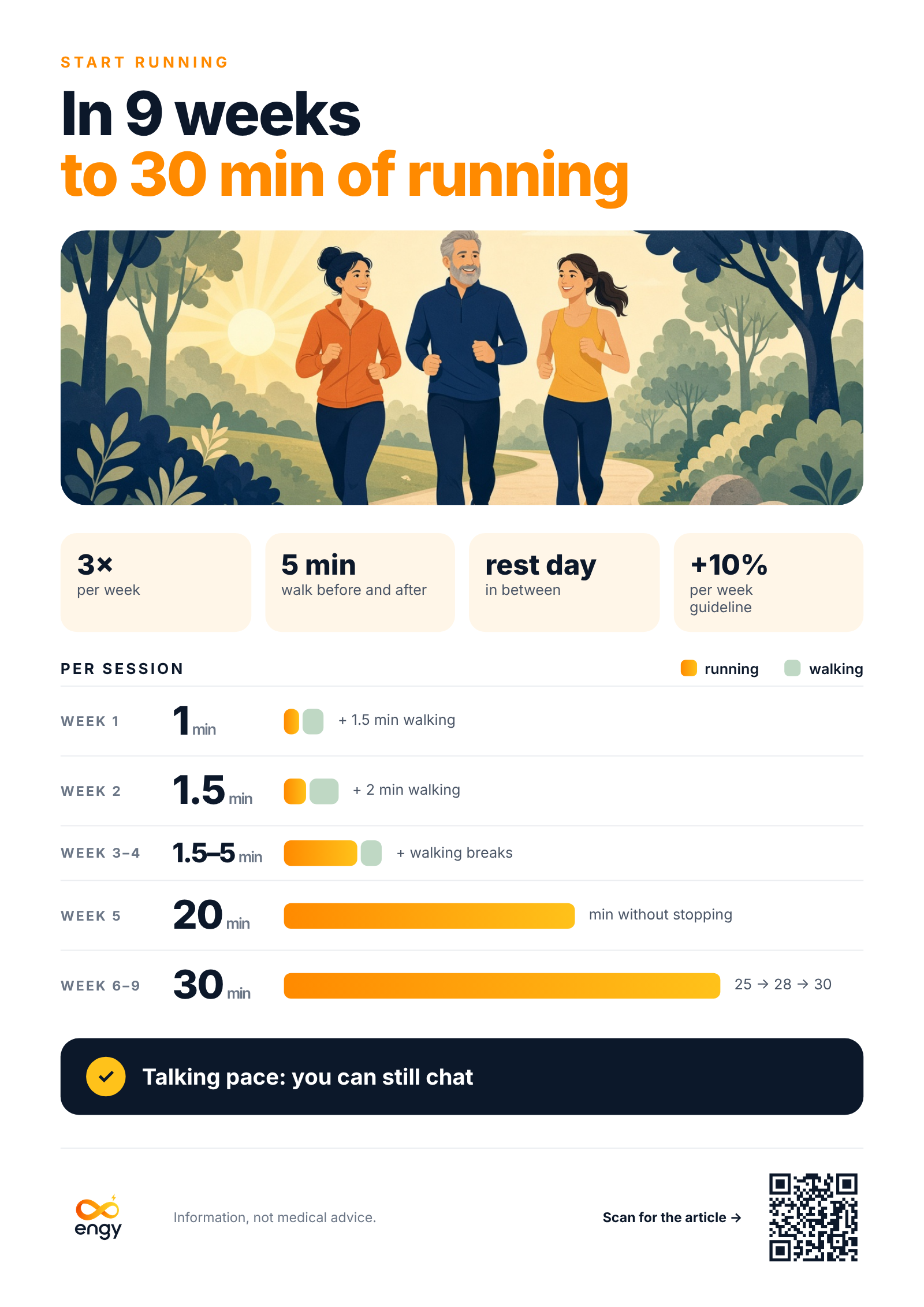
A widely used approach is to alternate running and walking, as in the free Couch to 5K plan from the NHS, the UK’s public health service. You run 3 times a week with a rest day in between, and each session starts and ends with a 5-minute walk. After 9 weeks you are running for 30 minutes without stopping:
| Week | Running and walking per session (according to the NHS) |
|---|---|
| 1 | 7 times 1 minute running and 1 minute 30 seconds walking, then 1 more minute running |
| 2 | 5 times 1 minute 30 seconds running and 2 minutes walking, then 1 minute 30 seconds running |
| 3 and 4 | running blocks of 1 minute 30 seconds to 5 minutes with walking breaks |
| 5 | from 3 times 5 minutes running to a first 20-minute run without stopping |
| 6 to 9 | step by step to 25, 28 and finally 30 minutes of running |
According to the NHS, you can also take longer than 9 weeks and go at your own pace, and it is best to speak to a GP first if you are worried about your health. A plan is no guarantee: in the Buist study, building up faster or more slowly made no difference to the number of injuries.
Download the plan
See the week-by-week plan on one page, or download it as an A4 to print.
The participants in that study ran at a comfortable pace at which they could still talk without getting out of breath. That roughly matches zone 2, an easy endurance pace at which you can still talk comfortably.
On rest days, walking fits in well, for example a long walk at the weekend. If you also do strength training on 2 days a week, you also cover the muscle-strengthening activities the WHO recommends.
If you stay tired for a long time or the same discomfort keeps coming back, these may be signs that you are not recovering enough. The NHS advises listening to your body and stopping if something does not feel right.
Sources
- Bull FC, Al-Ansari SS, Biddle S et al. World Health Organization 2020 guidelines on physical activity and sedentary behaviour. British Journal of Sports Medicine. 2020;54(24):1451-1462.
- Pedisic Z, Shrestha N, Kovalchik S et al. Is running associated with a lower risk of all-cause, cardiovascular and cancer mortality, and is the more the better? A systematic review and meta-analysis. British Journal of Sports Medicine. 2020;54(15):898-905.
- Lee DC, Pate RR, Lavie CJ et al. Leisure-time running reduces all-cause and cardiovascular mortality risk. Journal of the American College of Cardiology. 2014;64(5):472-481.
- Videbæk S, Bueno AM, Nielsen RO, Rasmussen S. Incidence of Running-Related Injuries Per 1000 h of running in Different Types of Runners: A Systematic Review and Meta-Analysis. Sports Medicine. 2015;45(7):1017-1026.
- Buist I, Bredeweg SW, van Mechelen W et al. No effect of a graded training program on the number of running-related injuries in novice runners: a randomized controlled trial. The American Journal of Sports Medicine. 2008;36(1):33-39.
- Nielsen RØ, Parner ET, Nohr EA et al. Excessive progression in weekly running distance and risk of running-related injuries: an association which varies according to type of injury. Journal of Orthopaedic & Sports Physical Therapy. 2014;44(10):739-747.
- NHS. Couch to 5K running plan. Better Health, nhs.uk, accessed 17 October 2026.
- NHS. Get running with Couch to 5K. Better Health, nhs.uk, accessed 17 October 2026.