
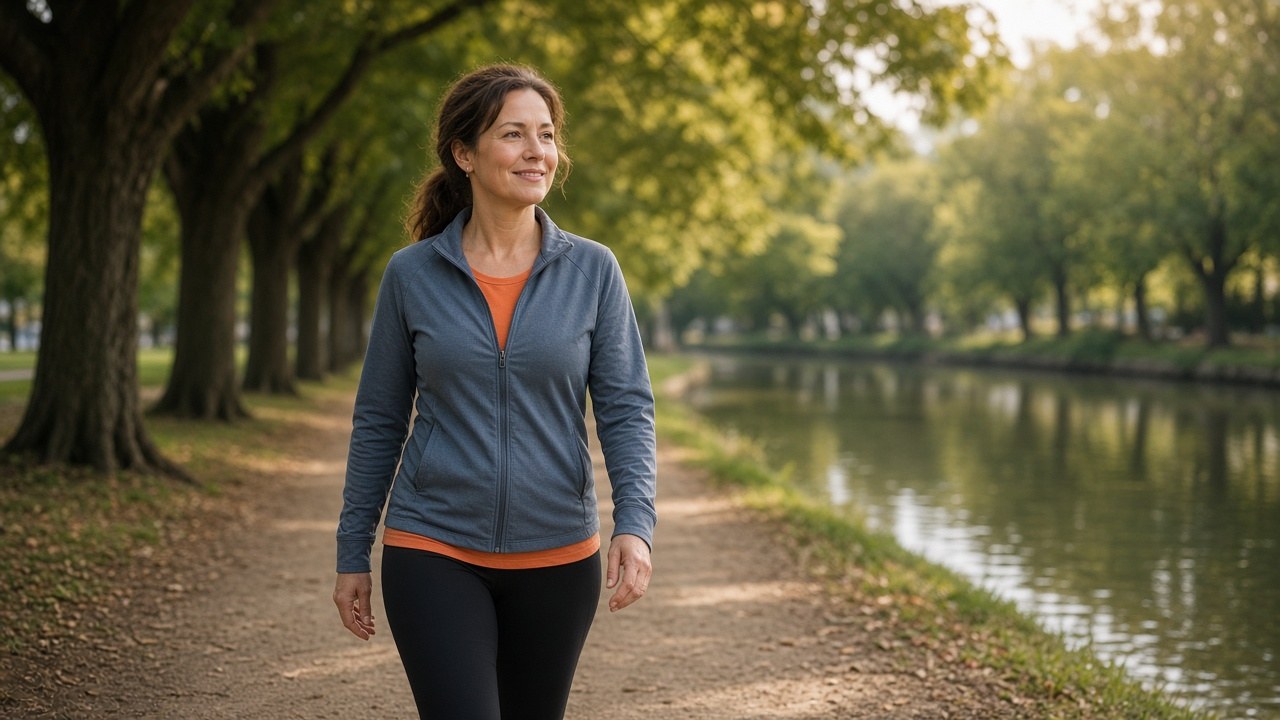
After a hard training session: what to do in the first 24 hours
General information, not medical advice. If you have health concerns, discuss them with your GP or a physiotherapist.
In short
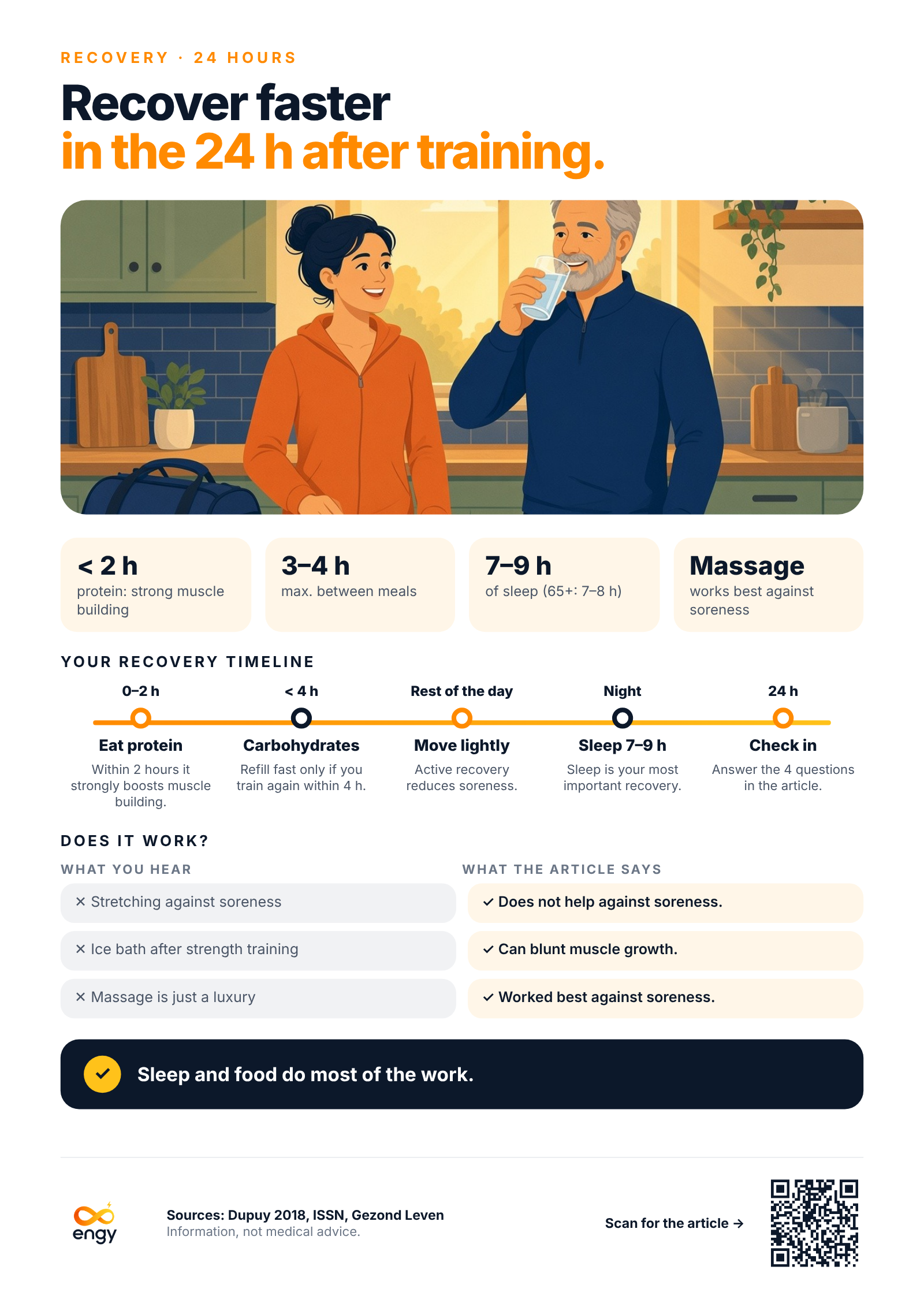
- Sleep is the foundation: adults need 7 to 9 hours a night, preferably at regular times.
- Within a few hours of your training, eat a meal with protein and carbohydrates.
- Gentle movement can ease muscle soreness a little. An ice bath is not necessary.
To recover after training, a few ordinary things matter most: sleep, food, gentle movement and a next training session that suits how you feel. This is what research says about the first 24 hours.
Sleep first
According to the US National Sleep Foundation, adults aged 18 to 64 need 7 to 9 hours of sleep a night, and people over 65 need 7 to 8 hours (Hirshkowitz et al., 2015). Regularity matters too: an expert panel from the same organisation concludes that consistent bedtimes and wake-up times are important for your health and your performance (Sletten et al., 2023). How to protect your sleep during busy training weeks is explained in our sleep checklist for training weeks.
Eating: when and what
You do not need to eat within a fixed number of minutes after training. According to a review by Aragon and Schoenfeld (2013), the so-called anabolic window, the period after training in which eating would help your muscles repair particularly well, is not short and urgent for everyone. Their practical guideline: keep your meals before and after training no more than three to four hours apart.
The ISSN (International Society of Sports Nutrition), an organisation for sports nutrition, sees your total protein intake over the day as the main priority. Good-quality protein up to two hours after training strongly stimulates the building of muscle protein (Kerksick et al., 2017). Glycogen, the energy store in your muscles, only needs to be replenished quickly if there are fewer than four hours until your next training session. If you do not train again until the next day, an ordinary meal is enough, such as rice with chicken or tofu and vegetables. How much protein you need per day is explained in our article on protein when you train.
Gentle movement instead of sitting still
A meta-analysis of 99 studies (Dupuy et al., 2018) found that light activity after training, such as easy cycling or walking, reduces muscle soreness a little, especially in the first few hours. It had no effect on feelings of fatigue. Stretching did not reduce soreness. In that analysis, massage worked best against soreness and fatigue, although these are all short-term effects.
An ice bath: useful for some, not necessary
According to the same meta-analysis, an ice bath, a few minutes sitting in cold water after training, reduces muscle soreness and feelings of fatigue. If you want to build muscle, be careful though: regularly getting into cold water right after strength training can slightly slow muscle growth (Piñero et al., 2024). The effect is small and the studies are of moderate quality. Cold showers were not studied. If you train to get stronger, for example with our starter plan for strength training, skip the ice bath right after your session. If you trained late, sleep and a simple meal come before an ice bath that delays your bedtime.
Adjusting your next training session
Adjust your next training session to how you slept and how you feel. According to the European and American associations for sport science and sports medicine, overtraining results from too heavy a training load combined with too little rest. Fatigue, declining performance and mood disturbances are among the signs (Meeusen et al., 2013). If you notice this for several weeks in a row, train for shorter periods or less hard.
How to recover after training: checklist for the first 24 hours
- Have you planned enough time to sleep at your usual hour?
- Have you eaten a meal with protein and carbohydrates within a few hours?
- Have you moved a little instead of sitting all day?
- Does your next training session match how you feel?
Download the recovery timeline
The first 24 hours after training on one page, also as an A4.
When to see a doctor?
See your GP or a physiotherapist if you have sharp pain in a joint, swelling, muscle soreness that does not ease after a few days, or if you feel tired, low or weaker for weeks despite rest.
Sources
- Hirshkowitz M et al. (2015). National Sleep Foundation’s sleep time duration recommendations: methodology and results summary. Sleep Health, 1(1), 40–43.
- Sletten TL et al. (2023). The importance of sleep regularity: a consensus statement of the National Sleep Foundation sleep timing and variability panel. Sleep Health, 9(6), 801–820.
- Aragon AA, Schoenfeld BJ (2013). Nutrient timing revisited: is there a post-exercise anabolic window? Journal of the International Society of Sports Nutrition, 10(1), 5.
- Kerksick CM et al. (2017). International society of sports nutrition position stand: nutrient timing. Journal of the International Society of Sports Nutrition, 14, 33.
- Dupuy O, Douzi W, Theurot D, Bosquet L, Dugué B (2018). An Evidence-Based Approach for Choosing Post-exercise Recovery Techniques to Reduce Markers of Muscle Damage, Soreness, Fatigue, and Inflammation: A Systematic Review With Meta-Analysis. Frontiers in Physiology, 9, 403.
- Piñero A et al. (2024). Throwing cold water on muscle growth: A systematic review with meta-analysis of the effects of postexercise cold water immersion on resistance training-induced hypertrophy. European Journal of Sport Science, 24(2), 177–189.
- Meeusen R et al. (2013). Prevention, diagnosis, and treatment of the overtraining syndrome: joint consensus statement of the European College of Sport Science and the American College of Sports Medicine. Medicine & Science in Sports & Exercise, 45(1), 186–205.


7 Comments