
Omega-3 for athletes: literacy beyond the HDL story
Disclaimer: This article is informational and not medical advice, not a dosing prescription, and not a nudge to start supplements. If in doubt, on blood thinners or other medication, clotting issues, pregnancy or allergies: talk to a doctor or pharmacist. No disease claims.
TLDR
- Omega-3 is a family: ALA (plant) ≠ EPA/DHA (long chain, mainly fish/algae). For sports literacy, EPA+DHA matter most.
- Do not reduce it to “HDL up.” Evidence in athletes covers status, endurance/cardio context, subjective muscle soreness — with dose and duration sensitivity (ISSN 2025).
- In Belgium most people eat too little fish; Sciensano: average well under the Superior Health Council recommendation.
- Food first; supplements as a bridge, not a replacement for the training base.
- Not everyone benefits; EFSA: no UL set, but safe bands for supplemental intake — not a blank cheque for megadoses.
On social media omega-3 is still often sold as “good for your cholesterol” or “more HDL.” Too narrow, and sometimes misleading. For recreational athletes the more useful question is: do you get enough EPA and DHA at all, what does the sports literature actually say, and when is an oil capsule context — not fashion?
Not everyone benefits from an extra tub. Who already eats oily fish regularly and has no specific reason rarely wins a race by “even more omega-3.” Who rarely eats fish or algae products does have something to discuss — with food as the first lever.
What it is: ALA, EPA, DHA
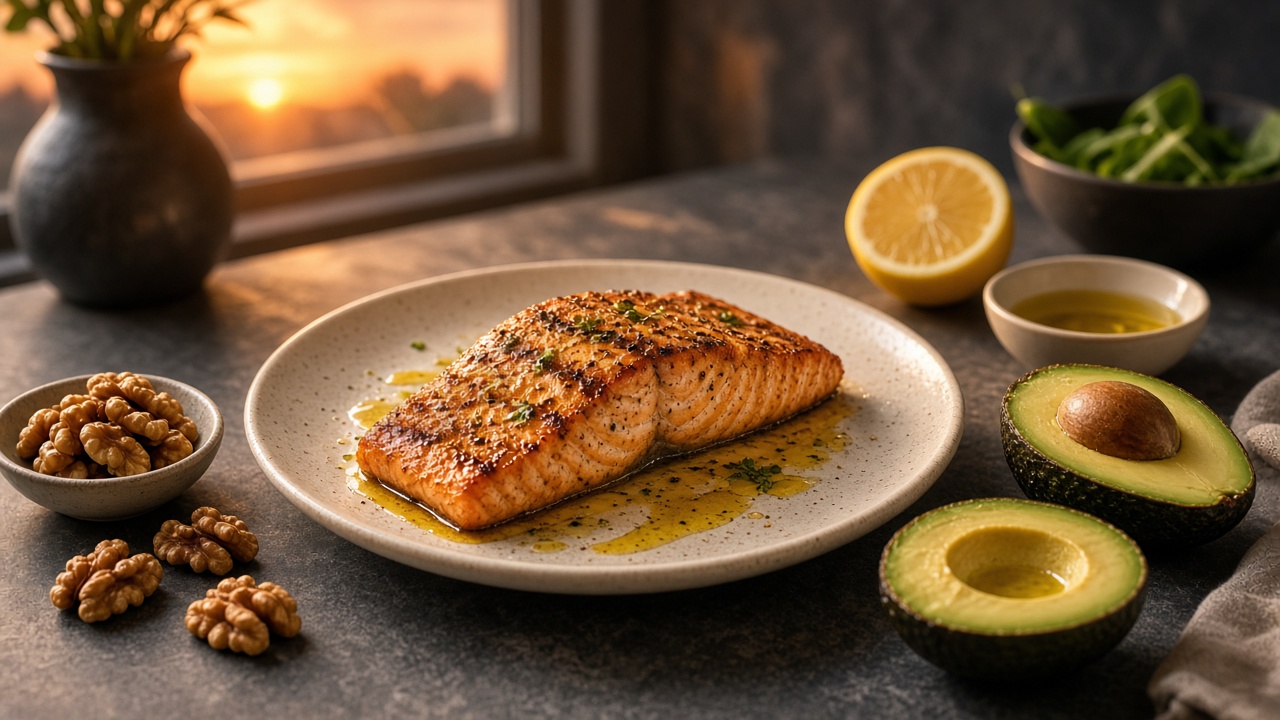
Omega-3 covers several fatty acids. ALA (alpha-linolenic acid) sits in flaxseed, walnuts, rapeseed oil. Conversion to the long-chain EPA and DHA is limited in humans. That long chain is mainly in oily fish (salmon, mackerel, herring, sardine) and in some algae-oil supplements. On a label what counts is not “1000 mg fish oil,” but how much EPA+DHA is in it.
The European Food Safety Authority (EFSA) often works for European adults with a direction around 250–500 mg EPA+DHA per day in the frame of cardiac function / dietary references — not a sports performance claim. That is EU population literacy, not a training protocol.
What the sports literature roughly says
The International Society of Sports Nutrition (ISSN) published a 2025 position stand on long-chain omega-3. In short, without hype: athletes may have a higher chance of inadequate status; food and/or supplements can raise status; EPA/DHA are linked in some studies to endurance and cardiovascular markers in aerobic work; hypertrophy benefit in young adults is not clearly shown; subjective muscle soreness can drop; effects are often dose- and duration-dependent.
That is not a blank cheque for “anti-inflammatory stacks.” It is an argument for status awareness — and for honest expectations: omega-3 replaces neither progressive overload, nor sleep, nor total energy intake.
Food first
Sciensano (Food Consumption Survey 2022–2023) shows Belgian adults eat on average roughly 126 g fish/shellfish per week, while the Superior Health Council recommends at least 200 g per week, including one oily-fish serving. A large share of the population misses that bar. Fish is not the largest source of total omega-3 in the survey (fats/oils and other groups weigh more for ALA-rich totals), but it is the classic source of EPA and DHA.
Tip: plan one to two times a week oily fish you like and can afford — canned mackerel or sardines count. Vegetarian or vegan? Then the conversation is about algae oil (EPA/DHA) plus ALA sources, not “extra walnuts as a full EPA/DHA replacement.”
When yes a supplement (context)
A supplement can make sense if:
- you (almost) never eat fish or EPA/DHA-fortified products;
- you want to improve status or intake with a professional without overhauling the menu;
- you have a specific, discussed context (not: “because elite contact athletes mention neuroprotection” when that is not your sport).
Choose on EPA+DHA content, not marketing ml. Quality and oxidation status differ; if unsure: pharmacist. On blood thinners or before a procedure? Doctor first — that is not a disease claim, that is caution.
When not / limits
Already enough oily fish and no reason to adjust? Extra capsules are then rarely the limiting factor for your 5K or strength block. EFSA could not set a formal Tolerable Upper Intake Level for EPA/DHA/DPA, but noted that supplemental EPA+DHA intakes up to roughly 5 g/day in adults raised no safety concerns in their assessment — and that observed intakes in the EU usually sit far below. “Safe up to X” is not the same as “more is better.” Megadoses without reason do not belong in recreational literacy.
I give no personal dosing scheme here. Labels and goals differ; that stays tailor-made with a professional.
Recommendations in bullets
- Think EPA+DHA, not only “omega-3” or “HDL story.”
- Prioritise oily fish per Superior Health Council / Sciensano reality; algae oil as plant EPA/DHA route.
- Supplement = bridge at low intake, not a replacement for training and sleep.
- Read labels for EPA+DHA mg; respect EU safety frames, no megadose culture.
- Not everyone benefits — on medication or if unsure: doctor/pharmacist.
Related
Further reading on Engy:
- Creatine & vitamin D: literacy without hype
- Protein needs for active adults
- Eating around training: timing without dogma
- Magnesium for recreational athletes
Sources (selection)
- Jäger, R., et al. ISSN position stand: long-chain omega-3 polyunsaturated fatty acids. Journal of the International Society of Sports Nutrition (2025).
- EFSA NDA Panel. Scientific Opinion on the Tolerable Upper Intake Level of EPA, DHA and DPA. EFSA Journal (2012); EFSA press note on safe supplemental bands.
- Sciensano — Food Consumption Survey 2022–2023: fish/shellfish; omega-3 fatty acids.
- Superior Health Council — dietary recommendations: at least 200 g fish/shellfish per week, including one oily-fish serving.
- EFSA — dietary reference / claim frame around EPA+DHA (incl. ~250 mg/day direction for normal heart function in approved claim context).





One Comment