

How much strength training per week? What WHO recommends and a practical weekly plan
General information, not medical advice. If you have complaints, discuss them with your GP or physiotherapist.
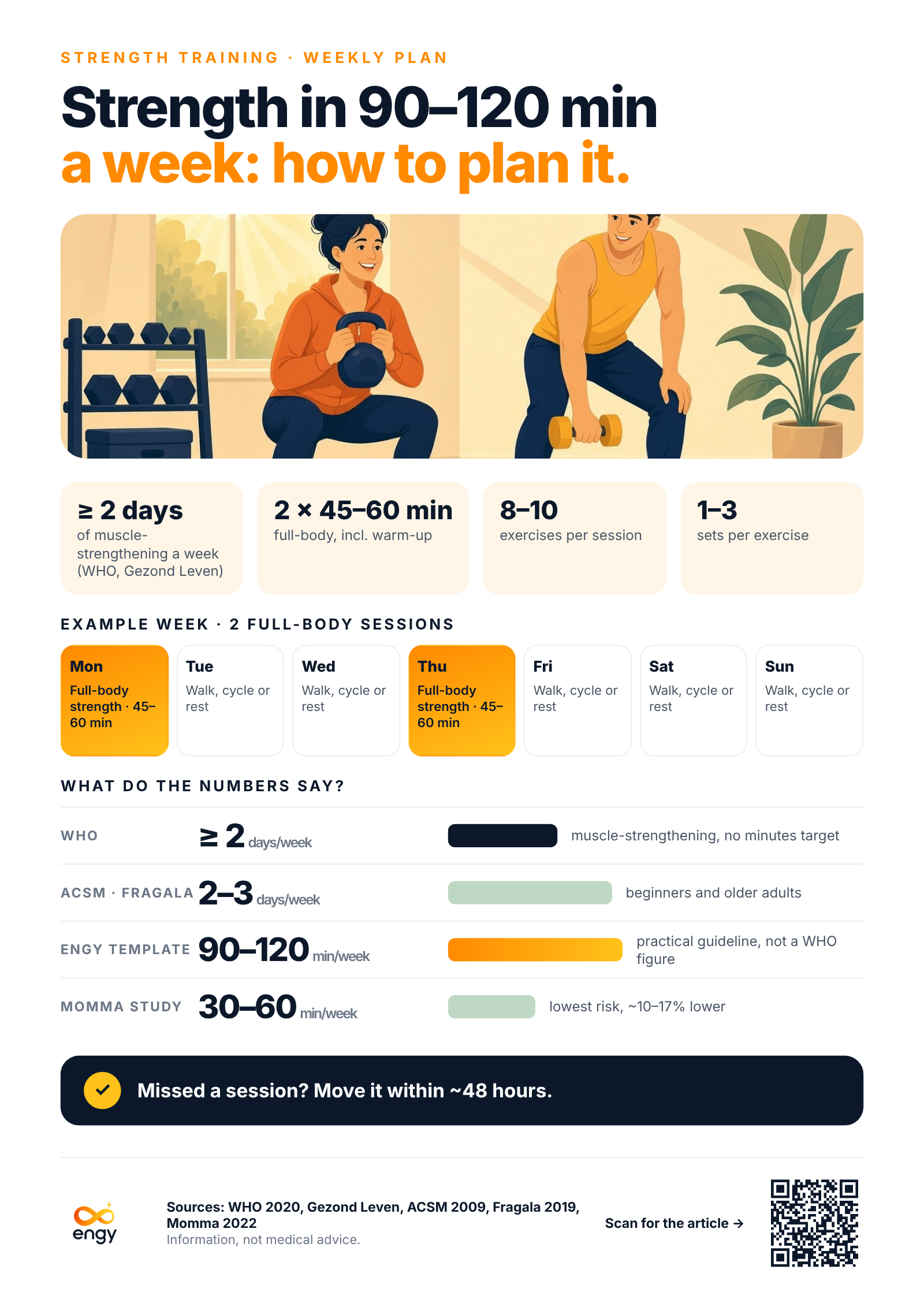
How much strength training per week is enough? WHO and Flanders do not prescribe a fixed number of minutes; they ask for muscle-strengthening activities on at least two days a week. On top of that, a practical weekly plan helps: two sessions of about 45 to 60 minutes for the whole body. Walking and easy endurance do not replace that stimulus.
What WHO and Flanders recommend
WHO (2020 guidelines, Bull et al.) advises adults to do 150 to 300 minutes of moderate-intensity or 75 to 150 minutes of vigorous-intensity aerobic activity per week, or an equivalent combination. On top of that come muscle-strengthening activities of moderate or greater intensity, for all major muscle groups, on at least two days a week. According to the guideline, these provide additional health benefits. For people aged 65 and over, multicomponent activity with an emphasis on balance and strength is added, on at least three days a week.
In Flanders, Gezond Leven (Flemish health recommendations 2021) aligns with that: at least twice a week specific activities to strengthen the large muscles and bones, on top of aerobic volume. The guidelines do not fix session length in minutes.
Mortality risk versus a training plan
A meta-analysis by Momma et al. (2022) linked muscle-strengthening activity, observationally, to about 10 to 17 percent lower risk of early death, cardiovascular disease, cancer and diabetes. The lowest risk estimate for early death sat around 30 to 60 minutes per week. That is not a contradiction with a plan of two sessions: Momma measures mortality, not muscle maintenance or muscle growth. For those outcomes, training volume plays a different role.
For muscle growth, research (Schoenfeld et al., 2017) points to a graded dose-response: higher weekly volume is linked to greater gains up to a higher level; the optimal upper limit remains unclear. Maintenance can use lower volume than building, although older adults generally need, according to Bickel et al. (2011), more maintenance volume than younger people.
Practical Engy guideline: two whole-body sessions
As a general guideline, aim for two whole-body sessions a week of about 45 to 60 minutes including warm-up. Together that is about 90 to 120 minutes. That is not a WHO or Fragala figure, but a handy template that meets the frequency of at least two days and leaves room for eight to ten exercises with one to three rounds. ACSM (2009) and Fragala et al. (2019) support frequencies of two to three days a week for beginners and older adults; they do not literally prescribe session length in minutes.
Choose movement patterns: knee bend or a bend at the hips, push, pull, and a core exercise or farmer carry. Work challengingly through the last repetitions with good technique. Gradually raise the load or the number of repetitions when you hit the range with clean form. Frequency and that gradual build-up matter more than which machine you use. A concrete start plan with exercises and progression is in our article on strength training for longevity.
How to fit it into your week
Block two fixed slots in your calendar, for example Monday and Thursday, as if they were appointments. If you miss one, shift within about 48 hours instead of scrapping the whole week. Combine with walking or zone 2 (an easy endurance pace at which you can still talk comfortably): good for fitness, but they load muscles differently from strength training. Plan rest too; a rest day or deload fits busy weeks or rising fatigue.
After a long break, build up carefully: technique and low load first, then volume. More volume is not the default answer after time off. Anyone who mainly wants to maximise muscle mass or sport performance often needs more volume or coaching; that remains a different goal from public-health guidelines.
Download the weekly plan
A sample week with two full-body sessions and the numbers on one page, also as an A4.
When to see a doctor?
If pain keeps coming back, if you doubt whether strength training suits you, or after a recent operation or acute injury, talk to your GP or physiotherapist.
Sources
- Bull FC et al. (2020). World Health Organization 2020 guidelines on physical activity and sedentary behaviour. British Journal of Sports Medicine, 54(24), 1451–1462. WHO publication: WHO guidelines on physical activity and sedentary behaviour.
- Vlaams Instituut Gezond Leven (2021). Vlaamse gezondheidsaanbevelingen beweging. See also: krachtoefeningen.
- Momma H et al. (2022). Muscle-strengthening activities are associated with lower risk and mortality in major non-communicable diseases: a systematic review and meta-analysis of cohort studies. British Journal of Sports Medicine, 56(13), 755–763.
- American College of Sports Medicine (2009). Progression models in resistance training for healthy adults. Medicine & Science in Sports & Exercise, 41(3), 687–708.
- Fragala MS et al. (2019). Resistance Training for Older Adults: Position Statement From the National Strength and Conditioning Association. Journal of Strength and Conditioning Research, 33(8), 2019–2052.
- Schoenfeld BJ, Ogborn D, Krieger JW (2017). Dose-response relationship between weekly resistance training volume and increases in muscle mass: A systematic review and meta-analysis. Journal of Sports Sciences, 35(11), 1073–1082.
- Bickel CS, Cross JM, Bamman MM (2011). Exercise dosing to retain resistance training adaptations in young and older adults. Medicine & Science in Sports & Exercise, 43(7), 1177–1187.






7 Comments