
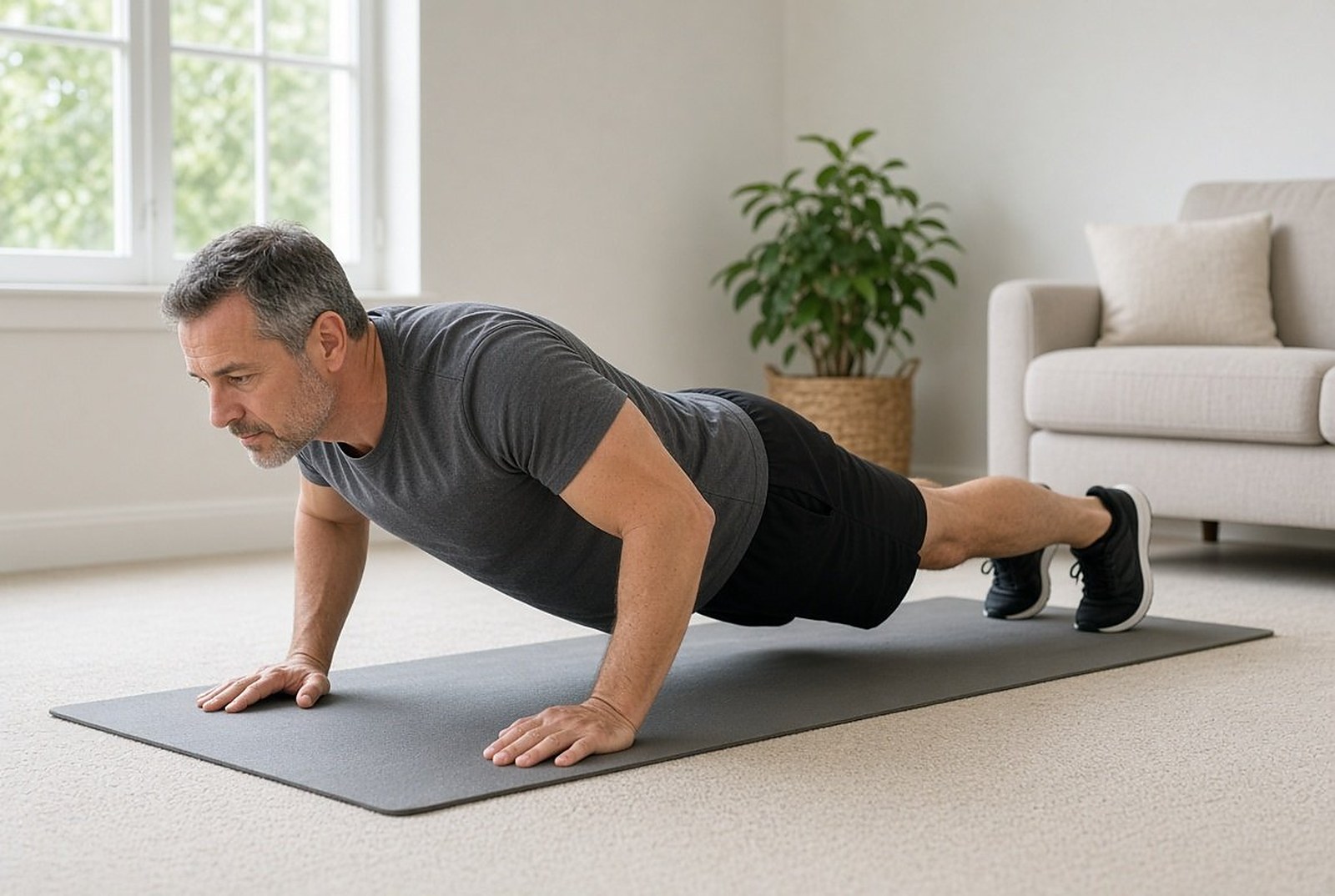
Strength training for beginners who already walk or run
General information, not medical advice. If you have a heart condition, joint problems or a recent injury, talk to your GP or physiotherapist about how to start.
Strength training for beginners who already walk or run is the logical next step: your fitness is there, and your muscles get a new challenge. This article explains why it is worth adding, how to start at home and how to make the exercises gradually harder.
Why walking or running is not enough
Walking and running mainly train your heart, lungs and endurance. Muscle-strengthening exercises, where your muscles work against resistance such as your body weight, a dumbbell or a resistance band, do something else: they maintain your muscles and strength. That is why the World Health Organization (WHO) gives adults two separate recommendations in its 2020 guidelines: 150 to 300 minutes of moderate-intensity activity a week, and on top of that muscle-strengthening activities for the major muscle groups on at least 2 days a week. The article on how much strength training per week makes sense explains how to fill those two days.
If you worry that strength work will hurt your running, there is good news. A 2022 meta-analysis by Schumann and colleagues pooled 43 studies and found no disadvantage for maximal strength and muscle growth when people combined endurance and strength training. Only explosive strength improved less when both were done in the same session. The article on combining cardio and strength goes into more detail.
How to start strength training for beginners
You do not need a gym. A handful of bodyweight exercises already works the main muscle groups:
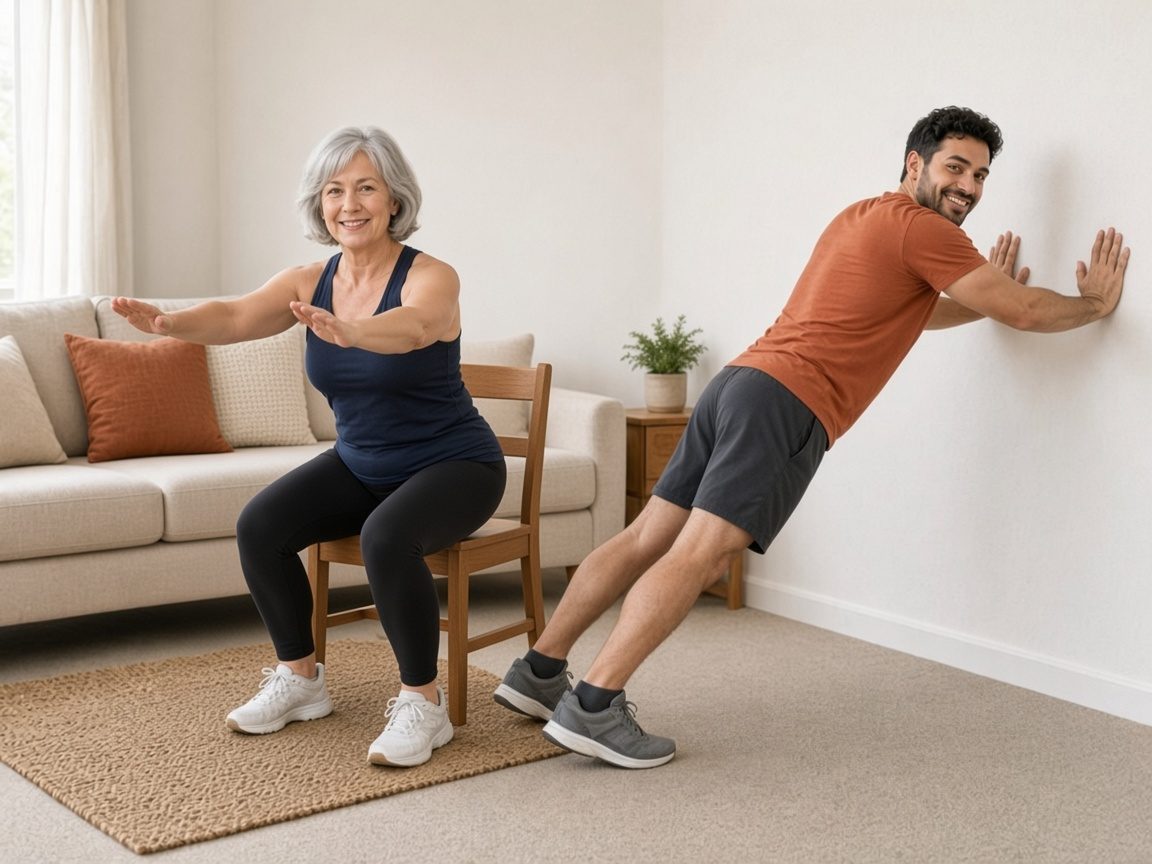
- In a squat you bend your knees as if sitting down on a chair; feel free to start with a real chair behind you.
- Do push-ups against a wall or on your knees first, later on a mat with straight legs.
- For your back, lie under a sturdy table and pull yourself up towards it, or use a resistance band.
- In a plank you rest on your forearms and toes and keep your body as straight as you can.
In its 2009 position stand, the American College of Sports Medicine advises beginners to do 1 to 3 sets of 8 to 12 repetitions per exercise, 2 to 3 times a week, working the whole body each time. A repetition is doing the movement once; a set is a number of repetitions in a row. Choose a version where the last repetitions feel hard but your technique stays good. A worked example is in this home strength training plan without equipment.
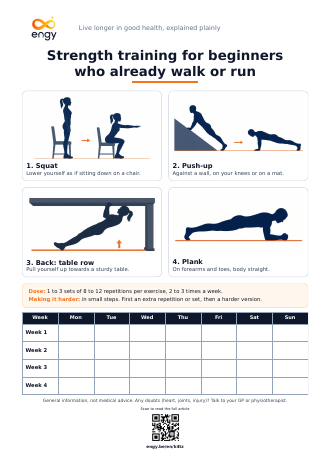
Free strength training exercise sheet
4 basic bodyweight exercises and a weekly plan to tick off. Print it and put it up.
Download the exercise sheet (A4, pdf)Making it harder, step by step
After a few weeks the exercises get easier. That is your cue to make them a little harder, because your muscles adapt to what you ask of them. According to the same position stand, you do this in small steps: first an extra repetition or set, then a harder version, such as moving push-ups from the wall to the floor, or some extra weight, like a backpack with water bottles. Schedule strength sessions on days without a long run, or after an easy walk, so you have enough energy for both.
References
- World Health Organization. WHO guidelines on physical activity and sedentary behaviour. 2020.
- American College of Sports Medicine. Progression models in resistance training for healthy adults. Medicine and Science in Sports and Exercise. 2009;41(3):687-708.
- Schumann M, Feuerbacher JF, Sünkeler M e.a. Compatibility of concurrent aerobic and strength training for skeletal muscle size and function: an updated systematic review and meta-analysis. Sports Medicine. 2022;52(3):601-612.



One Comment