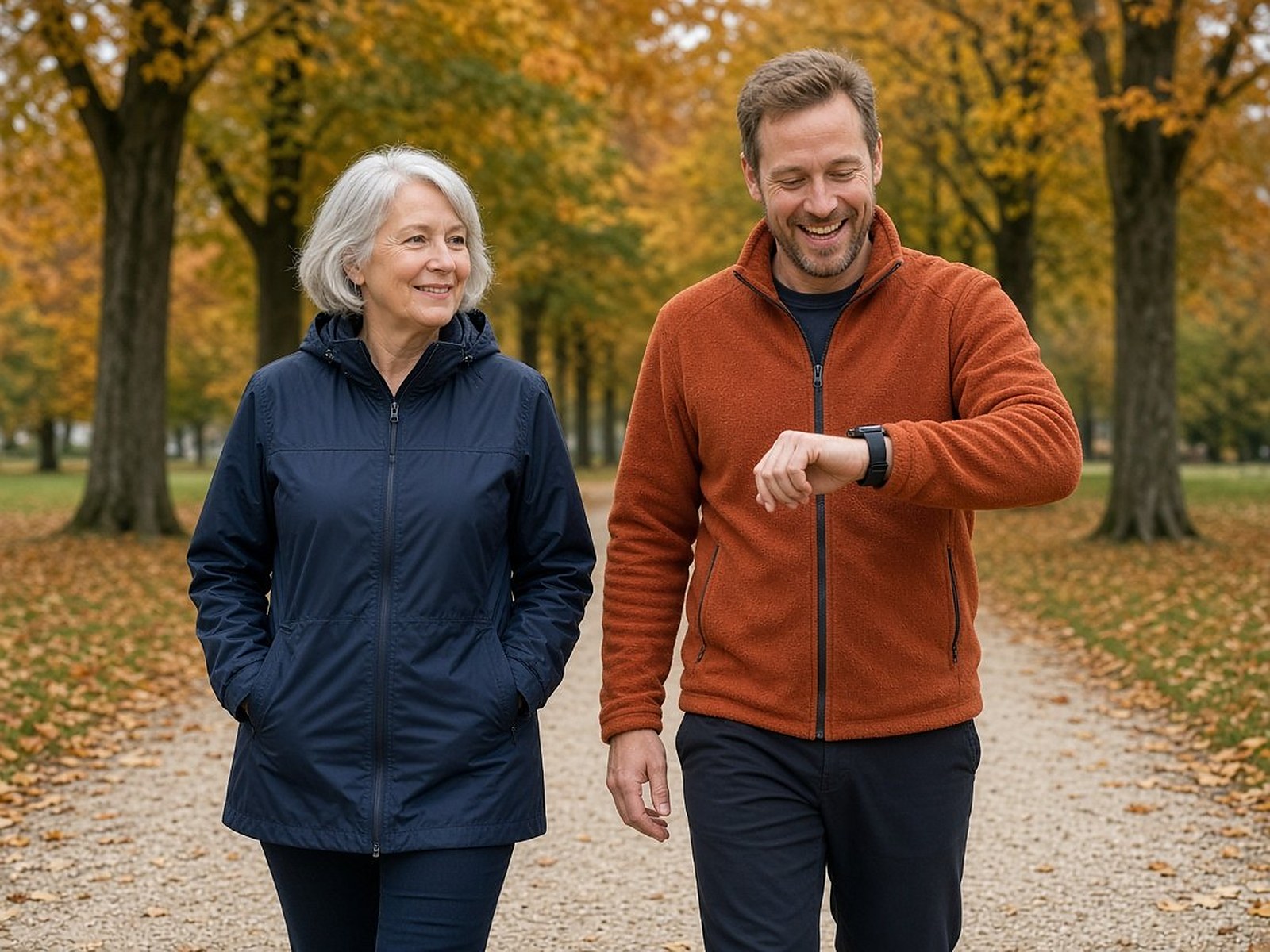
10,000 steps a day: still the right goal?
General information, not medical advice. If you have a heart condition or pain when walking, talk to your GP about how to build up your activity.
The goal of 10,000 steps a day is the default setting on many pedometers and smartwatches. This article explains where the number comes from, what large studies say about fewer steps and what gives you the most benefit in practice.
Where 10,000 steps comes from
In their 2004 review, American researchers Tudor-Locke and Bassett describe how the number appeared in Japan in the 1960s, with a pedometer sold as the manpo-kei, which literally means ten-thousand-steps meter. It was a round, easy-to-remember figure, not the result of health research. The same authors note that 10,000 steps is a reasonable goal for many people, but not always realistic for older adults or people with a chronic condition.
What studies say about fewer steps
A 2022 meta-analysis by Paluch and colleagues pooled 15 cohorts, groups of participants followed for years. The more steps people took per day, the lower their risk of dying during that period. In people over 60, the decline levelled off at around 6,000 to 8,000 steps a day, in younger adults at around 8,000 to 10,000. An even larger 2025 analysis by Ding and colleagues, covering 57 studies, found that 7,000 steps a day compared with 2,000 was linked to a 47 percent lower risk of death. The article on how many steps a day are worthwhile goes into more detail.
Both are observational studies: they show a link, not proof that the steps themselves make the difference. People who walk a lot are often healthier in other ways too. Still, the results point the same way: the biggest gain is for people who go from very few steps to a few more, and above a certain level the extra benefit shrinks.
Pace and sitting time count too
The World Health Organization (WHO) does not express its advice in steps but in minutes: 150 to 300 minutes of moderate-intensity activity a week, or 75 to 150 minutes of vigorous activity. Moderate means your breathing speeds up but you can still talk. Runners and cyclists call that easy pace zone 2, the intensity at which you can still hold a conversation, as the article on zone 2 training explains. Brisk steps therefore count towards the WHO minutes; strolling counts far less.
Gezond Leven, the Flemish institute for health promotion, also recommends regularly breaking up long periods of sitting. Standing up during a phone call, taking the stairs or walking part of your commute adds steps without needing extra time.
What a step counter can do for you
A step counter or smartphone is mainly useful to see where you stand. If you usually take few steps, one extra walk a day or a short stroll after a meal is already progress. If you reach 10,000 steps easily, good; if you do not, that is no reason to give up. Consistency over the weeks matters more than one record day.
References
- Tudor-Locke C, Bassett DR Jr. How many steps/day are enough? Preliminary pedometer indices for public health. Sports Medicine. 2004;34(1):1-8.
- Paluch AE, Bajpai S, Bassett DR e.a. Daily steps and all-cause mortality: a meta-analysis of 15 international cohorts. The Lancet Public Health. 2022;7(3):e219-e228.
- Ding D, Nguyen B, Nau T e.a. Daily steps and health outcomes in adults: a systematic review and dose-response meta-analysis. The Lancet Public Health. 2025;10(8):e668-e681.
- World Health Organization. WHO guidelines on physical activity and sedentary behaviour. 2020.
- Gezond Leven. De bewegingsdriehoek (the physical activity triangle, in Dutch). Accessed October 2026.