Which sport is right for me? Walking, running, cycling, swimming and strength compared
Which sport is right for me? It’s the question I get asked more than any other, usually by people who want to get started but can’t see the wood for the trees. Walking, running, cycling, swimming, strength training: each has its strengths. Below I put them side by side, with what they train, what they cost and how to get started.
Informational, not medical advice.
TLDR
- There’s no perfect sport. The best one is the sport you enjoy, that suits your body and that you keep doing.
- Walking and cycling have the lowest threshold. Running is the most time-efficient cardio. Swimming is the gentlest on your joints.
- Strength training isn’t an extra: the WHO recommends muscle-strengthening exercise at least twice a week.
- The benchmark for adults: 150 to 300 minutes of moderate activity a week, plus strength work twice.
- Combining works best. A simple weekly mix is at the bottom.
First: what do you want out of it?
Each sport trains something different. Endurance sports such as walking, running, cycling and swimming mainly strengthen your heart, lungs and stamina. Strength training keeps your muscles and bones strong, something that matters more and more as you age. For a long, healthy life you need both. That’s also what the WHO guidelines for adults say: 150 to 300 minutes of moderate-intensity activity a week (or 75 to 150 minutes of vigorous activity), plus muscle-strengthening exercise on at least two days.
Practical matters count as well: your joints, your budget, your schedule and what you simply enjoy. A sport you drop after three weeks won’t do much for you.
Walking
What it trains: basic fitness, circulation and leg muscles. Brisk walking counts as moderate-intensity activity.
Joints: very low load. Suitable for almost everyone, including people with excess weight or after a long break.
Cost and threshold: next to nothing. Good shoes are enough.
Time: 30 minutes a day, five days a week, and you’ve hit 150 minutes. You can also split it into ten-minute chunks.
Starter tip: walk at a pace where you can still talk but no longer sing. Build up your daily steps, as I explain in steps and NEAT.
Running
What it trains: endurance, heart and lungs, and thanks to the impact, your bones too.
Joints: the highest load of the five. Every stride is a small landing. That’s good for your bones, but it calls for a gradual build-up to avoid overload.
Cost and threshold: low. Running shoes, and you can head out from your front door.
Time: the most time-efficient cardio. Because running quickly becomes vigorous, a minute of running counts roughly double compared with moderate activity in the WHO guidelines.
Starter tip: start by alternating walking and running, for example one minute running and two minutes walking. Pair it with some strength work; see strength alongside running.
Cycling
What it trains: endurance and leg muscles, especially your thighs and glutes.
Joints: low load. Your weight rests on the saddle, so no jolts. A properly fitted bike helps prevent knee and back trouble.
Cost and threshold: low to moderate. Most people already own a bike. A road bike or indoor trainer is optional.
Time: very flexible. The easiest approach is to build cycling into your day, for example on the way to work.
Starter tip: swap one car trip a week for the bike. Also read cycling to work.
Swimming
What it trains: heart, lungs and virtually your whole body: shoulders, back, arms, core and legs.
Joints: the gentlest of all. The water carries your weight. Ideal for joint problems or rehab after an injury. Downside: little stimulus for your bones.
Cost and threshold: moderate. You need a pool with suitable opening hours, and reasonable technique. If your front crawl is shaky, you’ll be out of breath fast.
Time: factor in travel and changing. Two sessions of 30 to 40 minutes a week make a good base.
Starter tip: take a few adult lessons and swim in blocks of a few lengths with short breaks. Whether swimming is better cardio than running or cycling, I looked into in swimming vs running.
Strength training
What it trains: muscle strength and mass, bones, balance and the strength you need to climb stairs or carry a heavy shopping bag.
Joints: low to moderate load, depending on the exercises and the weight. With good technique and a gradual build-up, it suits almost everyone.
Cost and threshold: from free (bodyweight at home) to a gym membership.
Time: two sessions of 30 to 45 minutes a week already deliver a lot.
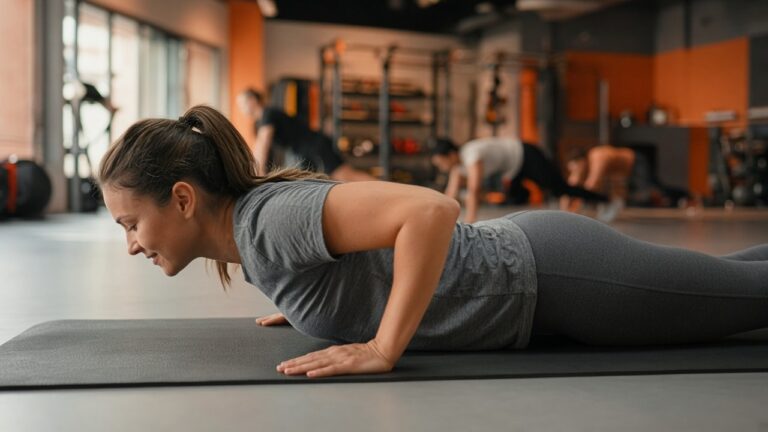
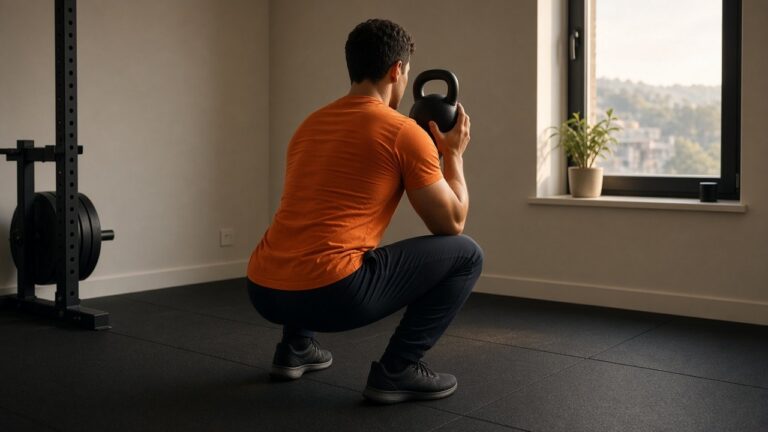
Starter tip: start at home with squats, push-ups against a table, lunges and a plank. You’ll find a concrete routine in strength training at home with no equipment.
Side by side
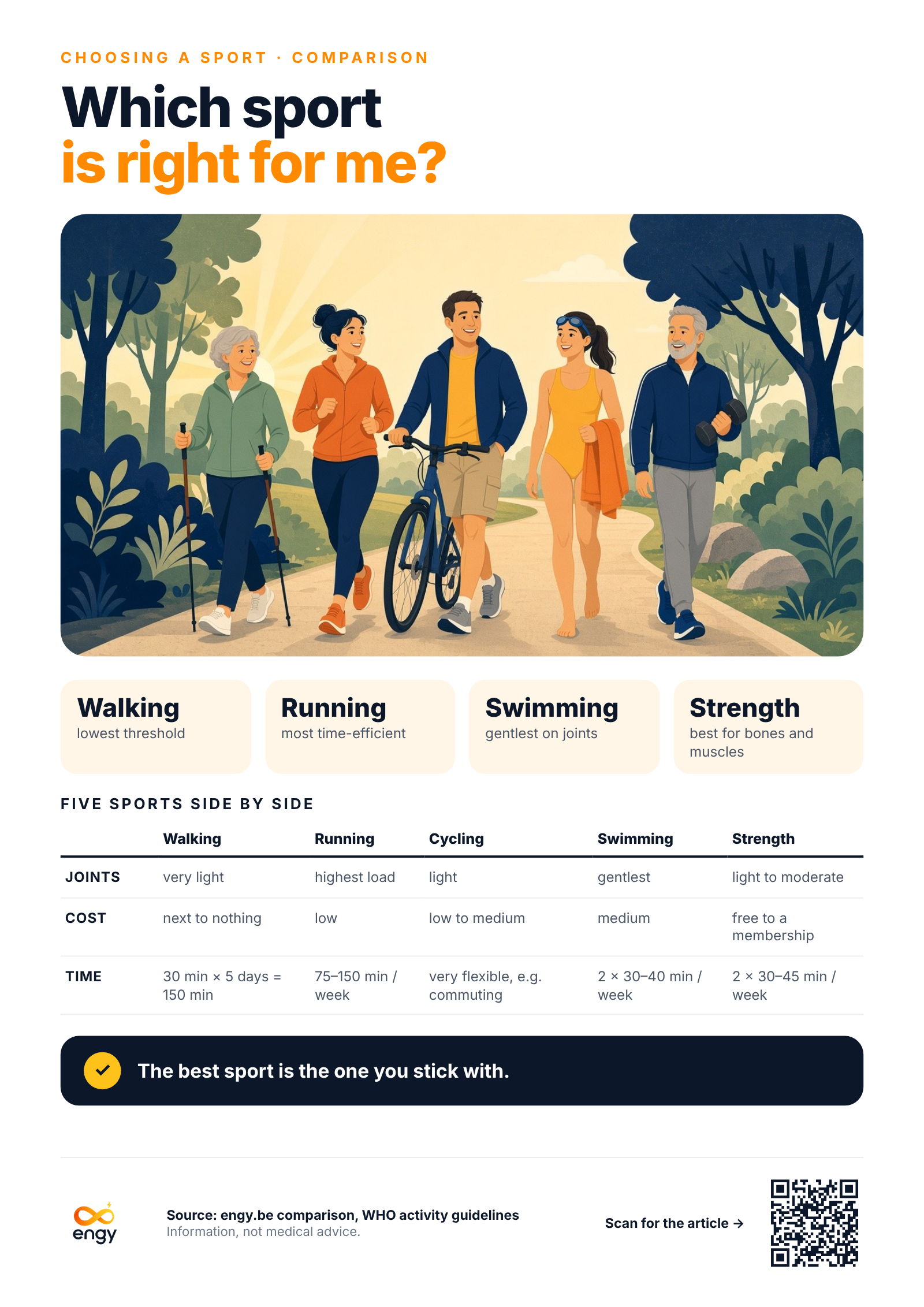
- Lowest threshold: walking and cycling.
- Most time-efficient for fitness: running.
- Gentlest on your joints: swimming, followed by cycling.
- Best for bones and muscles: strength training, followed by running.
- Most complete full-body workout: swimming and strength training.
Download the comparison
Five sports side by side on one page, also as an A4.
A simple weekly mix
You don’t have to choose. Most people get the most out of a mix of two or three sports. An example that fits into an ordinary working week:
- Daily: walk or cycle as much as possible to get around.
- Twice a week: 30 to 45 minutes of strength training, at home or at the gym.
- Two or three times a week: 30 to 45 minutes of an endurance sport of your choice, such as running, cycling or swimming.
- Once a week: a longer, easy walk or bike ride at the weekend.
That gets you to 150 to 300 minutes a week without much fuss, plus the two strength sessions from the WHO guidelines. Busy? A smaller base will do too, as I described in the minimum viable health week.
Start small, build up gradually and pick what you enjoy. Not everyone benefits from the same thing, and that’s fine.
This article is informational and not medical advice. If you have a chronic condition, heart problems or an injury, or haven’t been active for a long time, check with your GP or physiotherapist first.
Sources (selection)
- World Health Organization (2020). WHO guidelines on physical activity and sedentary behaviour.
- Flemish Institute for Healthy Living (Vlaams Instituut Gezond Leven). The physical activity triangle (bewegingsdriehoek). gezondleven.be (in Dutch).
- Gómez-Bruton A et al. (2013). Is bone tissue really affected by swimming? A systematic review. PLoS ONE, 8(8), e70119.