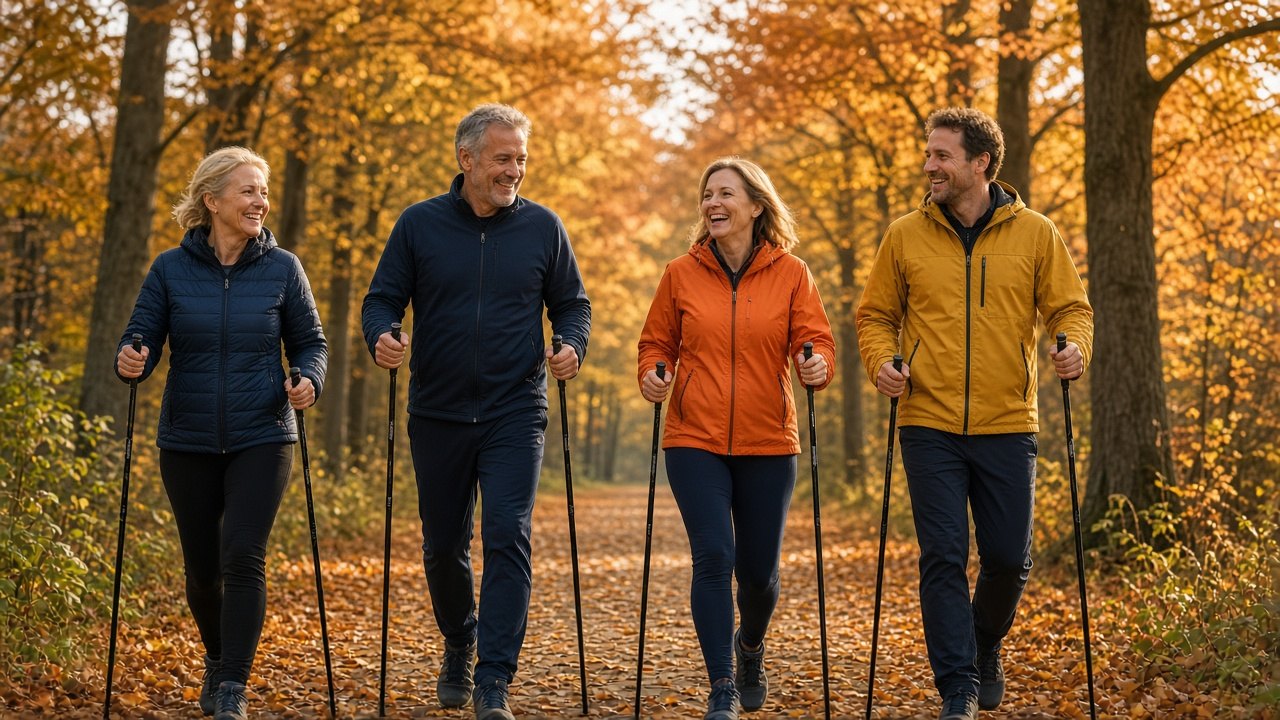
Nordic walking: more than walking with poles, if you use them properly
General information, not medical advice. If you have symptoms, discuss them with your GP or physiotherapist.
In short
- Nordic walking is brisk walking with special poles that you actively push off with, so your arms, shoulders and trunk work too.
- It takes more energy than ordinary walking, while one foot always stays on the ground.
- Research mainly shows benefits for resting heart rate, blood pressure, fitness and quality of life. On heart attack or dementia there is hardly any direct research.
Nordic walking has an old-fashioned reputation, but according to an HLN article of 9 October 2026 (in Dutch), the sport is ready for a comeback.
What it is
According to the same article, the method was developed in Finland, where cross-country skiers trained in summer with their ski poles. The principle is simple: you push yourself forward with the poles in a diagonal rhythm. Your right arm moves forward with your left leg and vice versa.
Because your upper body joins in, you use more energy. In a 2002 field study by the Cooper Institute, an American research centre focused on physical activity and prevention, 11 women and 11 men walked 1600 metres on an athletics track, once with and once without poles. With poles, energy expenditure rose from 4.6 to 5.4 kcal per minute in the women and from 5.7 to 6.9 kcal per minute in the men. Oxygen consumption was higher as well. Yet the participants did not find the effort noticeably harder.
What the research shows
A 2013 review (which summarises several studies) brought together 16 randomised trials with a total of 1062 patients and 11 observational studies with 831 patients. Nordic walking had beneficial effects on resting heart rate, blood pressure, endurance, maximal oxygen uptake and quality of life, in people with various conditions. On several points it did better than brisk walking without poles.
On heart attack or dementia there is hardly any direct research. Regular movement is good for your health, which is why the World Health Organization recommends that adults get 150 to 300 minutes of moderate-intensity activity per week, or 75 to 150 minutes of vigorous activity, plus muscle-strengthening exercise on at least 2 days a week. Nordic walking counts towards the minutes, but according to the sports physician quoted by HLN it is not full strength training.
Because one foot always stays on the ground and there is no flight phase in which both feet leave the ground, it puts less load on your body than running, according to the same sports physician. It also fits into a long weekend walk, and on days when walking outside is not possible, zone 2 on a home trainer is an easy alternative. Zone 2 is an easy endurance pace at which you can still talk comfortably.
Technique in brief
According to the sports physician quoted by HLN, many people use their poles wrongly, for example as a support. The points below are general guidelines, not a tested protocol.
- Pole length: a common guideline is your height in centimetres times 0.68. At 1.75 metres that gives about 119 centimetres, so choose the nearest available size.
- Use the strap: Nordic walking poles have a strap, a kind of glove, that lets you release the grip behind you without losing the pole.
- Angle backwards: the tip points diagonally backwards, not out in front of you as with a hiking pole.
- Push off actively: push the pole back past your hip and then open your hand.
- Relaxed shoulders: swing from the shoulder and keep your grip relaxed.
Building up gradually
Increase duration and pace gradually. This schedule is an example, not a tested programme.
- Week 1: three times 20 to 30 minutes on flat ground. First let the poles trail to find the diagonal rhythm, then start pushing off lightly.
- Week 2: three times 30 minutes.
- Week 3: three times 35 to 40 minutes, including one outing with gentle slopes.
- Week 4: three times 40 to 45 minutes. In one session, walk four times 3 minutes at a brisker pace, with 2 easy minutes in between each time.
Week 4 adds up to 120 to 135 minutes. After that, you can keep building towards the WHO’s 150 minutes. A lesson at a local club helps you learn the technique. For variety, stair intervals at home are a short, harder addition.
When to see a doctor?
If you have heart, joint or balance problems, or have not been active for a long time, first discuss with your GP or physiotherapist how to start.
Sources
- Migom E (2026, 9 October). Beter dan wandelen, minder belastend dan lopen: nordic walking is klaar voor een comeback. HLN.
- Tschentscher M, Niederseer D, Niebauer J (2013). Health benefits of Nordic walking: a systematic review. American Journal of Preventive Medicine, 44(1), 76–84.
- Church TS, Earnest CP, Morss GM (2002). Field testing of physiological responses associated with Nordic Walking. Research Quarterly for Exercise and Sport, 73(3), 296–300.
- World Health Organization (2020). WHO guidelines on physical activity and sedentary behaviour.