Airing your home in autumn: fresh air without blowing your heating out the window
For information only, not medical advice.
TLDR
- According to Belgium’s Federal Public Service (FPS) Public Health, we spend more than 85 percent of our time indoors. In autumn the windows close, and moisture, CO2 and smells build up.
- The FPS advises airing your home twice a day for a quarter of an hour, and keeping CO2 in frequently used rooms below 900 ppm.
- Too much moisture raises the risk of mould. The World Health Organization links damp and mould at home to more respiratory complaints.
- An air purifier is an addition, not a replacement: it doesn’t lower CO2.
Last winter I bought a simple CO2 monitor, mostly out of curiosity. The first night it sat in the bedroom. At six in the morning, door shut, window shut, it showed a reading I hadn’t expected. Those numbers didn’t make me ill, but they did explain why I sometimes got up with a heavy head.
Now that the heating is coming back on and flu and COVID are going around again, it felt like a good moment to find out what good indoor air actually is.
Why autumn makes it tricky
In summer, windows and doors are often open. In October everything closes to keep the heat in. Meanwhile we keep cooking, showering, drying laundry and breathing. All of that puts moisture, CO2 and other substances into the air, and they have nowhere to go.
The FPS Public Health calls CO2 a good indicator of how well the air is being refreshed. A high reading means too little fresh air is coming in, and that other substances and tiny droplets from breathing can build up as well.
Which numbers make good reference points?
- CO2: the FPS advises staying below 900 ppm. The Flemish indoor environment decree uses a guideline value of less than 500 ppm above outdoor air, which in practice also comes to around 900 ppm.
- Humidity: the same decree gives a relative humidity between 40 and 60 percent as the guideline for winter.
A nuance: a CO2 monitor doesn’t measure fine dust, radon or mould spores. It only tells you whether you’re refreshing the air enough. Radon is a different story, which I covered in testing your home for radon.
What I do differently now
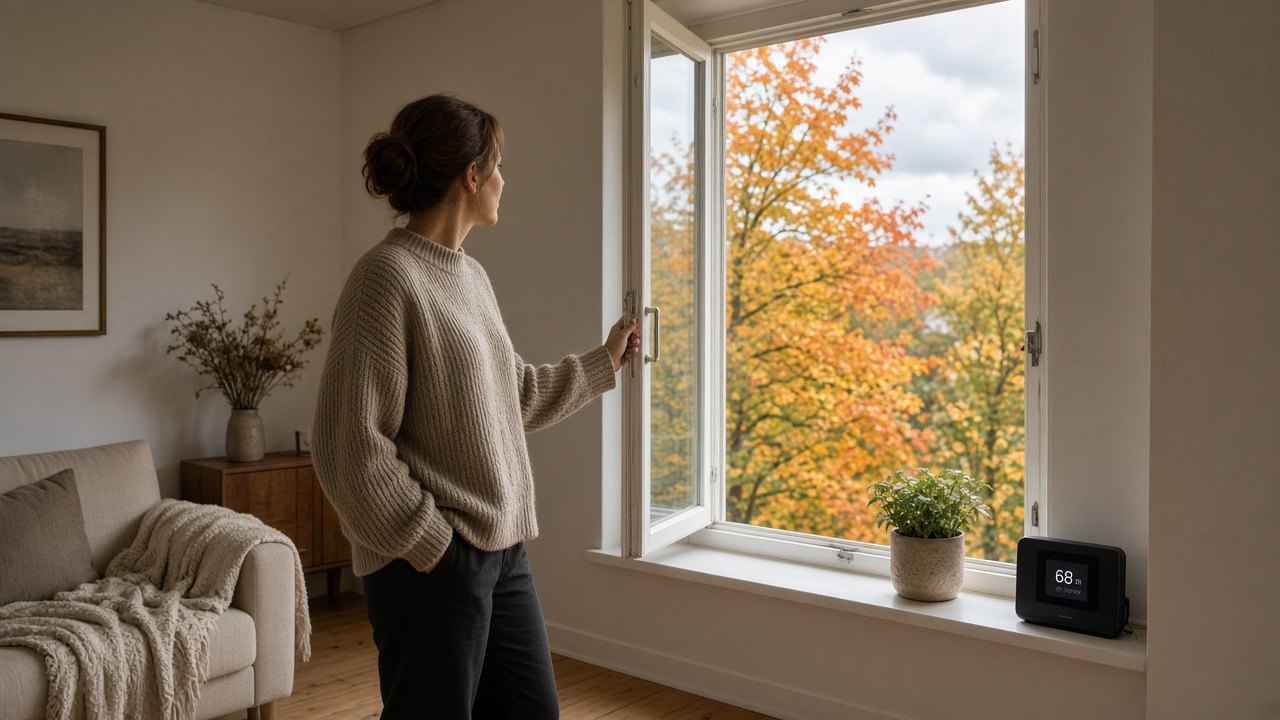
Air out short and hard. Morning and evening, I open two windows on opposite sides for a quarter of an hour. The air flows through quickly without the walls and furniture cooling down. A window left ajar all day costs more heat and refreshes less air.
Remove moisture where it starts. Cooker hood on while cooking, ideally one that vents outside. After a shower, bathroom door closed and the window or fan on. I dry laundry as much as possible in a room I can air out well.
Vents open, ventilation maintained. At our place, the trickle vents above the windows are often closed in winter “because of the draught”. They’re open again now. If you have mechanical ventilation, replacing the filters on time helps.
Don’t forget the bedroom. We spend eight hours in there with the door shut. A window ajar or the door open often already makes a difference. A cool bedroom also helps you sleep better, see keeping your bedroom cool.
Air out extra during and after DIY. Paint, glue and sanding put a lot into the air. Tackling old materials? Read my piece on asbestos at home first.
When it needs extra attention
If you see black spots in corners, it smells musty or there’s often condensation on the windows, there’s probably a structural moisture problem. Airing alone won’t solve that. People with asthma, or with young children or older people in the house, should also take this seriously.
Recommendations
- Cross-ventilate for a quarter of an hour twice a day.
- Remove moisture at the source: cooker hood, bathroom, laundry.
- Keep vents open and maintain your systems.
- A CO2 monitor in the living room or bedroom is a cheap reality check.
- An air purifier only as an addition.
This article is for information only and is not medical advice. If you have respiratory complaints that you link to your home, talk to your GP.
Sources (selection)
- FPS Public Health, Food Chain Safety and Environment. Impact van de binnenluchtkwaliteit op je gezondheid. health.belgium.be.
- Departement Zorg (Flemish government). Bewaak de focus op luchtkwaliteit tijdens het gebouwontwerp (guideline values of the indoor environment decree). departementzorg.be.
- WHO Regional Office for Europe (2009). WHO guidelines for indoor air quality: dampness and mould. Copenhagen: WHO.