
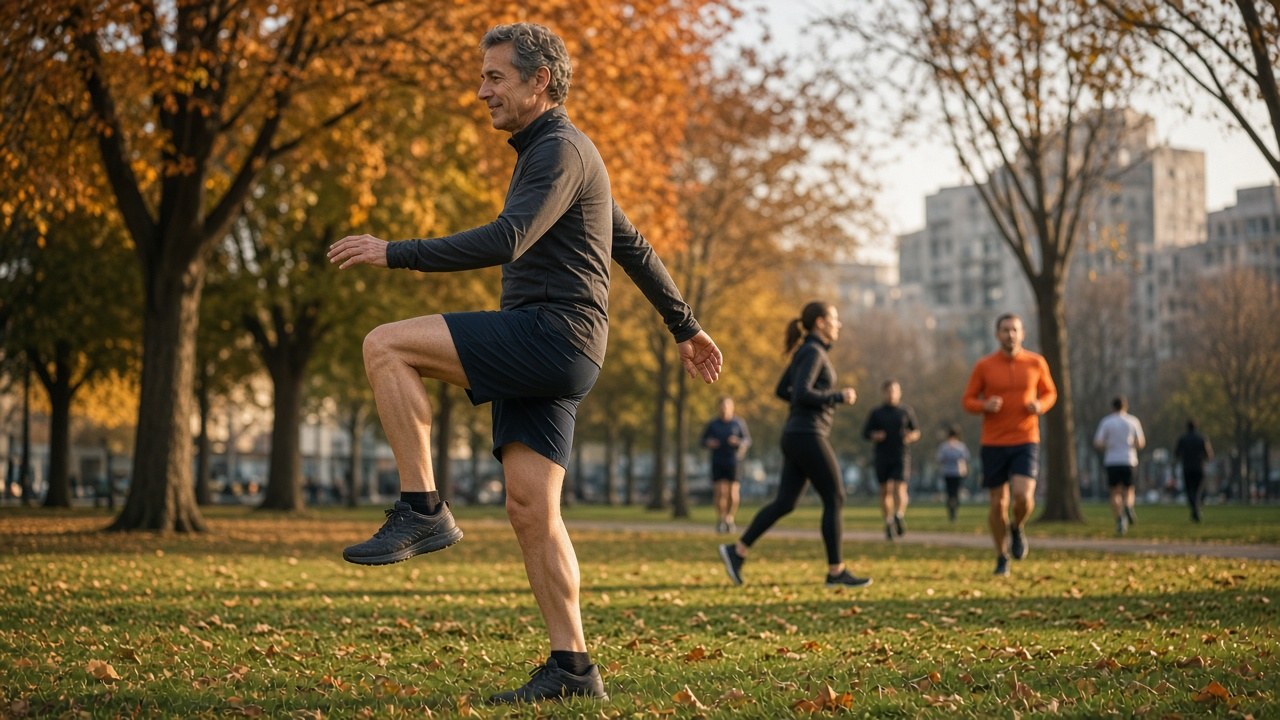
Balance training: the longevity investment almost nobody does
TLDR
- Test: stand ten seconds on one leg, hands by your sides, looking forward. If you cannot, there is work to do.
- After fifty, fall risk rises, and a fall is one of the biggest threats to independent ageing.
- Balance is trainable: a few minutes a day with single-leg stance, single-leg RDL and stepping drills.
- Combine with strength training: strong legs and good balance reinforce each other.
Balance is one of those skills you only think about once it slips. A kerb higher than expected, a wet stair, a child bumping into your legs. I noticed it putting on socks: on one leg it was less smooth than before. Reason enough to look at it properly.
Why balance is more than a circus trick
In older adults, a fall is one of the main causes of injury and loss of independence. The World Health Organization lists falls as the second leading cause of death from unintentional injury worldwide. A broken hip at 75 is often the start of a long decline.
Striking: a Brazilian study by Araújo and colleagues (2022) in nearly 1,700 people aged 51 to 75. Those who could not stand on one leg for ten seconds had a clearly higher mortality risk in the following years, even after adjusting for age and other factors. That does not mean standing on one leg lengthens your life. It is a signal: the test packs strength, coordination and a healthy nervous system into one simple measure. It fits the list of healthspan levers.
The test: ten seconds on one leg
How I do it: barefoot, next to a table or wall for safety. Lift one foot and place it against the inside of your other calf. Arms by your sides, eyes on a fixed point. Hold ten seconds, three attempts per leg.
- Easy? Try with eyes closed. That is much harder.
- Cannot do it? No panic, but a clear work point.
- Big left–right gap? Useful info for your training.
Three drills I build in daily
1. Single-leg stance while doing something else
Brushing teeth, waiting for the kettle, washing up: ideal moments. Twice thirty seconds per leg, without extra time in the calendar. Too easy? Slowly turn your head left to right or stand on a rolled towel.
2. Single-leg RDL
The Romanian deadlift on one leg trains balance, hamstrings and glutes at once. Stand on one leg, soft knee, hinge from the hips forward while the other leg goes back. Back straight, hips square to the floor. Start without weight, later take a light dumbbell. Three sets of eight per leg is enough. It fits nicely in a strength training after forty programme.
3. Stepping drills
A fall often happens because you do not take a step fast enough to catch yourself. Train that: quick small steps forward, sideways and back, return to centre. Or a step-up on a stair, slow and controlled. Two minutes is enough.
What does the research say on fall prevention?
A large Cochrane review by Sherrington and colleagues (2019) pooled more than a hundred studies in community-dwelling older adults. Exercise programmes mainly of balance and functional drills reduced falls by about a quarter. Programmes that combine several training types, such as balance and strength, also did well. Walking-only programmes scored lower.
Strength and balance therefore go hand in hand. Strong legs help you recover when you wobble, and grip strength also helps when you need to grab a rail.
Practical Engy tip
Tie balance to a fixed habit, such as brushing teeth. Do the test once a month and note your result. If you are older or have fallen before, practise next to a wall or solid furniture, or ask a physiotherapist for a tailored programme.
Recommendations
- Do the ten-second test and note the result.
- Two to five minutes of balance daily, tied to a habit.
- Single-leg RDL and stepping drills two to three times a week.
- Combine with strength training for the legs.
Sources (selection)
- Araújo CG et al. (2022). Successful 10-second one-legged stance performance predicts survival in middle-aged and older individuals. British Journal of Sports Medicine, 56(17), 975–980.
- Sherrington C et al. (2019). Exercise for preventing falls in older people living in the community. Cochrane Database of Systematic Reviews, CD012424.
- Sherrington C et al. (2017). Exercise to prevent falls in older adults: an updated systematic review and meta-analysis. British Journal of Sports Medicine, 51(24), 1750–1758.
- World Health Organization (WHO). Falls, factsheet.

One Comment