High-fibre fruit: raspberries, pears and kiwis compared
General information, not medical advice. If you have symptoms or follow a diet for medical reasons, discuss it with your GP or dietitian.
Eating high-fibre fruit can help your gut. Most adults eat less fibre than recommended. Here is how much you need, which fruits contain the most and what research says about fruit and bowel movements.
How much fibre do you need?
Dietary fibre is the part of plant foods your small intestine cannot digest. It reaches the large intestine intact, where it makes stools softer and bulkier and feeds gut bacteria. The European Food Safety Authority (EFSA) sets 25 grams of fibre a day as an adequate intake for normal bowel function in adults: an amount that is enough, not a strict minimum. In 2025 the Belgian Superior Health Council called 25 to 29 grams a day sufficient, with extra benefit above 30 grams.
Fibre does more than help digestion. In 2019 a team brought together 185 cohort studies, which follow large groups for years, and 58 clinical trials, in which participants are assigned a diet, in The Lancet. People with the highest fibre intake had a 15 to 30 percent lower risk of death, cardiovascular disease, type 2 diabetes and colorectal cancer than those with the lowest. The biggest gains came from 25 to 29 grams a day. Again, these are mainly links.
High-fibre fruit: the front runners
Among the fruit you often see in shops, raspberries and blackberries come out on top. According to the US Department of Agriculture (USDA) database, raspberries contain about 6.5 grams of fibre per 100 grams and blackberries about 5 grams. Pears and kiwis are around 3 grams, apples 2.4 grams and bananas 2.6 grams. One large pear with its skin already gives 5 grams or more. Eat the skin: it holds a good share of the fibre.
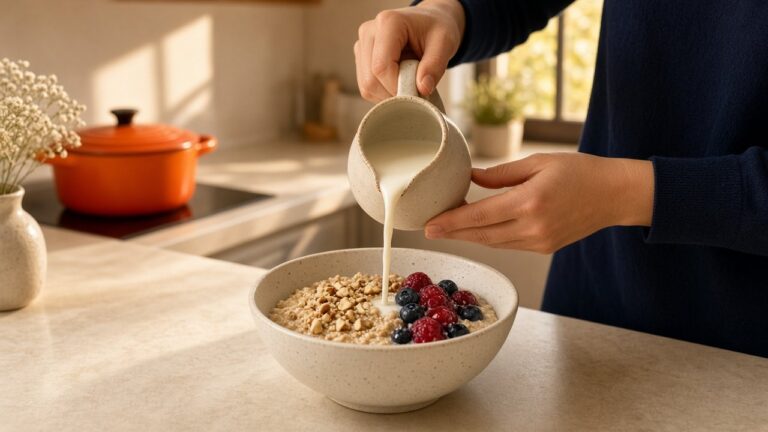
Fruit provides both soluble and insoluble fibre. Pectin, a soluble fibre, forms a kind of gel with water. According to the Vlaams Instituut Gezond Leven, this fibre lowers LDL cholesterol, the kind that can build up in blood vessels. Grains provide more insoluble fibre, which adds bulk to stools. Fruit and whole grains complement each other, for example in a bowl of oatmeal for breakfast with grated pear or raspberries.
Kiwis and prunes for slow bowels
In a partly randomised 2021 US study, 79 adults with chronic constipation received two green kiwis a day, prunes or psyllium for four weeks, psyllium being a fibre supplement made from the husk of a plantain seed. All three groups had more frequent bowel movements, and kiwi caused the fewest side effects such as bloating. The study was small and had no untreated group, but it shows plain fruit has a place next to supplements.
Why juice counts for less
When you squeeze fruit, much of the fibre stays in the press. Gezond Leven therefore puts juice and smoothies in the grey zone: less fibre, more sugars, and they fill you up less. For more fibre, choose whole fruit. The Superior Health Council recommends 250 grams of fruit a day, as the article how much fruit per day explains.
Build up gradually
If you eat little fibre, increase it step by step and drink enough water. A sudden jump can cause wind or a bloated belly because bacteria break down (ferment) the fibre; your gut gets used to it. Fermented foods such as yoghurt and kefir also fit this diet, see the article on fermented food. To start: a pear or kiwi at breakfast and an apple with its skin as a snack. If you notice blood in your stools, unexplained weight loss or a lasting change in bowel habits, see your GP. If you have irritable bowel syndrome (IBS), adjust fibre with a dietitian.
Sources
- Superior Health Council (Belgium). Dietary recommendations for the Belgian population (advice 9805-9807). June 2025 (in Dutch/French).
- EFSA Panel on Dietetic Products, Nutrition and Allergies. Scientific opinion on dietary reference values for carbohydrates and dietary fibre. EFSA Journal, 2010;8(3):1462.
- Reynolds A et al. Carbohydrate quality and human health: a series of systematic reviews and meta-analyses. The Lancet, 2019;393(10170):434–445.
- Chey SW et al. Exploratory comparative effectiveness trial of green kiwifruit, psyllium, or prunes in US patients with chronic constipation. American Journal of Gastroenterology, 2021;116(6):1304–1312.
- USDA. FoodData Central (raspberry, blackberry, pear, kiwi, apple, banana, raw), accessed 25 October 2026.
- Fruit. Vlaams Instituut Gezond Leven (Flemish Institute for Healthy Living), accessed 25 October 2026.