
Fries or boiled potatoes: why the preparation matters most for type 2 diabetes
General information, not medical advice. If you have diabetes or an increased risk, discuss your diet with your GP or a dietitian.
Fries or boiled potatoes: for type 2 diabetes, it is mainly the preparation that seems to count. Type 2 diabetes is a disease in which your blood sugar stays too high. A large 2025 study finds a link between fries and type 2 diabetes, but not between boiled, baked or mashed potatoes and type 2 diabetes.
What the large 2025 study finds
The study appears in the medical journal BMJ and follows 205,107 American men and women, mostly health professionals, who have no diabetes, cardiovascular disease or cancer at the start. It combines three prospective cohort studies: research that follows large groups of people for years and looks at who becomes ill. Such a study shows a link, not proof that fries are the cause.
During follow-up, 22,299 participants develop type 2 diabetes. The researchers take into account body mass index, the ratio between weight and height, and other risk factors. What remains is this: for every 3 extra servings of fries per week, the risk of type 2 diabetes is 20 percent higher. For 3 extra servings of potatoes in general, it is 5 percent. Boiled, baked and mashed potatoes combined show no significant link, so no link strong enough to rule out chance.
The researchers add a meta-analysis, a pooling of the results of 13 cohorts. There too, fried potatoes go together with a higher risk of type 2 diabetes.
What you eat instead also counts
The analysis estimates that replacing 3 servings of fries per week with whole grains goes together with a 19 percent lower risk of type 2 diabetes. That is a calculation based on observational data, not a trial in which people actually swap their food. Replacing potatoes with white rice, by contrast, goes together with a higher risk.
So white rice is not automatically a better choice. Looking for more variety? Read how to build up legumes gently for your gut.
Fries or boiled potatoes in the food pyramid
The Flemish Institute for Healthy Living (Vlaams Instituut Gezond Leven) places potatoes together with whole grains in the dark green group of its food pyramid. Preferably you eat them simply boiled, and there is no need to peel them. According to Gezond Leven, boiled or mashed potatoes are not unfavourable for health and contain potassium, phosphorus, vitamin C and B vitamins. They also go well with high-protein meals without meat or fish.

Fries and croquettes belong in the red group of foods to limit. Gezond Leven advises limiting fries to once every two weeks at most, with this tip: fries every week? Try every other week. Among people over 65, 1 in 3 Flemish people eat boiled or steamed potatoes every day.
The Belgian Superior Health Council writes in its June 2025 recommendations that the preference goes to boiled or pan-fried products, while the consumption of deep-fried products is best kept limited. Gezond Leven also advises eating at least 125 grams of wholegrain products every day. Only 2 percent of Flemish people eat more than 125 grams of wholegrain per day. Wholemeal bread and other minimally processed food are an easy win.
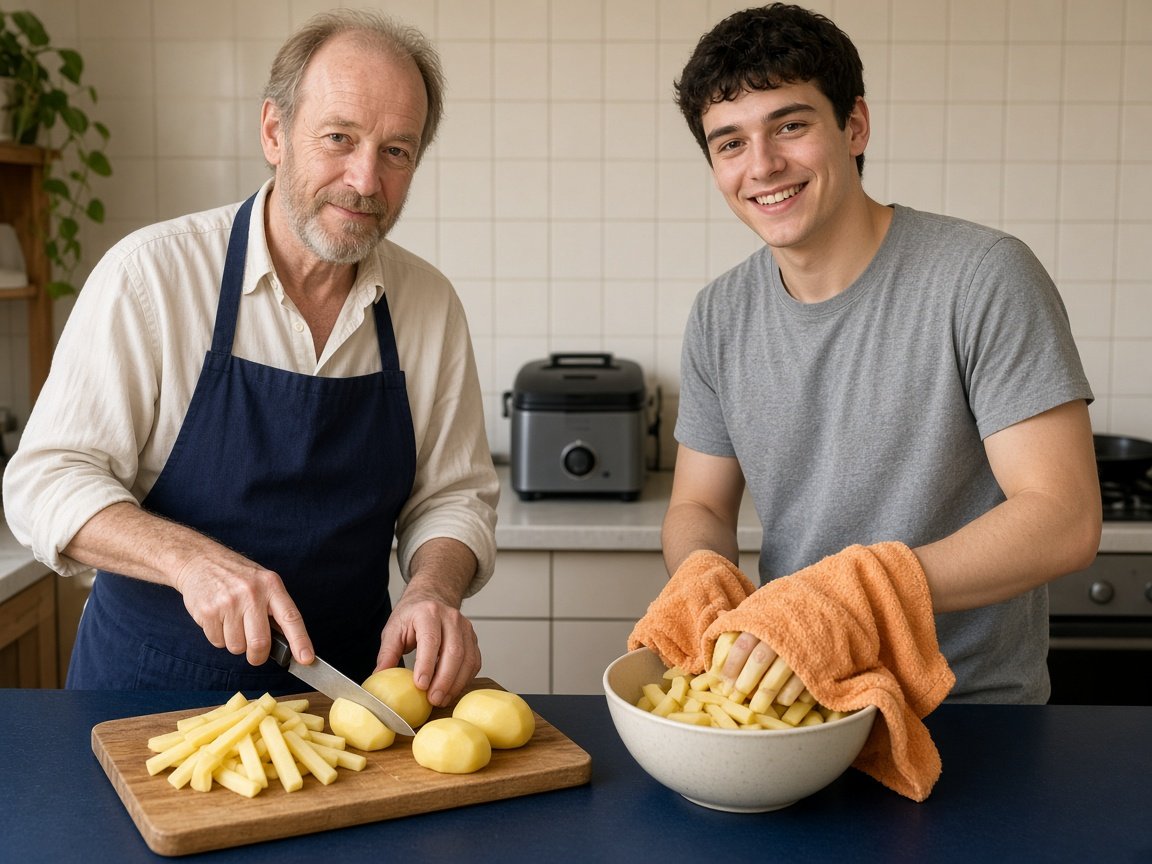
Making fries at home: how to do it better
If you still make fries, the Belgian Federal Agency for the Safety of the Food Chain (FASFC) gives tips against acrylamide. This substance forms when starchy food is cooked at high heat and turns brown. The European Food Safety Authority (EFSA) concludes in 2015 that acrylamide in food potentially increases the risk of cancer, although the evidence from human studies is limited and inconclusive. According to EFSA, fried potato products are one of the most important sources. The FASFC tips:
- Keep the oil no hotter than 180 °C; 175 °C is recommended.
- Replace the oil after at most 10 uses, or sooner if it turns dark, syrupy or rancid.
- Choose potatoes sold for fries, which contain fewer sugars, and do not store them colder than 6 °C.
- Cut thicker fries, soak them for a few minutes in warm water or blanch them, and pat them dry.
- Do not fry too many at once and fry them until they are light golden: the browner, the more acrylamide.
These tips are about acrylamide, not diabetes. For that risk, what counts most is how often you eat fries, so on the other days boiled potatoes simply stay on the menu.
Sources
- Mousavi SM, Gu X, Imamura F, e.a. Total and specific potato intake and risk of type 2 diabetes: results from three US cohort studies and a substitution meta-analysis of prospective cohorts. BMJ, 2025 (prospective cohort study and meta-analysis).
- Vlaams Instituut Gezond Leven. Brood, volkoren graanproducten en aardappelen (bread, wholegrain products and potatoes, in Dutch). Accessed in October 2026.
- Vlaams Instituut Gezond Leven. Aanbevelingen van de Hoge Gezondheidsraad met focus op voedingsmiddelen (recommendations of the Superior Health Council, in Dutch). Superior Health Council, June 2025.
- Federal Agency for the Safety of the Food Chain. Tips voor de bereiding van frieten (tips for preparing fries, in Dutch). Accessed in October 2026.
- European Food Safety Authority. Acrylamide in food is a public health concern. Press release, 4 June 2015.