

Rest day or deload: when to take a step back
General information, not medical advice. If you have health concerns, discuss them with your GP or a physiotherapist.
In short
- Hard training every day is not proof of discipline. Rest and a lighter week belong in a sound plan.
- A rest day is a day without hard training. Active rest is light movement without a new peak load.
- A deload, a planned lighter training week, typically lasts five to seven days and mainly lowers volume.
Many recreational athletes think training every day means you are serious. Discipline also means knowing when to step back. This article explains when a rest day deload choice makes sense: full rest, active rest or a lighter week. The World Health Organization (WHO) counts 150 to 300 minutes of moderate-intensity or 75 to 150 minutes of vigorous activity per week, plus muscle-strengthening work on at least two days. More is not better if you fall behind on how you recuperate after training.
What a rest day is
A rest day is a planned day without hard training: no long series, no hard interval work, no records. A walk to the bakery or a bike ride to work is ordinary movement, not hard training, and still counts toward your daily activity.
On a rest day, sleep normally, eat as usual and plan the week. Do not do hard interval work out of guilt. One rest day may not be enough if you have felt tired for weeks; a lighter programme then helps more.
When is active rest a good idea?
Active rest is light movement without a new peak load: easy cycling, walking or moving gently. A meta-analysis of 99 studies (Dupuy et al., 2018) found that light activity after training reduces muscle soreness a little, especially soon after the effort, with no effect on feelings of fatigue. Massage scored higher against soreness and fatigue.
Active rest suits the day after a hard but well-tolerated session, when you feel stiff but not wiped out. If you feel clearly heavier or sleep poorly, choose passive rest instead. If the walk turns into a hill race, it is no longer rest.
Rest day deload: when a lighter week helps
A deload, a planned lighter training week, is a short phase with less training stress so you can build up again afterwards. Practical recommendations for strength and physique sports (Bell et al., 2025) often place a planned deload every four to eight weeks, typically lasting five to seven days. Volume goes down; intensity may stay high or drop slightly. It is not a full stop and not a competition taper.
For a moderate need to rest, about 40 to 60 percent less volume is a common rule of thumb from that same practice paper, not a law. Expert coaches (Bell et al., 2023, Delphi consensus) mainly see deload through fewer series, repetitions or training days. There is little strict research in recreational athletes; these are practice recommendations.
Plan a deload after a few weeks of rising load, or if progress and rest both slip. Do not call every weak week a deload if you trained inconsistently.
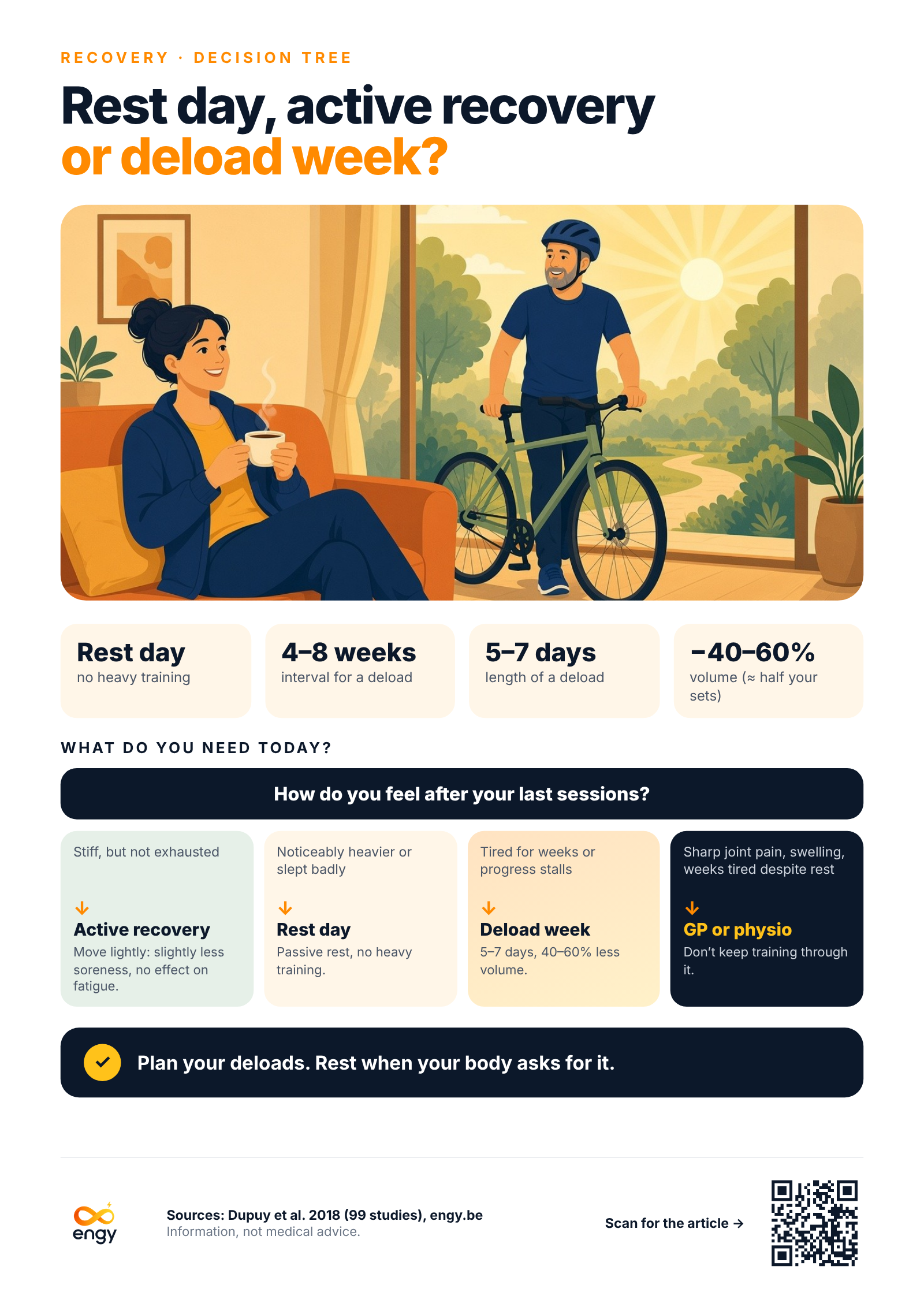
Download the decision tree
Rest day, active recovery or deload week: choose at a glance, also as an A4.
Signs you are not resting enough
Watch for red flags to revise your training load:
- performance that stalls or drops for weeks;
- sleep that stays fragmented;
- irritability or a loss of training drive without a clear reason;
- muscle soreness after training (DOMS) that lasts longer than usual, or sharp joint pain.
Temporary overload (overreaching) is often reversible with enough rest according to European and American sport science associations (Meeusen et al., 2013). An overtraining syndrome is complex and should not be diagnosed via a blog.
Sample week: working and training in the evening
Many people combine work with a late session and a short night. This is an example, not a prescription:
| Day | Focus |
|---|---|
| Monday | Strength training A (evening) |
| Tuesday | Easy endurance (zone 2, a calm pace where you can still talk easily), a walk or rest |
| Wednesday | Strength training B |
| Thursday | Active rest or rest |
| Friday | Endurance or shorter strength training C |
| Saturday | Optional easy movement or a family walk |
| Sunday | True rest day |
In a busy week, cut Friday’s hard training before you cut a night of sleep. In a deload week, keep the same days, roughly halve the number of series and go to bed earlier.
When to see a doctor?
See your GP or a physiotherapist for sharp pain in a joint, swelling, ongoing muscle soreness outside the usual window after hard training, or if you feel tired, irritable or weaker for weeks despite rest.
Sources
- Bell L, Strafford BW, Coleman M, Androulakis Korakakis P, Nolan D (2023). Integrating Deloading into Strength and Physique Sports Training Programmes: An International Delphi Consensus Approach. Sports Medicine – Open, 9(1), 87.
- Bell L, Darragh IAJ, Travis SK, Rogerson D, Nolan D (2025). A Practical Approach to Deloading: Recommendations and Considerations for Strength and Physique Sports. Strength and Conditioning Journal.
- Dupuy O, Douzi W, Theurot D, Bosquet L, Dugué B (2018). An Evidence-Based Approach for Choosing Post-exercise Recovery Techniques to Reduce Markers of Muscle Damage, Soreness, Fatigue, and Inflammation: A Systematic Review With Meta-Analysis. Frontiers in Physiology, 9, 403.
- World Health Organization (2020). Physical activity (fact sheet; see also Guidelines on physical activity and sedentary behaviour, 2020).
- Meeusen R et al. (2013). Prevention, diagnosis, and treatment of the overtraining syndrome: joint consensus statement of the European College of Sport Science and the American College of Sports Medicine. Medicine & Science in Sports & Exercise, 45(1), 186–205.






5 Comments