
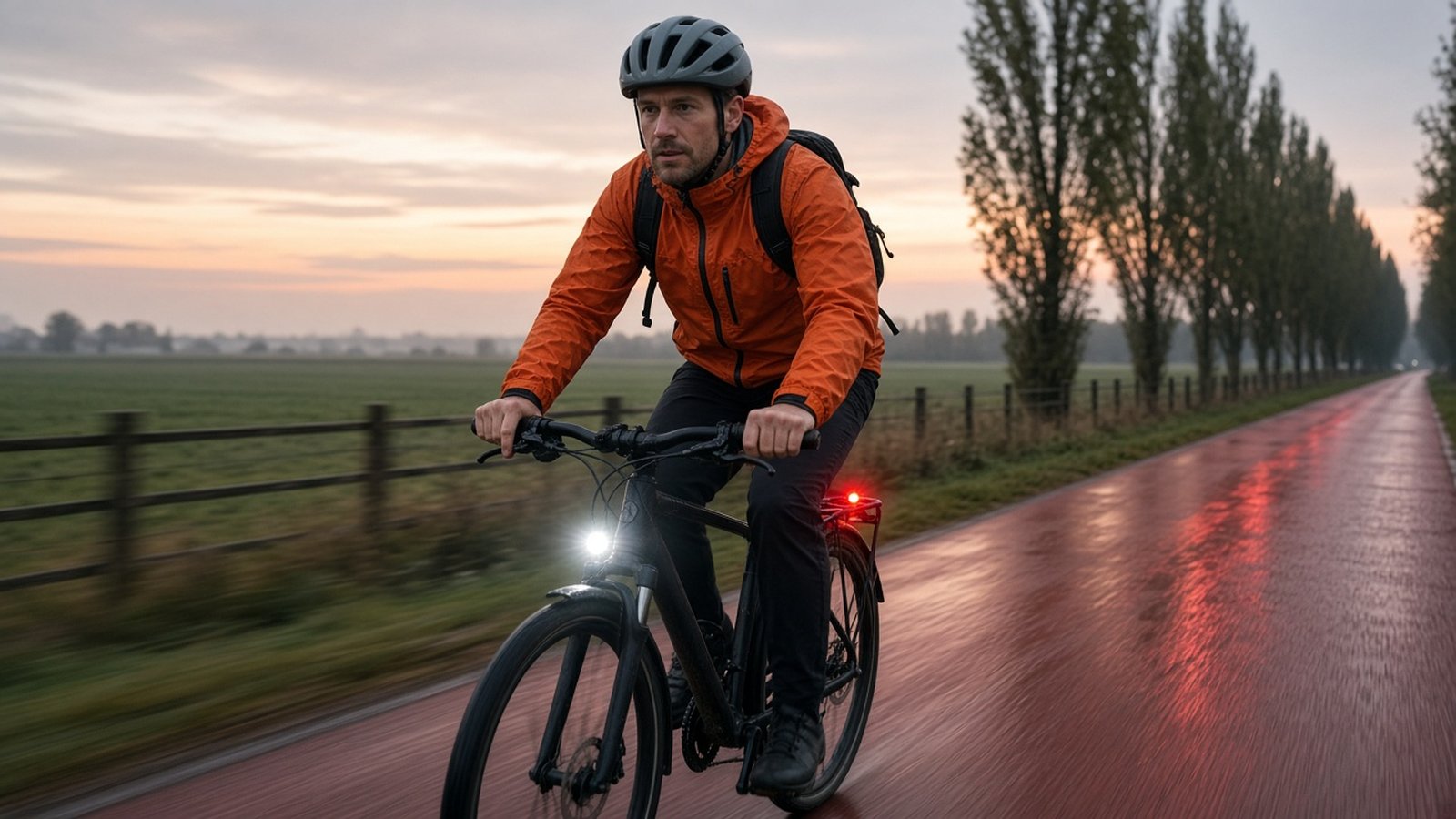
Cycling to work: your daily training without extra time
TLDR
- In a large British study, people who cycled to work had a clearly lower risk of cardiovascular disease, cancer and early death than those who went by car or public transport.
- It’s an association, but a strikingly consistent one: Danish research found something similar.
- Three days a week, twenty minutes each way, already adds up to two hours of moderate activity, almost half of what the WHO recommends.
- An e-bike counts too. Treat the ride as training: easy on most days, a bit harder now and then.
The racing season is winding down and the spring classics are long gone. Yet in the mornings I see more riders than ever. Not in the Ardennes, but on the bike path to work: rain jacket on, backpack strapped, lights blinking. I recently became one of them, and I wondered how much those daily kilometres really give you.
What the British study found
In 2017, the BMJ published a study by Carlos Celis-Morales and colleagues at the University of Glasgow. They followed more than 260,000 working adults from the UK Biobank for about five years. Those who commuted by bike were about 41 percent less likely to die during that period, and had clearly less cardiovascular disease and cancer than those who didn’t commute actively.
Even people who cycled part of the way and did the rest by train or car did better. Walking helped mainly the heart and blood vessels.
The caveat: this is observational. Cyclists may also be healthier in other ways. But an older Danish study in Copenhagen saw something similar, even after adjusting for leisure-time exercise. That makes the story more credible.
Why it works so well
The big advantage of cycling to work: you don’t have to find extra time for it. The movement is built into a trip you make anyway. Three times a week, twenty minutes there and twenty back, is two hours. The WHO recommends 150 to 300 minutes of moderate activity a week for adults. That gets you a long way.
Most of those rides are also at an easy pace, exactly the kind of effort I described in my piece on zone 2 training. And it fits perfectly with the idea of more everyday movement alongside your sport.
What about e-bikes?
They count too. In the European PASTA project, e-bike users got about as much weekly physical activity as regular cyclists, mainly because they covered longer distances. Your heart rate doesn’t climb as high, but you ride more often and further. If you still want some training in it, turn the assistance down a notch.
Turn it into training
- Most rides easy. You should still be able to talk. You arrive at work fresh.
- One harder ride a week. For example, a few two-minute efforts of solid pedalling on a quiet stretch.
- Don’t forget strength. Cycling trains your legs, but not much else. Two short strength sessions a week fill the gap, as I explained in strength alongside endurance.
Getting safely through autumn
Now that the mornings are getting darker, visibility is everything. In Belgium a white front light, a red rear light and reflectors are mandatory. A high-vis vest and a helmet aren’t, but I wear them anyway. Where you can, pick a quieter route away from heavy traffic: it’s more pleasant and you breathe in less exhaust. It’s also worth asking whether your employer pays a cycling allowance.
Engy’s practical tip
Start with one or two days a week and build up gradually. Lay out your rain gear the night before, and the threshold in the morning is much lower. If you have heart problems or have been inactive for a long time, check with your doctor first.
Sources (selection)
- Celis-Morales CA et al. (2017). Association between active commuting and incident cardiovascular disease, cancer, and mortality: prospective cohort study. BMJ, 357, j1456.
- Andersen LB et al. (2000). All-cause mortality associated with physical activity during leisure time, work, sports, and cycling to work. Archives of Internal Medicine, 160(11), 1621–1628.
- Castro A et al. (2019). Physical activity of electric bicycle users compared to conventional bicycle users and non-cyclists. Transportation Research Interdisciplinary Perspectives, 1, 100017.
- World Health Organization (2020). WHO guidelines on physical activity and sedentary behaviour.




2 Comments