
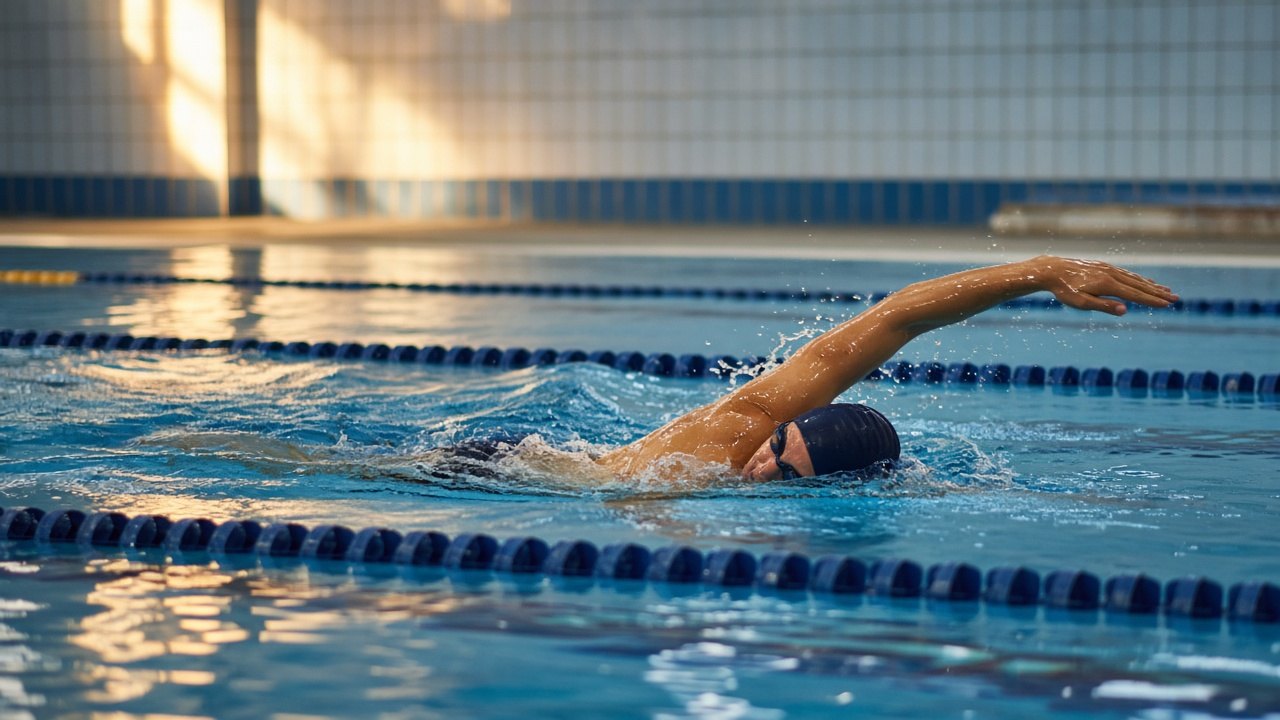
Swimming vs running (or cycling): which is the better cardio for you?
Swimming vs running: which is the better cardio? If you do your lengths at the pool, you’ll often hear that swimming is “the healthiest sport there is”. Runners and cyclists, meanwhile, swear by their own sport. Sporza, the Flemish public sports broadcaster, recently looked into it in its IN FORM series, and I dug into it myself too. The short answer: there’s no winner, but there is a best choice for you.
Informational, not medical advice.
TLDR
- Swimming, running and cycling all train your heart and lungs. Which one is “better” depends on your goal, your technique and what you’ll stick with.
- Your heart rate in the water is usually lower than on dry land, often by around ten beats at maximal effort. A lower heart rate doesn’t automatically mean an easier workout.
- Swimming is the gentlest on your joints, but gives your bones little stimulus. Running does load them; cycling sits in between.
- Per minute, easy swimming doesn’t necessarily burn more than running. In the water, technique makes a huge difference.
- The smartest approach for most people: combine them, and add strength training.
What “good cardio” actually means
Cardio is any effort that keeps your heart, lungs and blood vessels working for a sustained period. Whether that happens in the water, on the road or on a cycle path matters less to your heart than you might think. What counts is how long and how hard you move, and above all how often. The WHO recommends 150 to 300 minutes of moderate-intensity activity a week for adults, or 75 to 150 minutes of vigorous activity. Which sport you use to get there is deliberately left open.
A British cohort study of more than 80,000 adults (Oja and colleagues, 2017) found 28 percent lower all-cause mortality and 41 percent lower cardiovascular mortality in swimmers compared with non-swimmers. In cyclists the association was smaller; in runners it was no longer significant after adjusting for other factors. That sounds like a clear winner, but this is observational research: people who swim regularly also differ in other ways from those who don’t. It doesn’t prove cause and effect. Mostly it shows that swimming holds its own.
Your heart rate in the water: lower, and that’s normal
If you swim with a sports watch, you’re sometimes surprised: your heart rate is lower than when running, even though it feels like you’re swimming your lungs out. In a US study of recreational swimmers, maximal heart rate in the water was about 11 beats per minute lower than on the treadmill. Other studies find somewhat smaller or larger differences. The explanation lies in the water itself. You’re horizontal, water pressure pushes blood back towards your heart, your heart pumps more blood per beat and the cool water helps too. On top of that, mainly your arms and core do the work, and that muscle mass is smaller than your legs.
In practice: don’t simply take your running zones into the pool. If you train by heart rate, count roughly ten beats lower in the water, or just train by feel. If you can still talk in short sentences, you’re in an easy endurance zone. More on that in zone 2 training explained.
Calories: it depends on your pace and technique
In the international tables of energy use per activity (the Compendium of Physical Activities, a widely used US reference), moderate swimming, easy running and cycling at a decent pace are in the same ballpark. Fast swimming or hard running burns a lot more. Two caveats make the difference in practice:
- Technique: a skilled swimmer glides efficiently through the water. A beginner burns much more per metre, but also lasts much less long.
- Breaks: an hour at the pool is rarely an hour of swimming. Hanging on the wall between lengths is pleasant, but it doesn’t count as training.
If your main goal is to burn a lot of energy in little time, running and brisk cycling are simpler for most people. Swimming can do it too, but only once your technique allows a continuous pace.
Your joints and your bones
Here swimming clearly wins on one count: the water carries your weight. No jolts, no landings. That makes it ideal for people with excess weight, osteoarthritis, back problems or during rehab after an injury. Cycling is joint-friendly too; running is the least so: every stride is a small landing.
But that landing has an upside. Bones get stronger under load. A systematic review (Gómez-Bruton and colleagues, 2013) found that swimmers mostly have bone density similar to people who don’t exercise, and lower than athletes who run or jump. So swimming doesn’t harm your bones, but it doesn’t build them much either. If you only swim or cycle, it’s worth adding some strength or impact training. See also strength alongside running; the same logic applies to swimmers and cyclists.
Which muscles do the work
Swimming is a genuine full-body workout: shoulders, back, arms, core and legs. Running and cycling are mainly leg sports, although your core works hard when running. What swimming doesn’t really do is make your legs stronger for stairs, hills and getting up from a chair. Training on dry land remains useful.
Who suits what?
- Swimming: for joint problems, excess weight, rehab after an injury, or if you simply love being in the water. Condition: reasonable technique, or a willingness to learn it.
- Running: if you’re short on time and don’t want equipment. Good for bones, but build up gradually to avoid injuries.
- Cycling: if you’re after long, easy endurance or want to build movement into your day. Do read my piece on cycling to work.
How many lengths make a good workout?
In a 25-metre pool, one length is 25 metres. So four lengths make 100 metres and forty lengths make a kilometre. A recreational swimmer easily takes two and a half to four minutes per 100 metres of front crawl or breaststroke, including rest at the wall. A kilometre then takes you roughly half an hour to three quarters of an hour.
- Starter: 15 to 20 minutes, for example 4 to 6 blocks of 4 lengths (100 metres) with 30 to 60 seconds’ rest. That’s 400 to 600 metres in total.
- Intermediate: 30 to 40 minutes, 1,000 to 1,500 metres in blocks of 200 to 400 metres with 20 to 30 seconds’ rest.
Three half-hour sessions of easy swimming add up to 90 minutes of moderate activity, more than half of the 150 minutes in the WHO guidelines. If you swim at a vigorous pace, each minute counts roughly double: 75 minutes a week is then enough.
Talking underwater doesn’t work, so do the talk test at the wall. If you can say a short sentence straight after a block, you’re at a moderate intensity. If only single words come out, it’s vigorous. Start each block slower than you think, keep your rest breaks short and fixed (time them on the pool clock), and lengthen the blocks before you start swimming faster.
How I combine them
So swimming vs running doesn’t have to be a choice. The best sport is the one you keep doing. But combining has real advantages: you spread the load, you get bored less and you train your body more broadly. An example week:
- One or two easy endurance sessions of 30 to 45 minutes (cycling or running).
- One swim session of 30 to 40 minutes, without long breaks at the wall.
- Two short strength sessions for legs, back and bones.
- As many daily steps as possible, such as cycling or walking to work.
Unsure about your swimming technique? Take a few lessons. An adult course or swimming club helps more than a hundred lengths on your own. And if it’s raining, zone 2 works just as well on the indoor trainer.
This article is informational and not medical advice. If you have heart or lung problems, or are recovering from an injury, check with your GP, a sports physician or a physiotherapist first.
Sources (selection)
- Sporza (2026). Zwemmen is supergezond, maar is het betere cardio dan lopen of fietsen? Ilias zoekt het antwoord voor IN FORM (in Dutch).
- Oja P, Kelly P, Pedisic Z et al. (2017). Associations of specific types of sports and exercise with all-cause and cardiovascular-disease mortality: a cohort study of 80 306 British adults. British Journal of Sports Medicine, 51(10), 812–817.
- DiCarlo LJ, Sparling PB, Millard-Stafford ML, Rupp JC (1991). Peak heart rates during maximal running and swimming: implications for exercise prescription. International Journal of Sports Medicine, 12(3), 309–312.
- Gómez-Bruton A et al. (2013). Is bone tissue really affected by swimming? A systematic review. PLoS ONE, 8(8), e70119.
- Herrmann SD et al. (2024). 2024 Adult Compendium of Physical Activities. Journal of Sport and Health Science, 13(1), 6–12.
- World Health Organization (2020). WHO guidelines on physical activity and sedentary behaviour.
- GezondNU (2026). Hoeveel banen moet je zwemmen voor een goede workout? (in Dutch).





One Comment