

Stopping caffeine before sleep: how late can you drink coffee?
General information, not medical advice. If you have symptoms, discuss them with your GP or a sleep clinic.
Stopping caffeine before sleep sounds simple, but the timing differs by source and by person. The Flemish Institute Gezond Leven links coffee and tea to sleep hygiene: a maximum of 4 cups a day, and preferably no more coffee or tea after 3 p.m. That is a concrete cutoff for anyone who wants to rest in the evening without late caffeine.
Stopping caffeine: what does Gezond Leven say about coffee and tea?
On the page about improving your sleep, caffeine sits next to other habits such as screens, alcohol and a regular wake time. Gezond Leven limits coffee and tea to a maximum of 4 cups a day because of caffeine, and moves the last cup to before 3 p.m. Tea counts: black and green tea also contain caffeine. Herbal tea without caffeine falls outside that limit, but check the label if you are unsure.

That 3 p.m. rule is a preventive habit, not a laboratory boundary. If you go to bed early, 3 p.m. sits closer to bedtime than if you only sleep at midnight. Gezond Leven also explains that drinking too much just before bed can trigger night-time toilet visits, aside from caffeine.
What does research show six hours before bed?
Drake, Roehrs, Shambroom and Roth published in 2013 in the Journal of Clinical Sleep Medicine a small randomised study in 12 healthy sleepers. They received 400 milligrams of caffeine (a solid dose) at 0, 3 or 6 hours before their usual bedtime, or placebo. Objective measures showed at all three times a drop in total sleep time of more than one hour versus placebo. The authors conclude that you are better off avoiding substantial caffeine for at least six hours before bedtime.
The study is small and used a high dose. It still supports the message that caffeine in the late afternoon or early evening still counts, even if you think you notice nothing. In the same study, subjective disruption sometimes stood out less than the objective measure: you do not always feel the impact.
How do you set your own cutoff?
Combine both sources pragmatically. Keep the Gezond Leven line of a maximum of 4 cups and no coffee or tea after 3 p.m. as your default. If you are sensitive or sleep poorly, also count with the six-hour zone from Drake and colleagues: with bedtime at 10.30 p.m., that means no large caffeine dose after about 4.30 p.m. Energy drinks and cola count; decaf coffee or herbal tea are safer evening alternatives.

Many people push the last coffee to after dinner, because the habit feels social. Gezond Leven places the limit earlier, at 3 p.m., precisely to avoid that late stimulus. Combine that with an evening ritual without screens and without alcohol as a nightcap: those three habits reinforce each other more often than one perfect trick.
If you work shifts or mainly drink tea, still count the caffeine. A large premium coffee can sit closer to the 400 milligrams in the Drake study than a small home cup. If you doubt your dose, check the label on capsules or energy drinks and hold the daily total next to Gezond Leven’s maximum-4-cups line.
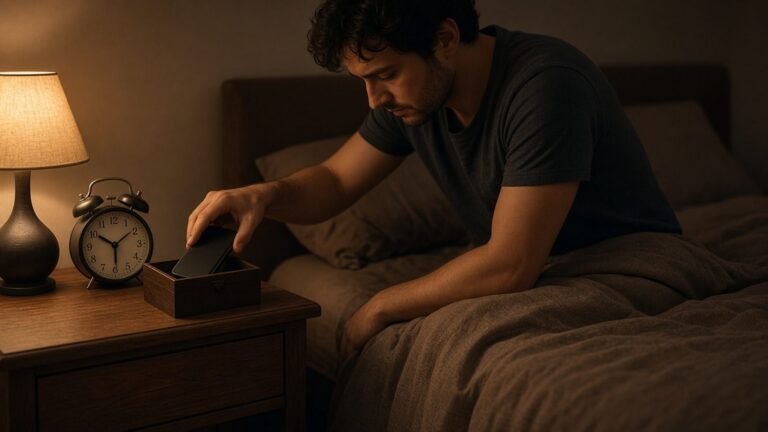
Caffeine is only one piece of night rest. Alcohol disrupts sleep quality in another way, as in alcohol and sleep. A phone in the bedroom keeps stimuli going; many people put it outside the bedroom. If you still lie awake, it sometimes helps to get up after about twenty minutes. A short afternoon nap of about 20 minutes can help by day, but does not replace a night without late caffeine.
If after two weeks of an early cutoff nights are still hard, note bedtime, caffeine times and alcohol. Those notes help your GP see faster whether caffeine plays the lead or only a supporting role. Cutting caffeine can be done gradually if needed to limit headaches; stopping abruptly is unpleasant for some, but that is separate from the sleep study above.
If falling or staying asleep remains difficult despite an early cutoff, talk to your GP. They can check whether something other than coffee is involved.
Sources
- Vlaams Instituut Gezond Leven. Je slaap verbeteren. gezondleven.be, accessed 16 October 2026.
- Drake C, Roehrs T, Shambroom J, Roth T. Caffeine effects on sleep taken 0, 3, or 6 hours before going to bed. Journal of Clinical Sleep Medicine. 2013;9(11):1195-1200.
- Drake C, Roehrs T, Shambroom J, Roth T. Caffeine Effects on Sleep Taken 0, 3, or 6 Hours before Going to Bed. PMC version of the same article, 2013.



2 Comments