Evening exercise and sleep: how late is too late?
TLDR
- Moderate exercise in the evening usually does not harm your sleep according to research, and may even improve it slightly.
- Very intense training that ends less than an hour before bedtime can delay falling asleep a little.
- Give your body time to cool down, dim the lights and skip caffeinated pre-workout late in the day.
- Training in the evening beats not training at all.
For many people, the evening is the only time to exercise. Work, kids, traffic jams: by the time you have a moment, it is already eight o’clock. And then you hear everywhere that you should not train in the evening because you will sleep badly. I often train in the evening myself, so I wanted to know whether that advice holds up.
What does the research say?
A meta-analysis by Stutz, Eiholzer and Spengler (2019) pooled 23 studies in healthy adults. The conclusion surprised me: on average, evening exercise did not disrupt sleep. There was even a small increase in deep sleep. Only with very intense exercise ending less than an hour before bedtime did the researchers see that people took slightly longer to fall asleep.
A later meta-analysis by Frimpong and colleagues (2021), focused specifically on intense evening exercise, painted a similar picture: high intensity in the evening did not lead to worse sleep, as long as there was some time between training and bedtime. The more time, the smaller the effect.
Why intense training right before bed can be tricky
After a hard session your body is still “switched on”: your heart rate is higher, your core temperature has risen and your nervous system is in action mode. To fall asleep well, your core temperature actually needs to drop a little. That is also why a cool bedroom helps so much.
A calm session, such as a walk, some yoga or light strength work, hardly causes that problem. A brutal interval session at half past ten followed by lights out at eleven is, however, asking for a while of tossing and turning.
How I plan my evening sessions
Timing
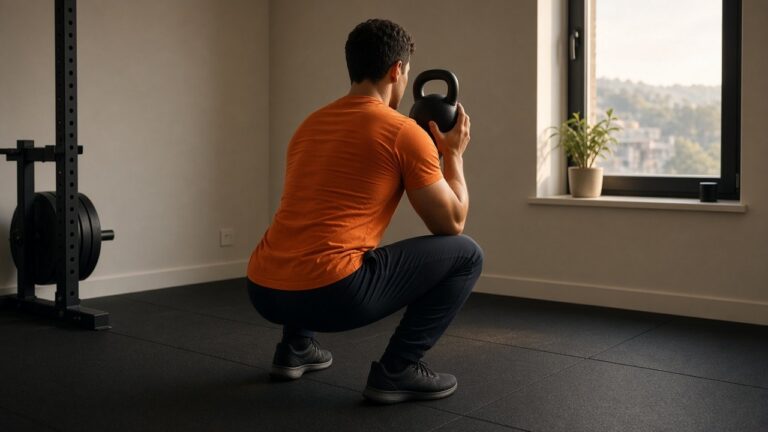
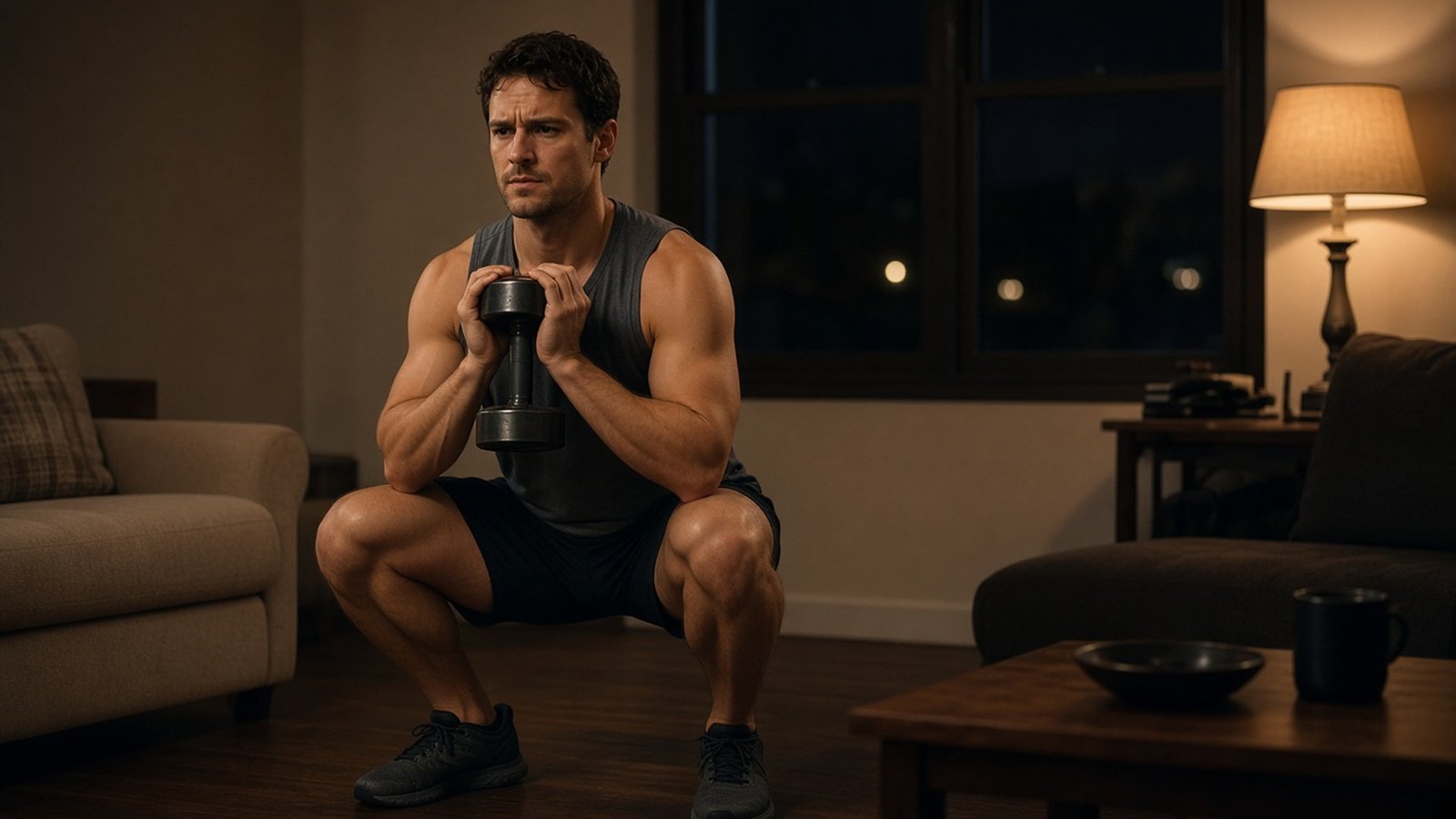
I try to finish hard workouts at least one and a half to two hours before I go to sleep. Light strength work or mobility in the living room can happen later. A few goblet squats or some stretching after dinner feel more relaxing than energising.
Cooling down
After training I take five to ten minutes to move gently and wind down. A lukewarm shower helps too. A warm bath an hour before bed sounds contradictory, but works on the same principle: your body cools down faster afterwards.
Dimming the lights
Bright light in the evening suppresses melatonin, the hormone that gets you ready for sleep. Gooley and colleagues (2011) showed that ordinary room light before bedtime can already suppress melatonin considerably. After training I turn the lights down and put my phone away. I wrote earlier about screen time and sleep.
No pre-workout late in the day
This may be the most important one. Many pre-workout drinks contain 150 to 300 mg of caffeine, sometimes more. Drake and colleagues (2013) found that caffeine taken even six hours before bedtime still measurably disrupted sleep. A pre-workout at seven in the evening therefore keeps working until well after midnight. You can read more in my piece on caffeine and pre-workout.
Practical Engy tip
Keep a simple log for two weeks: what time you trained, how hard it was and how you slept. You will quickly discover your own limit. Some people sleep fine after a late session, others lie awake. Listen to your own data.
Recommendations
- Evening training is fine, and better than not training.
- Finish hard sessions at least an hour and a half before bedtime.
- Cool down, dim the lights, put the phone away.
- No caffeine or pre-workout in the afternoon and evening.
Sources (selection)
- Stutz J, Eiholzer R, Spengler CM (2019). Effects of evening exercise on sleep in healthy participants: a systematic review and meta-analysis. Sports Medicine, 49(2), 269–287.
- Frimpong E et al. (2021). The effects of evening high-intensity exercise on sleep in healthy adults: a systematic review and meta-analysis. Sleep Medicine Reviews, 60, 101535.
- Drake C et al. (2013). Caffeine effects on sleep taken 0, 3, or 6 hours before going to bed. Journal of Clinical Sleep Medicine, 9(11), 1195–1200.
- Gooley JJ et al. (2011). Exposure to room light before bedtime suppresses melatonin onset and shortens melatonin duration in humans. Journal of Clinical Endocrinology & Metabolism, 96(3), E463–E472.