

Restarting training after a break: build smart without trusting session one
Disclaimer: This article is informational and not medical advice, injury treatment or an individual programme. With pain, swelling or symptoms that worsen: talk to a doctor or physiotherapist.
TLDR
- After a break, fitness often drops faster than your feeling suggests — do not blindly trust “it felt ok” in session 1.
- Rebuild volume and intensity; the familiar “max +10% per week” is at best a rough guideline, not a law.
- Yes: 1 quality session, lower load, strength in, protect sleep. No: chasing old PRs right away.
- Red flags: sharp/local pain, swelling, compensatory movement, symptoms that worsen every session.
- Crosslink: combine with rest day/deload and cardio+strength in the week.
Six weeks of little sport, more terrace time, then opening the old split as if nothing happened: familiar. Feeds cheer “day one back.” Sports doctor Tom Teulingkx (known from the podcast Biefstuk in de broek) recently warned in Belgian media against exactly that first-session feeling. As a practitioner I recognise the pattern: motivation is high, tendons and blood volume are not there yet.
Not everyone benefits from “just picking up where you left off.” Context matters: how long the break, which sport, age, prior injuries.
What shifts physiologically (short)
In well-trained endurance athletes, VO₂max can already drop within two to four weeks; blood volume can fall too. Result: the same run feels heavier because it is heavier — higher heart rate at the same pace. Strength loss is slower, but tendons and attachments are not “ready” for sudden old kilos. That is not a panic story; it is load management.
Belgian recreational athletes with evening gym: you often have few days. Then prefer one quality block over three half-hearted “catch-up” sessions.
A build-up that works
Weeks 1–2: volume down, quality up
Halve or cut hard into sets/kilometres versus your pre-break peak. Keep RPE lower than your ego wants. Endurance: easy tempo. Strength: technique + submaximal load, big muscle groups — legs, hips, trunk, calves — twice a week is a solid line when you restart.
The “10% rule”
Adding at most 10% per week sounds scientific. In practice it is at best a rule of thumb not to go too fast; there is no strong universal evidence that exactly 10% is the magic limit. Use it as a brake, not a contract. Progression may be faster or slower — depending on sleep, pain-free movement and how you feel the next morning.
When yes / when not
- Yes restart with ambition: break was short, no injury history, sleep ok, you build 2–4 weeks.
- Not “all-in” in week 1: after illness, surgery, or if you already had tendon issues; or when sleep and stress are already peaking.
Red flags (take them seriously)
Soreness (DOMS) is normal after restart. Sharp or very local pain, swelling, pain that makes you move differently, symptoms that worsen every session, or pain that does not ease after several days: those are signals to stop and have a professional look — not a “mental toughness” test.
Download the restart plan
The build-up after a break and the red flags on one page, also as an A4.
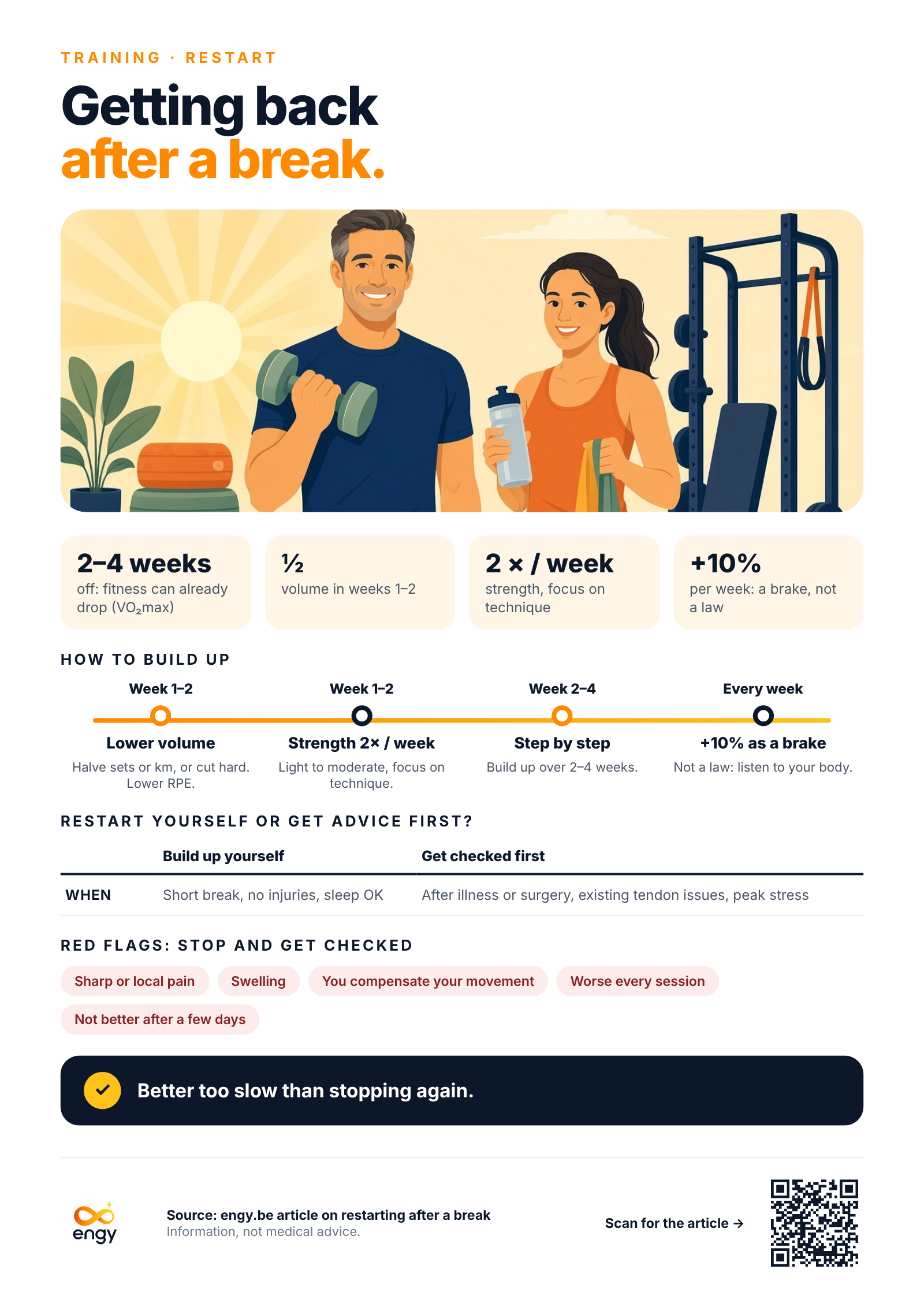
Restart in a realistic week
Link restart to what you already have on Engy: zone-2 (an easy endurance pace at which you can still talk comfortably) for easy volume, strength as a longevity tool, and enough recovery via sleep. A minimum viable week after a break is smaller than your Instagram feed suggests — see also minimum viable health week.
Recommendations in bullets
- Do not blindly trust “it felt good” in session 1.
- Weeks 1–2: lower load, 1 focus per evening, 2× light/moderate strength.
- Use +10%/week as a brake, not dogma.
- Red flags → doctor/physio, no heroics.
- Sleep and rest days belong in the restart plan.
Sources (selection)
- HLN / sports doctor Tom Teulingkx — warning on intensive restart after holiday (Sept 2026); framing inspiration, not a republication.
- WHO. Guidelines on physical activity and sedentary behaviour (2020) — rebuild within general activity frames.
- ACSM position stands on progressive overload and return-to-activity (general frame).
- Mujika, I. & Padilla, S. — detraining literature (VO₂max/blood volume with reduced training).






3 Comments