
Sleep and recuperation: checklist for training weeks
General information, not medical advice. If you have ongoing sleep problems or extreme daytime fatigue, talk to your GP.
In short
- Sleep and recuperation go together: duration and regular timing both matter in training weeks.
- Most adults aim for 7–9 hours per night, at least 7 hours on a regular basis; adults 65+ for 7–8 hours.
- Evening training is fine, but hard sessions close to bedtime can disrupt sleep. Cut caffeine in time and wind down calmly.
Sleep is not a side note next to your training. It is an important part of recuperation after zone 2 (an easy endurance pace at which you can still talk comfortably) and other sessions, especially in weeks with late workdays and training between 18:00 and 21:30.
Why sleep matters for recuperation
Training gives your body a stimulus; during recuperation it adapts. A meta-analysis in athletes (Gwyther et al., 2022) shows that sleep interventions mainly improve subjective sleep quality, sleepiness and mood. There was no clear effect on performance. Organising sleep better is therefore worthwhile, but not a magic button for better results.
Sleep duration targets
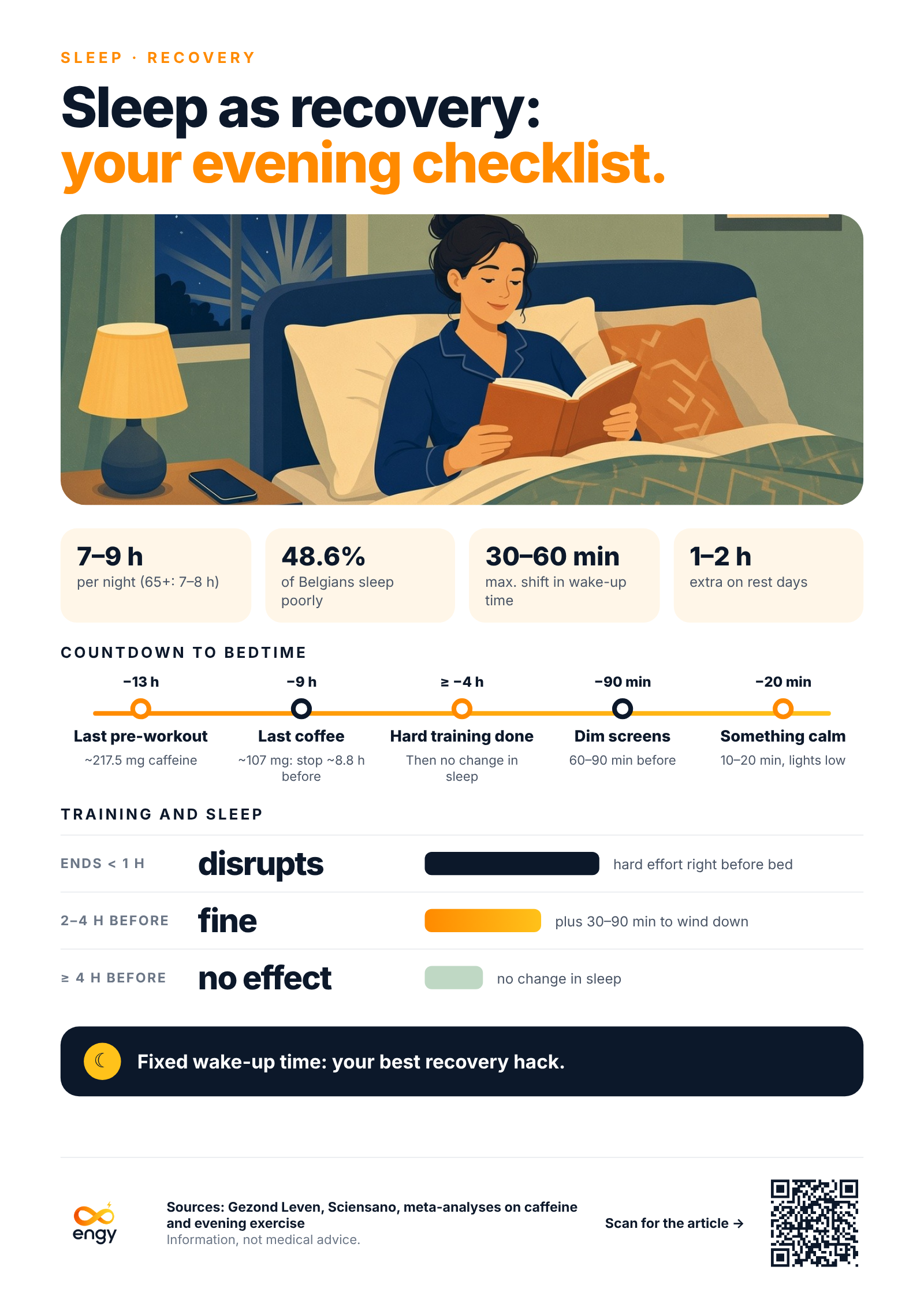
According to the National Sleep Foundation (Hirshkowitz et al., 2015), most adults need 7–9 hours per night; for adults 65 and over it is 7–8 hours. The American Academy of Sleep Medicine and the Sleep Research Society together recommend at least 7 hours on a regular basis (Watson et al., 2015).
In Belgium, Sciensano’s Health Interview Survey 2023–2024 found that about 48.6% of people aged 15 and over sleep poorly. Gezond Leven treats sleep as a theme alongside movement and sedentary behaviour.
Regular sleep and wake times support health and performance (Sletten et al., 2023). When you fall short on weekdays, the National Sleep Foundation notes that about 1–2 extra hours on rest days can help. As a general guideline, keep your wake time preferably within about 30–60 minutes of your usual time, even after a late session.
Evening checklist
These are common sleep-hygiene tips, not fixed rules. Dim screens 60–90 minutes beforehand; keep the room dark enough, cool and quiet; put the phone out of arm’s reach. Plan the time when you stop caffeine. Gardiner and colleagues (2023) found that caffeine shortened total sleep time by about 45 minutes on average. To avoid that drop, they report cut-offs of about 8.8 hours before bedtime for coffee (~107 mg) and about 13.2 hours for a high-caffeine pre-training supplement (~217.5 mg). Alcohol can disrupt sleep; be careful with it on heavy training evenings. Do not go to bed hungry, but avoid a heavy meal just beforehand. Give yourself 10–20 minutes of something calm, such as reading or a shower, instead of scrolling late into the night.
Download the evening checklist
The countdown to bedtime on one page, also as an A4 for your bedside table.
Late training after work
Evening exercise is not automatically bad. According to Stutz and colleagues (2019), vigorous exercise ending within one hour of bedtime can impair sleep onset latency, total sleep time and sleep efficiency. Frimpong and colleagues (2021) saw a small drop in REM sleep (the stage with rapid eye movements) after intense evening training, but overall no disruption when that training ended 2–4 hours before bed.
Research with sports watches and sleep trackers by Leota and colleagues (2025) shows a dose-response pattern: the later and heavier the session, the greater the chance of a later sleep onset. Sessions ending at least 4 hours before sleep onset were not associated with changes in sleep. As a general guideline, not as a figure from Leota, you can still allow 30–90 minutes to wind down calmly after a late session: cool down, shower, warm and dimmed light, no late caffeine, simple food, and emails not in bed.
When to see a doctor
If you have stubborn daytime fatigue, loud snoring or breathing pauses, weeks of trouble falling or staying asleep with an impact on work or mood, extreme sleepiness behind the wheel, or a sudden change after illness or medication, have that checked by your GP.
Sources
- Watson NF et al. (2015). Recommended Amount of Sleep for a Healthy Adult: A Joint Consensus Statement of the American Academy of Sleep Medicine and the Sleep Research Society. Sleep, 38(6), 843–844.
- Hirshkowitz M et al. (2015). National Sleep Foundation’s sleep time duration recommendations: methodology and results summary. Sleep Health, 1(1), 40–43. Public summary: NSF sleep duration recommendations.
- Sletten TL et al. (2023). The importance of sleep regularity: a consensus statement of the National Sleep Foundation sleep timing and variability panel. Sleep Health, 9(6), 801–820.
- Gwyther K et al. (2022). Sleep interventions for performance, mood and sleep outcomes in athletes: A systematic review and meta-analysis. Psychology of Sport and Exercise, 58, 102094.
- Gardiner C et al. (2023). The effect of caffeine on subsequent sleep: A systematic review and meta-analysis. Sleep Medicine Reviews, 69, 101764.
- Frimpong E et al. (2021). The effects of evening high-intensity exercise on sleep in healthy adults: A systematic review and meta-analysis. Sleep Medicine Reviews, 60, 101535.
- Stutz J, Eiholzer R, Spengler CM (2019). Effects of Evening Exercise on Sleep in Healthy Participants: A Systematic Review and Meta-Analysis. Sports Medicine, 49, 269–287.
- Leota J et al. (2025). Dose-response relationship between evening exercise and sleep. Nature Communications.
- Sciensano (2024). Resultaten van de Gezondheidsenquête 2023–2024; subjective well-being infographic: InfoGraphic_SubjWB_NL.
- Gezond Leven. Wat doet slaap voor je gezondheid?




7 Comments