Tendons after 50: why they adapt more slowly than your muscles and why 65 percent stiffer is good news
General information, not medical advice. If you have tendon pain, an injury or joint problems, talk to your GP or physiotherapist first.
When you start strength training at home, you often feel your muscles getting stronger quickly. Tendons after 50 do not automatically keep up. A tendon is the tough connective tissue that attaches muscle to bone, like the Achilles tendon above your heel. A tendon adapts too, but more slowly. This article follows on from the simple home strength training plan and explains how to bring your tendons along.
Why tendons after 50 adapt more slowly than muscles
In 2013, researchers at the Institute of Sports Medicine in Copenhagen measured how old the tissue in Achilles tendons of deceased people was. They used traces of carbon from the nuclear bomb tests of the 1950s and 1960s. The core of the tendon turned out to be formed during growth, up to about age 17, and barely renewed afterwards. Muscle tissue, by contrast, was renewed continuously.
A 2019 review by the same group describes that ageing probably slows down tendon cells, although human data are limited. In older rats, training counteracted some of these changes.
Even at 74, tendons still respond to training
In 2003, British researchers had nine people with an average age of 74 do leg strength training three times a week for 14 weeks. The tendon below their kneecap became 65 percent stiffer. That sounds negative, but for a tendon it means it stretches less and passes on force more efficiently. According to the researchers, this may help prevent tendon injuries. It was a small study, though.
A German meta-analysis from 2015 of 27 studies in healthy adults aged 18 to 50 found that the size of the load matters most. Programmes of at least 12 weeks gave larger effects on average, although that difference was not significant.
What tendons need that muscles do not
In a Japanese study from 2001, young men tensed their thigh muscles without moving for 12 weeks. This is called isometric training. One leg did short contractions of 1 second, the other long ones of 20 seconds. Strength and muscle volume increased equally in both legs, but only the long contractions made the tendon stiffer. So muscles can get stronger while tendons lag behind.
For tendons, slow and heavy therefore works better than fast and light, with a load you increase step by step. This principle is called progressive overload. A Danish trial from 2015 in 58 people with a painful Achilles tendon compared heavy, slow calf exercises, with 3 seconds up and 3 seconds down, three times a week, with eccentric training. That mainly trains the braking, lowering phase. Both worked equally well, after 12 weeks and after a year. The slow, heavy version was easier to stick with.
Three tendon-friendly exercises at home
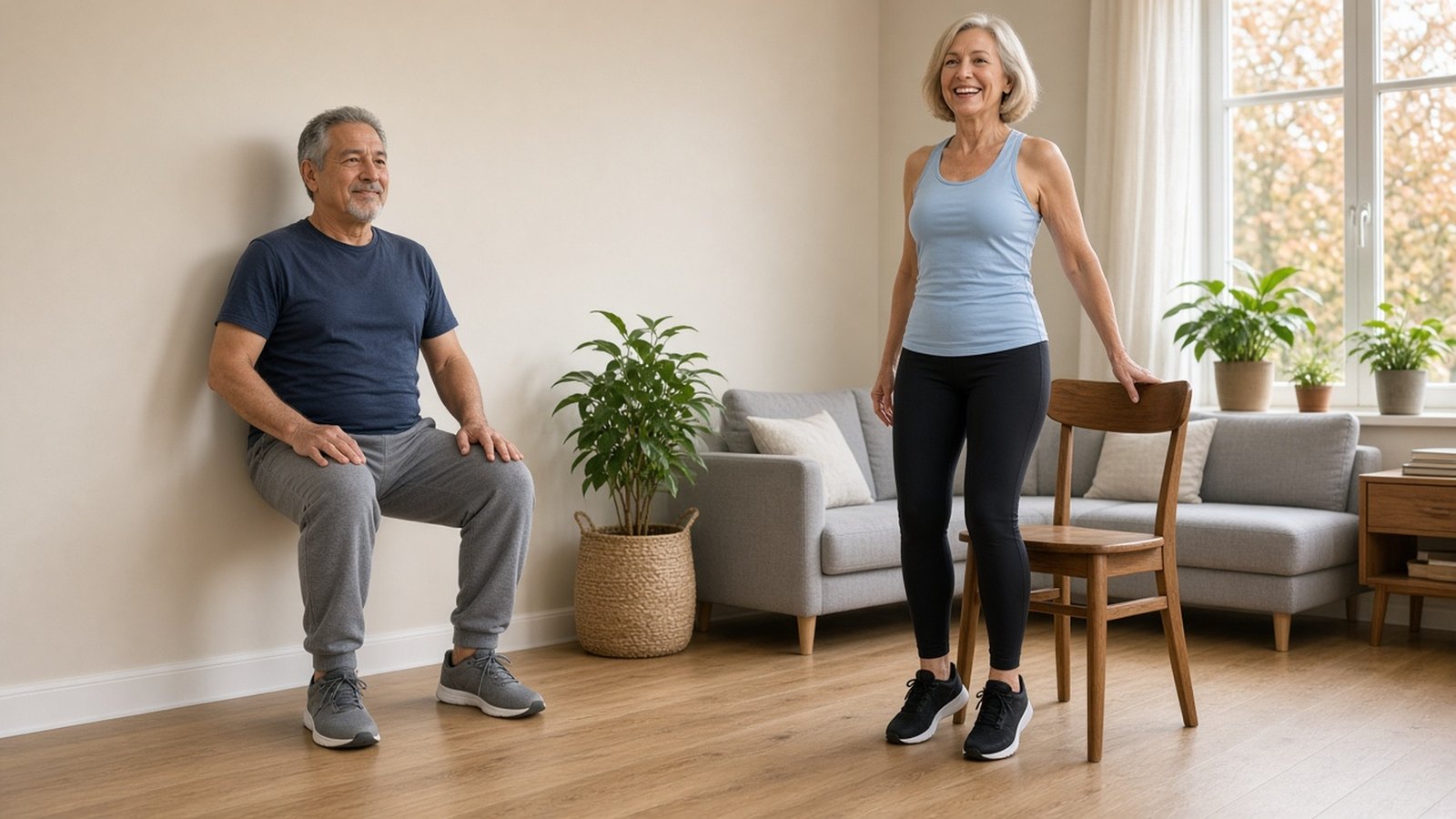
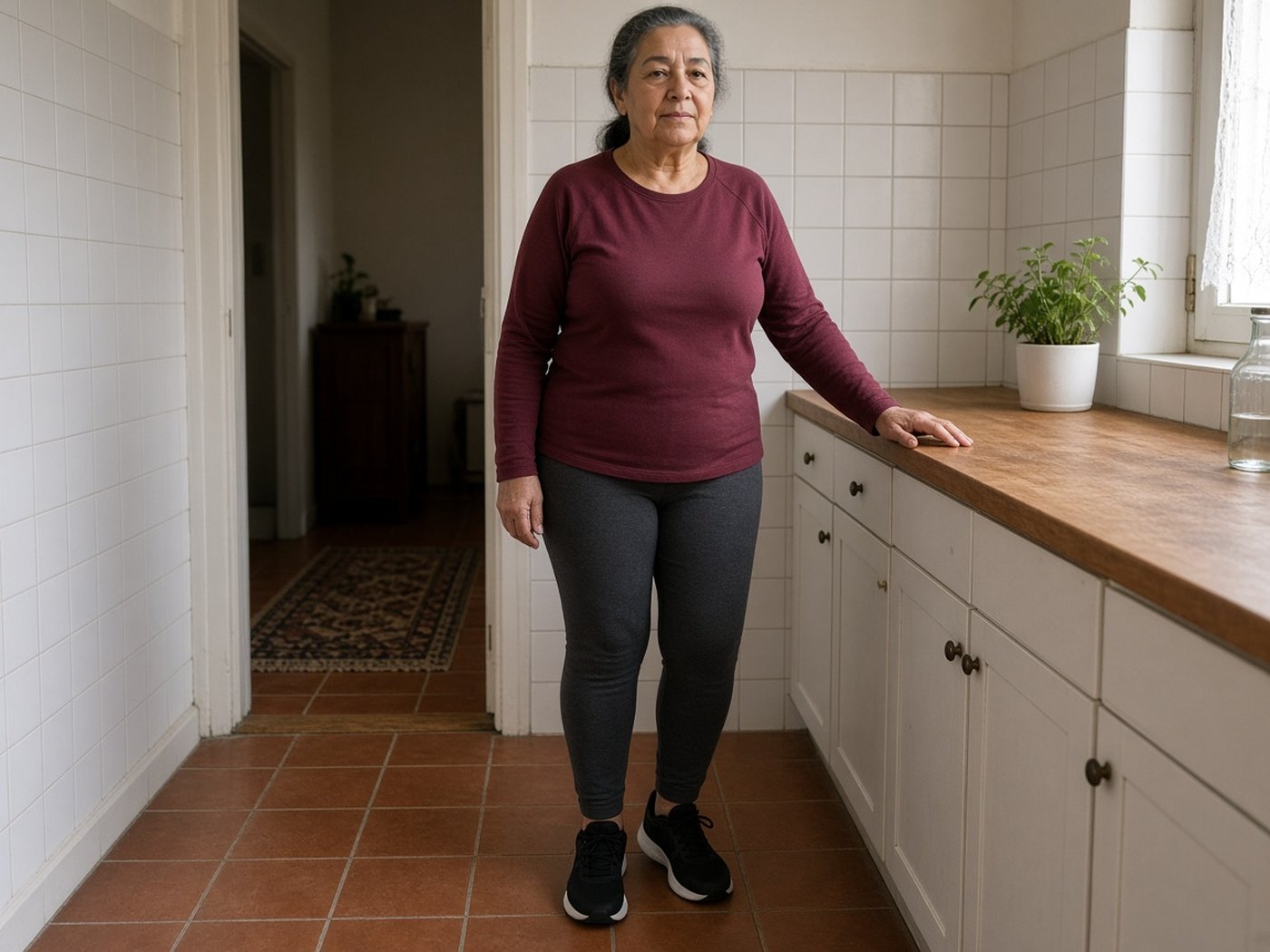
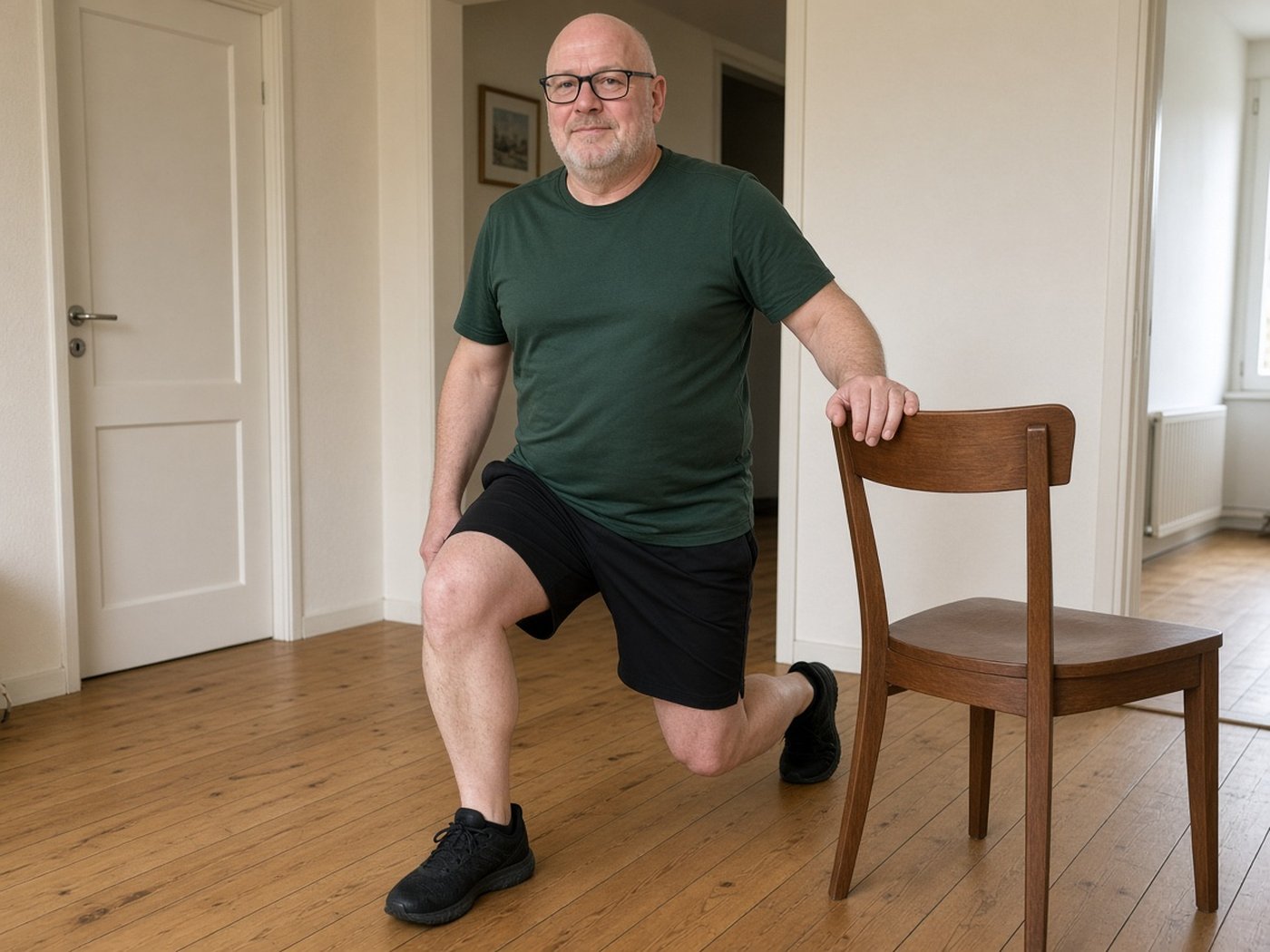
For calf raises, rise onto your toes in 3 seconds next to a wall or kitchen counter and lower in 3 seconds. If that is easy, do it on one leg. For the wall sit, lean your back against the wall, slide down to roughly chair height and hold for 20 to 45 seconds. What that does for your blood pressure is covered in the article on isometric training and blood pressure. For the slow lunge, take a big step forward, lower in 3 seconds and come back up in 3 seconds, with a chair for support.
In six volleyball players with a painful patellar tendon, a set of isometric contractions reduced pain for at least 45 minutes in an Australian study from 2015. That is a very small study.
A simple 12-week plan
This plan is loosely based on the progression in the Danish trial, from many light repetitions to fewer heavy ones, adapted for home.
- Weeks 1 to 4: twice a week, 3 sets of 12 to 15 slow repetitions, or 3 holds of 20 seconds.
- Weeks 5 to 8: three times a week, and make it heavier on one leg or with a backpack holding water bottles, 8 to 10 repetitions.
- Weeks 9 to 12: heavy enough that 6 to 8 slow repetitions are hard work, or holds of 30 to 45 seconds.
Leave at least one rest day between two sessions. On the days in between you can walk or cycle easily in zone 2, an easy pace at which you can still talk comfortably.
Pain rules: when to stop
In 2007, Swedish researchers used a pain-monitoring model in people with a painful Achilles tendon. Pain was allowed to reach 5 out of 10 during and after the exercises, but had to be gone by the next morning. Pain and stiffness were not allowed to increase from week to week. That model was meant for patients under supervision.
Stop and see your GP or physiotherapist if you have sharp pain, swelling, pain that is still there the next morning or symptoms that get worse week after week.
Sources
- Heinemeier KM, Schjerling P, Heinemeier J, Magnusson SP, Kjaer M. Lack of tissue renewal in human adult Achilles tendon is revealed by nuclear bomb 14C. FASEB Journal, 2013 (Institute of Sports Medicine, Copenhagen).
- Magnusson SP, Kjaer M. The impact of loading, unloading, ageing and injury on the human tendon. Journal of Physiology, 2019 (review).
- Reeves ND, Maganaris CN, Narici MV. Effect of strength training on human patella tendon mechanical properties of older individuals. Journal of Physiology, 2003.
- Bohm S, Mersmann F, Arampatzis A. Human tendon adaptation in response to mechanical loading: a systematic review and meta-analysis of exercise intervention studies on healthy adults. Sports Medicine Open, 2015 (meta-analysis, Humboldt University of Berlin).
- Kubo K, Kanehisa H, Fukunaga T. Effects of different duration isometric contractions on tendon elasticity in human quadriceps muscles. Journal of Physiology, 2001 (University of Tokyo).
- Beyer R, Kongsgaard M, Hougs Kjær B, et al. Heavy Slow Resistance Versus Eccentric Training as Treatment for Achilles Tendinopathy: A Randomized Controlled Trial. American Journal of Sports Medicine, 2015.
- Rio E, Kidgell D, Purdam C, et al. Isometric exercise induces analgesia and reduces inhibition in patellar tendinopathy. British Journal of Sports Medicine, 2015.
- Silbernagel KG, Thomeé R, Eriksson BI, Karlsson J. Continued sports activity, using a pain-monitoring model, during rehabilitation in patients with Achilles tendinopathy: a randomized controlled study. American Journal of Sports Medicine, 2007.