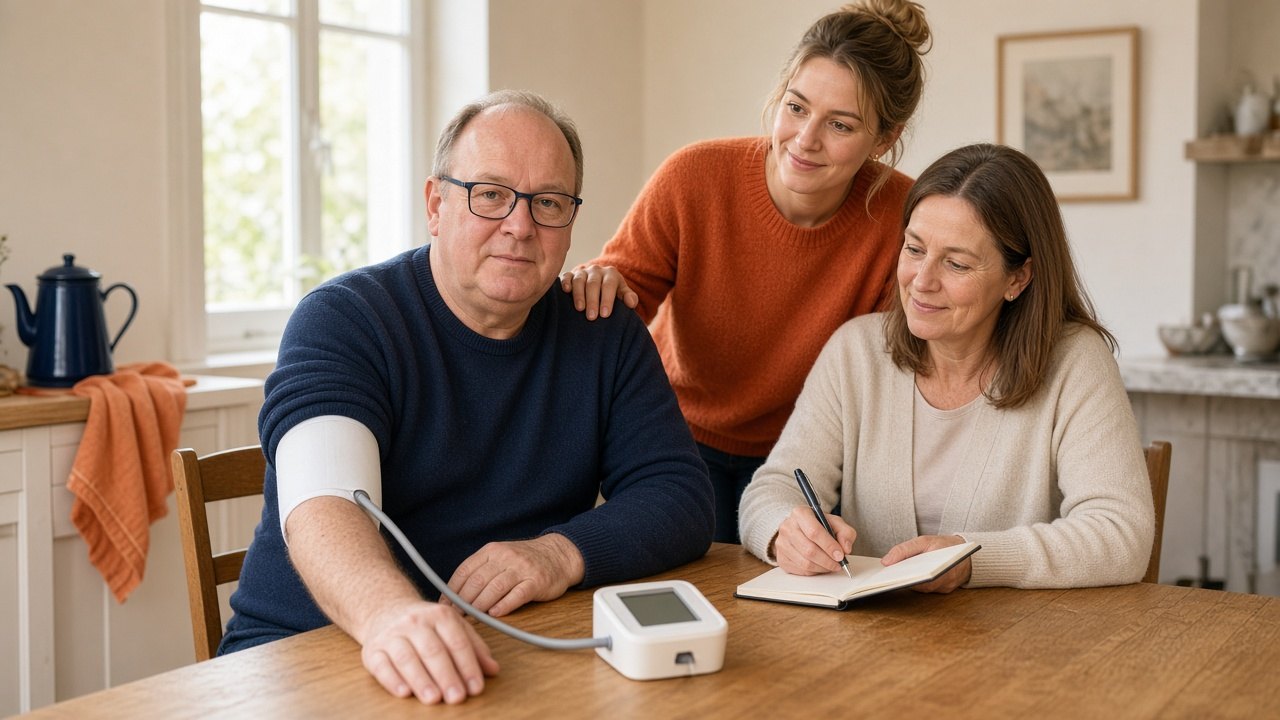
Blood pressure at home: which monitor to choose and what the readings mean
General information, not medical advice. Discuss your readings and any symptoms with your GP.
Measuring your blood pressure at home lets you keep an eye on it, even when you feel nothing. Here is which monitor to choose, how to measure correctly and what the numbers mean.
Why measuring at home is useful
According to the World Health Organization (WHO), measuring is the only way to know whether your blood pressure is too high. Worldwide, an estimated 1.4 billion adults aged 30 to 79 had high blood pressure in 2024, and 44 percent of them did not know it. In the 2023-2024 health interview survey by Sciensano, the Belgian public health institute, 15.8 percent of Belgians aged 15 and over report high blood pressure in the past 12 months, rising to 17.1 percent in Flanders.
At the doctor’s, your blood pressure can come out higher because of stress and nerves about the appointment. This is called white coat hypertension (hypertension is the medical term for high blood pressure). According to Gezondheid en Wetenschap, a Belgian Dutch-language website with reliable health information, 1 in 4 people are affected. The 2021 guideline of the European Society of Hypertension (ESH), the European association of blood pressure specialists, describes home measurement as a way to detect it, but notes that it can cause anxiety in some people.
Blood pressure at home: which monitor should you choose?
Choose an upper-arm monitor, a blood pressure device with a cuff (an inflatable band) around your upper arm. According to Gezondheid en Wetenschap, it is more accurate and reliable than a wrist monitor. The ESH guideline also generally advises against wrist devices, and devices without a cuff, such as smart wristbands, should not be used for home measurements.
Choose a validated device as well, meaning one whose accuracy has been tested against an established protocol. The guideline refers, among others, to the list at stridebp.org. A cuff that is too small overestimates your blood pressure and one that is too large underestimates it, so the size should match the circumference of your arm.
How to measure correctly
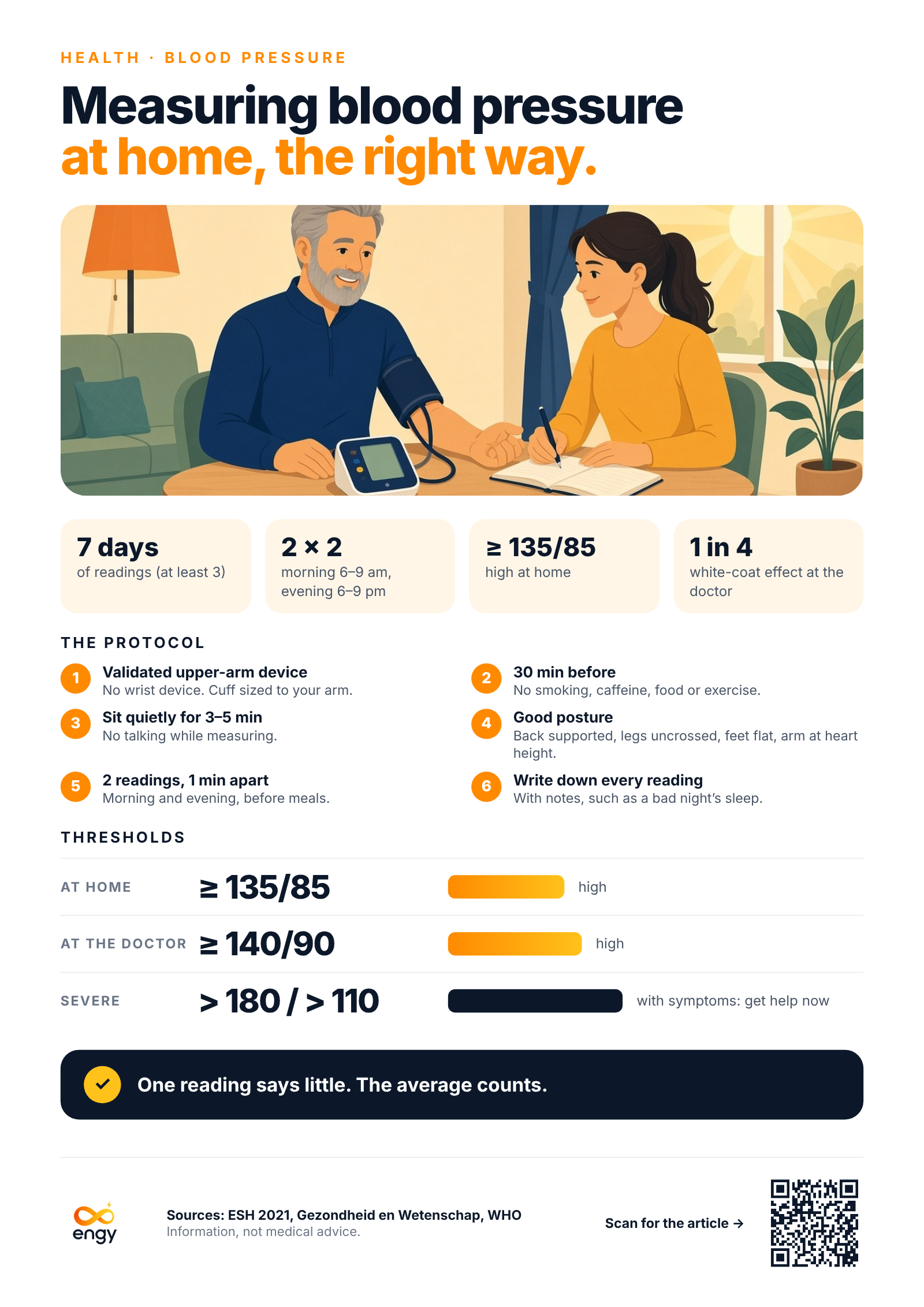
Gezondheid en Wetenschap advises measuring for 7 days in a row, 4 times a day: twice in quick succession in the morning between 6 and 9 a.m. and twice in the evening between 6 and 9 p.m. The ESH guideline also asks for 7 days, with a minimum of 3, and two readings each time with 1 minute in between, before meals.
The same conditions apply to every measurement:
- In the 30 minutes beforehand, you do not smoke, have caffeine, eat or exercise.
- You first sit relaxed for 3 to 5 minutes, and you do not talk during or between readings.
- Your back is supported, your legs are not crossed, your feet are flat on the floor and your bare arm rests on the table, with the middle of your upper arm at heart level.
- You do not measure right after getting up, straight after a meal, after exercise or when you feel stressed.
Write down every reading, together with anything unusual, such as a bad night’s sleep or having been ill.
Download the measuring protocol
The steps and thresholds on one page, also as an A4 to keep next to your monitor.
What the readings mean
Blood pressure is given as two numbers in millimetres of mercury (mmHg): the systolic pressure, when your heart contracts, and the diastolic pressure, when it relaxes. According to the ESH guideline, 140/90 mmHg or more counts as high at the doctor’s, but at home the threshold is lower: 135/85 mmHg or more.
Individual readings vary, and that is common, the guideline says. Decisions are based on the average of several readings.
What you can do yourself
According to Gezondheid en Wetenschap, healthy habits are often enough to lower your blood pressure: stopping smoking, moving enough, losing a few kilos if you are overweight, not having too much salt or alcohol, and no more than four cups of coffee or other caffeinated drinks a day. Most salt has already been added to foods such as bread, cheese, cold cuts and ready meals, so if you want to eat less salt, that is the best place to start.
For physical activity, the WHO mentions walking, swimming and dancing, but also activities that build strength, such as lifting weights. Taking more steps a day and giving strength training a regular place in your week both fit in with that.
When to see a doctor
Gezondheid en Wetenschap speaks of severe high blood pressure when the systolic pressure is above 180 mmHg or the diastolic pressure is above 110 mmHg. Only with a very severe rise can you get symptoms such as a nosebleed, headache, shortness of breath or poorer vision. If you have such symptoms together with high blood pressure, seek medical care immediately, as the WHO advises.
References
- Gezondheid en Wetenschap. Hoge bloeddruk (in Dutch). gezondheidenwetenschap.be, last updated 19 December 2024.
- Stergiou GS, Palatini P, Parati G et al. 2021 European Society of Hypertension practice guidelines for office and out-of-office blood pressure measurement. Journal of Hypertension. 2021;39(7):1293-1302.
- Van der Heyden J, Charafeddine R, Drieskens S. Gezondheidsenquête 2023-2024: Chronische ziekten en aandoeningen (in Dutch). Sciensano, April 2025.
- World Health Organization (WHO). Hypertension. Fact sheet, 25 September 2025.