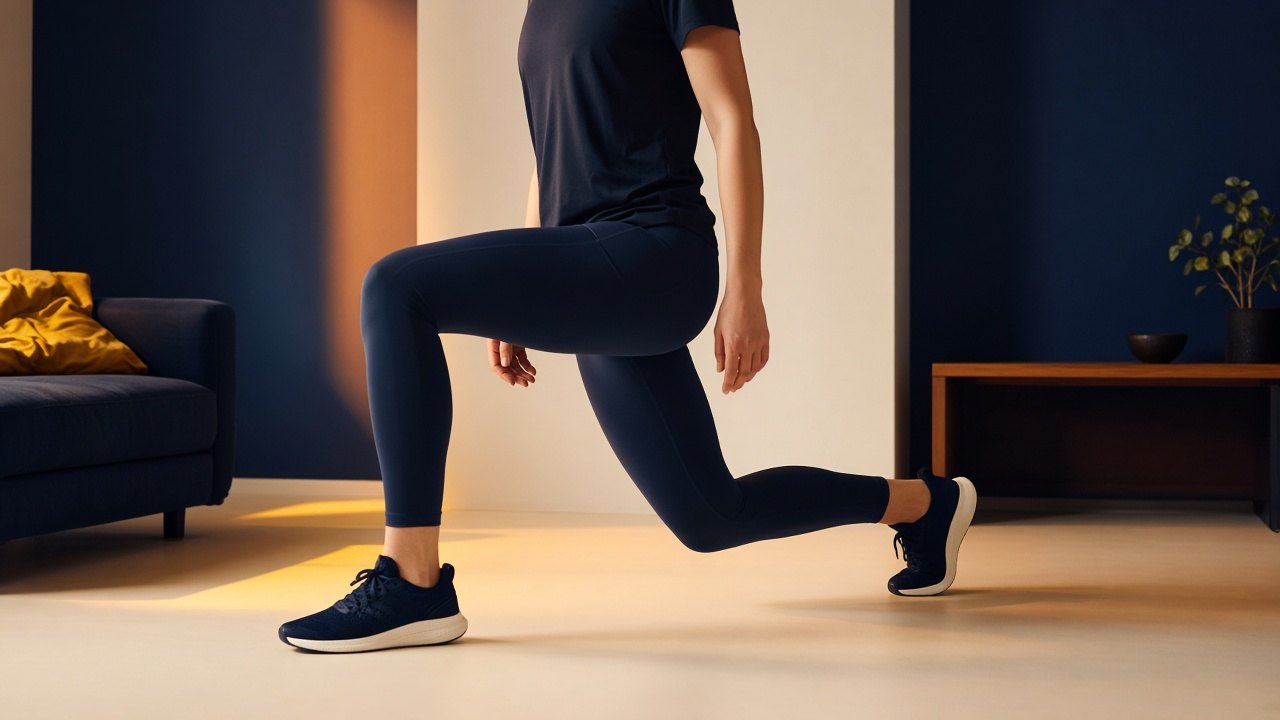
Lunges at home: single-leg strength with no equipment
General information, not medical advice. If you have knee, hip or balance problems, talk to your GP or physiotherapist.
In short
- Lunges are a single-leg strength move for home: no kit, but stability and leg strength.
- A realistic start is 2–3 sets of 6–10 reps per leg, controlled, with enough space and a support nearby.
- The WHO (2020) recommends muscle-strengthening on at least two days a week; single-leg work sits alongside bilateral moves and balance work.
- Knee pain, balance issues or a recent injury: adapt or get checked. This is not a rehab protocol.
Squats feel familiar, but walking, stepping and climbing often happen one leg at a time. Lunges fit that well: forward, reverse or stationary, without dumbbells. They need living-room space and attention to knee and hip, not a gym rack.
Why single-leg strength
The WHO guidelines (2020) stress muscle-strengthening activities on at least two days a week for adults, on top of aerobic movement. Gezond Leven translates that into the movement triangle. Single-leg exercises train stability around hip and knee and make asymmetries more visible than squats alone.
That ties into functional ageing: see balance training and fall prevention and grip strength as a functional signal. Lunges are not fall training by themselves; they are leg strength and control that also shows up in stair climbing.
Lunges at home: how to build them
- Set-up: enough space ahead, shoes or bare feet with grip, chair or wall nearby for support on early sets.
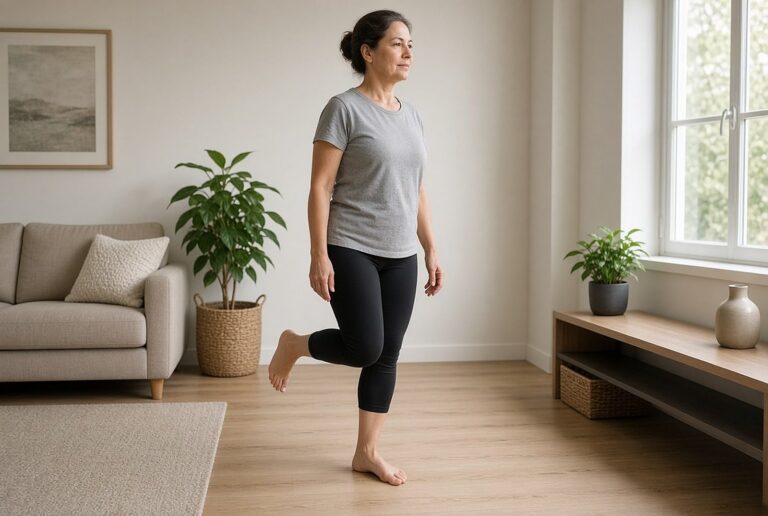
- Movement: one foot forward (or back for a reverse lunge), back knee drops toward the floor, front knee stays roughly over the ankle, torso upright. Drive up through the front heel.
- Volume: 2–3 sets of 6–10 reps per leg, rest 60–90 seconds. Beginners start with stationary lunges or smaller steps.
- Progression: sink deeper within comfort, slower tempo, or later a backpack with books. No ego sets.
They sit well after squats or hip hinges in the same session as strength training at home without equipment. On short days, lunges plus a plank are enough: one pattern done well beats five half-done.
Common mistakes
- Front knee shooting past the toes without control: smaller step or more focus on the hip sitting back.
- Torso tipping forward: hands on hips or lightly forward for balance, chest up.
- Stride too long with wobble: stationary first, then stepping.
With little time, stationary lunges by a table work: one hand lightly on the surface for balance, eight reps per leg. It feels less like a full workout and more like movement between other things.
Limits
Sharp knee pain, instability, dizziness or recent surgery: do not force lunges. Get that checked. If balance is poor, start with support or split squats where both feet stay put. This is not a physiotherapy protocol and not a promise you will never fall.
Sources
- World Health Organization. Guidelines on physical activity and sedentary behaviour (2020).
- Vlaams Instituut Gezond Leven. Movement triangle. gezondleven.be.