
Creatine literacy: 3–5 g per day without the loading myth
TLDR
- Creatine monohydrate: often 3–5 g per day, every day — loading is optional, not a must.
- Food-first stays: meat/fish supply some creatine; the supplement tops up if you want that.
- Pick a third-party tested product; more grams ≠ faster results.
- Pair with contamination check, magnesium literacy and omega-3: fish first.
Creatine is one of the few supplements I do not immediately sit sceptical about — and at the same time I see loading schemes and “10 grams or it does not work” claims roll by. I keep it boring: daily dose, water with it, no promises of “bulk in two weeks.” Literacy first, tub of powder later.
What creatine roughly does
Creatine helps your muscles refill phosphocreatine faster — useful for short, explosive effort and for strength sets. Effects are usually modest and cumulative: think weeks of consistent intake, not one magic scoop for a PR. People who mostly do endurance sometimes notice less “wow” than someone who combines squats and sprints — that is fine, no reason for panic-supplementation.
Dose without the loading myth
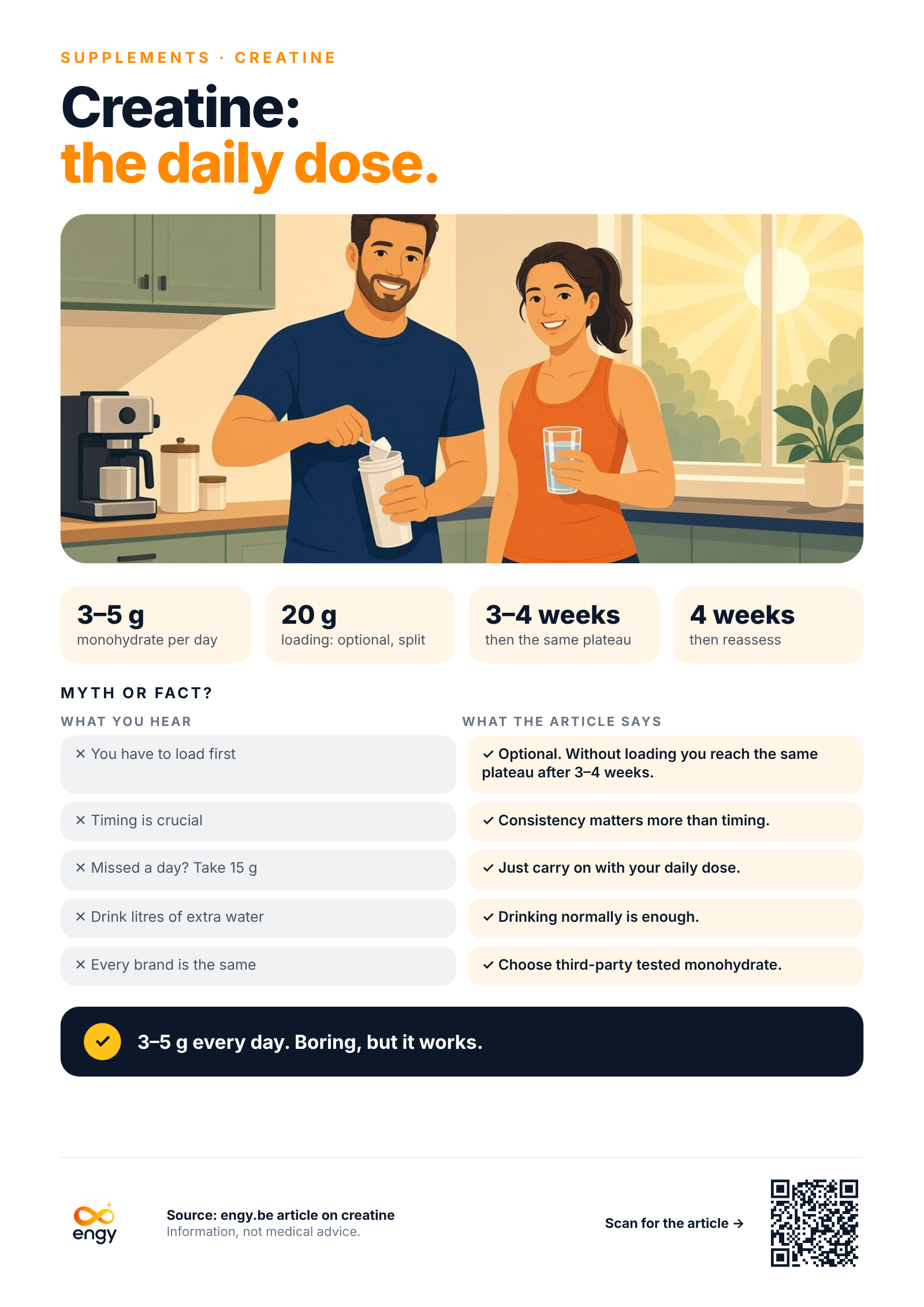
- 3–5 g monohydrate per day is the standard range in many reviews.
- Loading (20 g/day, split) fills muscles faster, but after ~3–4 weeks you sit with 3–5 g/day on a comparable plateau. I skip loading if my stomach wants calm.
- Timing: less important than consistency; with a meal or shake is fine.
- Fluid: just drink normally; you do not need an extra-litre ritual.
Food-first and quality
Red meat and fish contain creatine, but often not enough to hit those 3–5 g if you eat little of them. Supplementing is then a practical choice — not a moral duty. Do: do not buy a random tub without label transparency. Same logic as with third-party tests and how I look at omega-3: food first, then a simple, tested product. And if you feel cramps or “mineral chaos,” creatine is rarely the only suspect — see magnesium literacy.
Note: kidney issues or medical context? That belongs with a doctor, not blog advice. For healthy athletes, monohydrate is one of the best-researched options — still not a wonder fix.
Download the overview
The daily dose and the most common myths on one page, also as an A4.
Practical Engy tip
Put 5 g next to your coffee machine or in your shake routine. Miss a day: just continue, no “catch-up dose” of 15 g. After four weeks: better training quality or body weight + water retention you know? Keep it. Notice nothing and no appetite for powder? Stopping is allowed.
Recommendations in bullets
- 3–5 g/day monohydrate; loading optional.
- Consistency > timing tricks.
- Third-party tested; food-first mindset.
- Crosslinks: contamination, magnesium, omega-3.
Sources (selection)
- ISSN / sports nutrition position stands (US) — creatine monohydrate, dose ranges; translate without supplement-marketing tone.
- EFSA/EU nutrition frameworks — caution on claims; medical exceptions with a doctor.
- Engy: supplement-contaminatie-third-party, magnesium-krampen-supplement-literacy, omega-3-vis-eerst-capsules.