
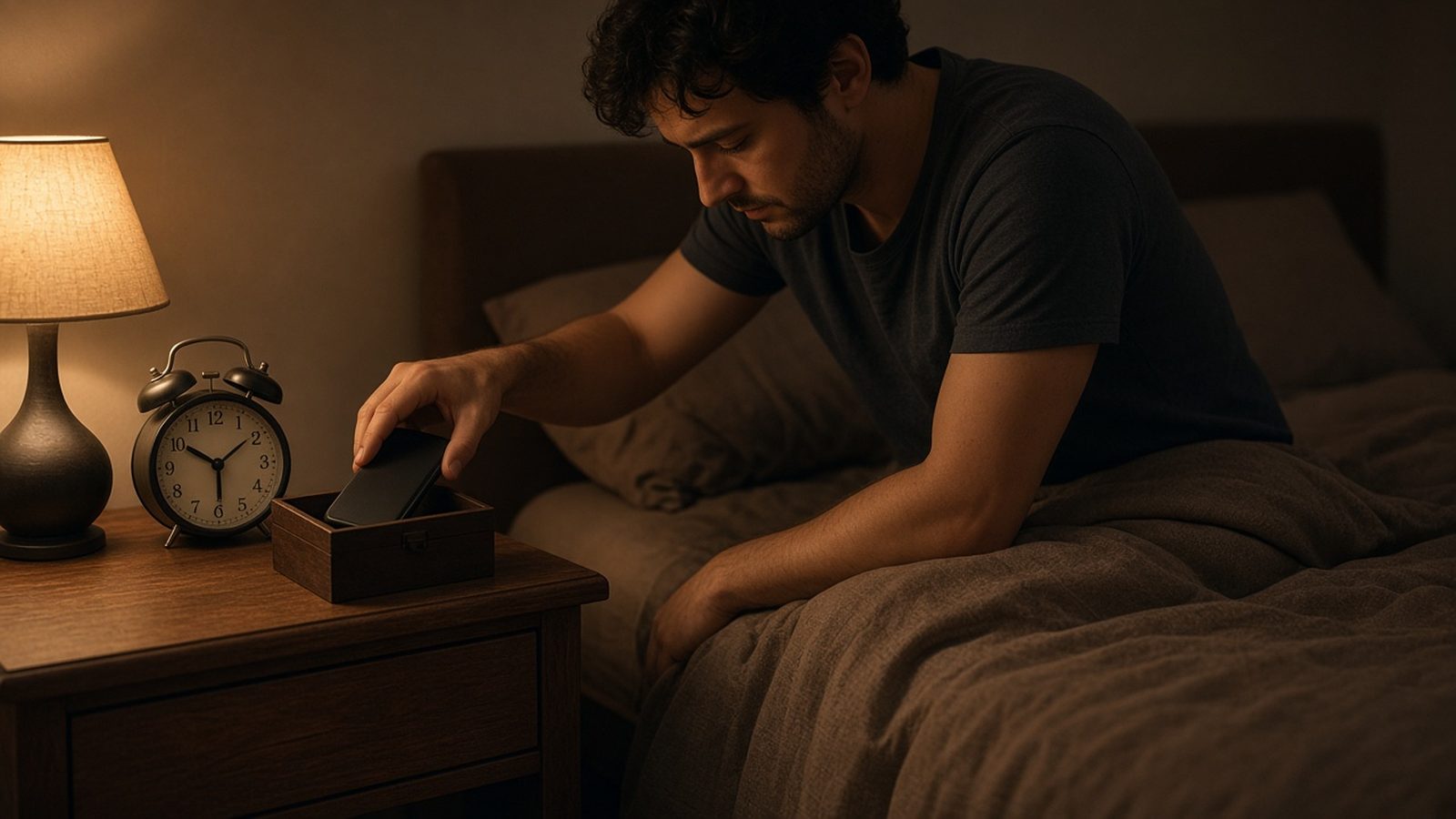
A regular sleep schedule: what research says about regularity and sleep duration
General information, not medical advice. If you are often tired despite enough hours of sleep, or have been sleeping badly for a long time, discuss it with your GP.
When you think about sleeping well, you usually think about the number of hours, but timing counts too. A regular sleep schedule means you go to bed and get up at roughly the same time every day, including days off. Say you go to bed at 11 pm on Wednesday, at 2 am on Saturday, and sleep in until 11 am on Sunday. Your sleep tracker may still count eight hours, and yet you can feel tired.
Regularity and sleep duration: what a large study found
The American Academy of Sleep Medicine (AASM) and the Sleep Research Society recommend at least seven hours of sleep per night for adults aged 18 to 60. According to the AASM, good sleep also requires appropriate timing and day-to-day regularity. You will find reference values by age in the sleep checklist for training weeks.
Windred and colleagues (2024) followed 60,977 participants in the UK Biobank, a large British health study, with an average age of almost 63. For one week they wore a movement sensor on the wrist, from which a regularity score was derived: 100 means someone slept and was awake at exactly the same hours every day, 0 a random pattern. The researchers divided them into five equal groups. During an average follow-up of just over six years, the four more regular groups had a 20 to 48 percent lower risk of dying than the least regular group, taking into account age, lifestyle and health, among other factors. Regularity predicted that risk better than sleep duration. It remains an association and not a demonstrated cause, and according to the authors a single week of measurement is only a snapshot.
Chaput and colleagues (2020) brought together 41 studies in a systematic review, a study that combines all available research on a question: later sleep timing and more variable sleep times were mostly associated with poorer health. They could not determine a threshold above which sleep times vary too much, and the quality of the evidence ranged from very low to moderate.
Social jetlag: when your week and your weekend drift apart
Wittmann and colleagues (2006) call the difference between your sleep times on work days and free days social jetlag. It arises when your working hours clash with your body clock, the internal rhythm that determines when you feel sleepy and when you are awake. Evening types in particular build up a sleep shortage during the week that they catch up on during free days.
In Chaput’s review, social jetlag was associated with poorer health, but weekend catch-up sleep with better health. A National Sleep Foundation panel (Sletten and colleagues, 2023) concludes that regular sleep times are important for health and performance, and that some extra sleep on free days may help if you sleep too little during the week.
How to build a regular sleep schedule
Gezond Leven, the Flemish institute for health promotion, advises going to bed at roughly the same time, only getting into bed when you feel sleepy, and getting up at the same time as much as possible. Your wake-up time is therefore the fixed point. Choose a time you can manage on most days, including Saturday, and work back from there to your bedtime. The US National Heart, Lung, and Blood Institute advises limiting the difference between weekdays and weekends to about an hour. Your evening counts too, especially if your bedtime shifts later because of a screen before sleep.
Light also plays a part. Phillips and colleagues (2017) followed 61 American students for a month. In the most irregular sleepers, the release of melatonin, the hormone that makes you sleepy in the evening, started on average only at 00:08, compared with 21:32 in the most regular sleepers. According to the researchers’ computer model, this was probably mainly due to a different pattern of light exposure across the day.
What a sleep tracker does and does not tell you
A sleep tracker can show how much your sleep times vary. Baron and colleagues (2017) describe patients who, because of their tracker data, believed they were sleeping badly and ended up in a perfectionistic quest for ideal sleep, which they call orthosomnia. So use such a device to follow your rhythm, not to chase a score. If you train a lot, also look out for signs of too little recuperation.
Sources
- Windred DP, Burns AC, Lane JM, Saxena R, Rutter MK, Cain SW, Phillips AJK (2024). Sleep regularity is a stronger predictor of mortality risk than sleep duration: A prospective cohort study. Sleep, 47(1), zsad253. PMID 37738616.
- Watson NF et al. (2015). Recommended Amount of Sleep for a Healthy Adult: A Joint Consensus Statement of the American Academy of Sleep Medicine and Sleep Research Society. Sleep, 38(6), 843–844. PMID 26039963.
- American Academy of Sleep Medicine (2015). Seven or more hours of sleep per night: A health necessity for adults. AASM.
- Chaput JP et al. (2020). Sleep timing, sleep consistency, and health in adults: a systematic review. Applied Physiology, Nutrition, and Metabolism, 45(10 Suppl. 2), S232–S247. PMID 33054339.
- Wittmann M, Dinich J, Merrow M, Roenneberg T (2006). Social jetlag: misalignment of biological and social time. Chronobiology International, 23(1–2), 497–509. PMID 16687322.
- Sletten TL et al. (2023). The importance of sleep regularity: a consensus statement of the National Sleep Foundation sleep timing and variability panel. Sleep Health, 9(6), 801–820. PMID 37684151.
- Vlaams Instituut Gezond Leven. Je slaap verbeteren. Gezond Leven (accessed 16/10/2026).
- National Heart, Lung, and Blood Institute (2022). Healthy Sleep Habits. NHLBI, National Institutes of Health.
- Phillips AJK et al. (2017). Irregular sleep/wake patterns are associated with poorer academic performance and delayed circadian and sleep/wake timing. Scientific Reports, 7, 3216. PMID 28607474.
- Baron KG, Abbott S, Jao N, Manalo N, Mullen R (2017). Orthosomnia: Are Some Patients Taking the Quantified Self Too Far? Journal of Clinical Sleep Medicine, 13(2), 351–354. PMID 27855740.



6 Comments