

Blood pressure on the high side? Why isometric training like the wall sit scores best
General information, not medical advice. If you have high blood pressure, a heart condition or take blood pressure medication, talk to your GP first.
Isometric training means tensing a muscle without moving, for example by sitting with your back against a wall as if on a chair. In a large comparison of exercise types, isometric training scores best for systolic pressure, the first number of your blood pressure, with that wall sit as the strongest variant.
What systolic and diastolic pressure mean
Blood pressure is measured in mmHg, millimetres of mercury. Systolic pressure is the pressure in your blood vessels when your heart contracts, diastolic the pressure between two beats. According to Gezondheid en Wetenschap, the Flemish guideline-based medical information website, your blood pressure is high with a systolic value above 140 mmHg or a diastolic value above 90 mmHg. It usually causes no symptoms, so you often only notice when you measure. How to do that correctly yourself is explained in the article on how to measure blood pressure at home.
What the large comparison of exercise types found
A meta-analysis pools the results of many studies, and a network meta-analysis also compares different exercise types with each other. The one by Edwards and colleagues (British Journal of Sports Medicine, 2023) combines 270 randomised trials, in which participants are assigned to a group by lot, with 15,827 participants in total. Each study lasts at least 2 weeks and compares with a control group that does not train.
Compared with those control groups, resting blood pressure falls on average by 8.24 mmHg systolic and 4.00 mmHg diastolic with isometric training. With aerobic training, meaning endurance exercise, it is 4.49 and 2.53 mmHg, with dynamic resistance training 4.55 and 3.04 mmHg and with combined training 6.04 and 2.54 mmHg. High-intensity interval training gives 4.08 and 2.50 mmHg.
The researchers also give each type a ranking score from 0 to 100 percent, which is not a percentage reduction. For systolic pressure, isometric training comes first with 98.3 percent. Among the variants, the wall sit comes out best for systolic pressure (90.4 percent) and running for diastolic pressure (91.3 percent). These are averages, and the comparison puts side by side exercise types that were often tested in different studies.
Isometric training in practice: the protocol from the studies
A review by Edwards and colleagues (Sports Medicine, 2024) reports that the best-studied protocols take about 11 to 20 minutes per session. The evidence mainly rests on 4 bouts of 2 minutes with 1 to 4 minutes of rest in between, 3 times a week for at least 3 weeks, using a handgrip device, a leg extension or the wall sit. The wall sit needs no equipment. In the wall sit studies, a session looks like this:
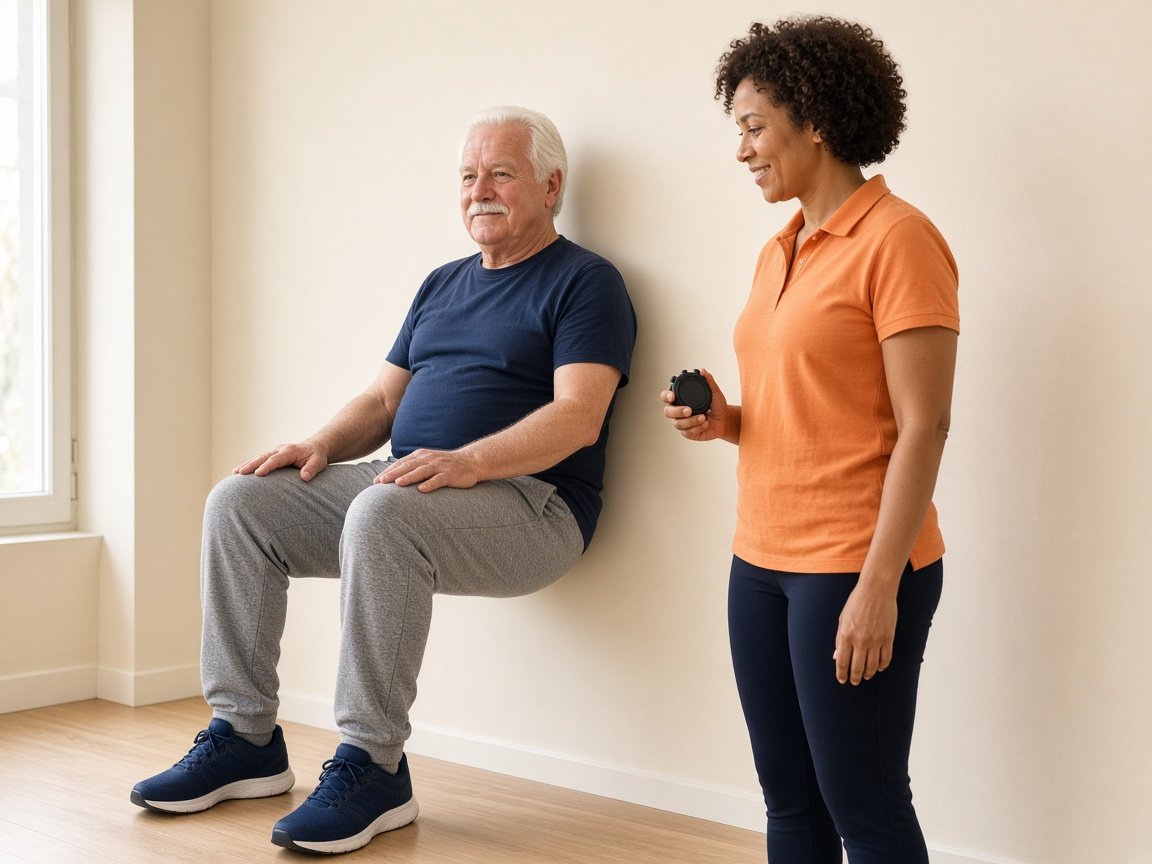
- You put your back against a wall and bend your knees until you sit as if on a chair.
- You hold that for 2 minutes and keep breathing calmly.
- You rest for 2 minutes and repeat until you have done 4 bouts of 2 minutes.
- You do this 3 times a week.
In most studies, a special incremental test sets each person’s knee angle at which the heart rate rises to 95 percent of peak heart rate, your highest heart rate. Newer research shows the wall sit also works if you set the intensity by how hard it feels, known as perceived exertion.
Keep breathing during every hold
The review asks you to breathe regularly and without interruption during a hold, so you do not unintentionally perform the Valsalva manoeuvre: forcefully breathing out against a closed throat, which sharply raises blood pressure. Put simply: do not hold your breath and do not strain. For people at higher risk, a handgrip exercise is probably more suitable according to the same source.
How it fits alongside walking, cycling and strength training
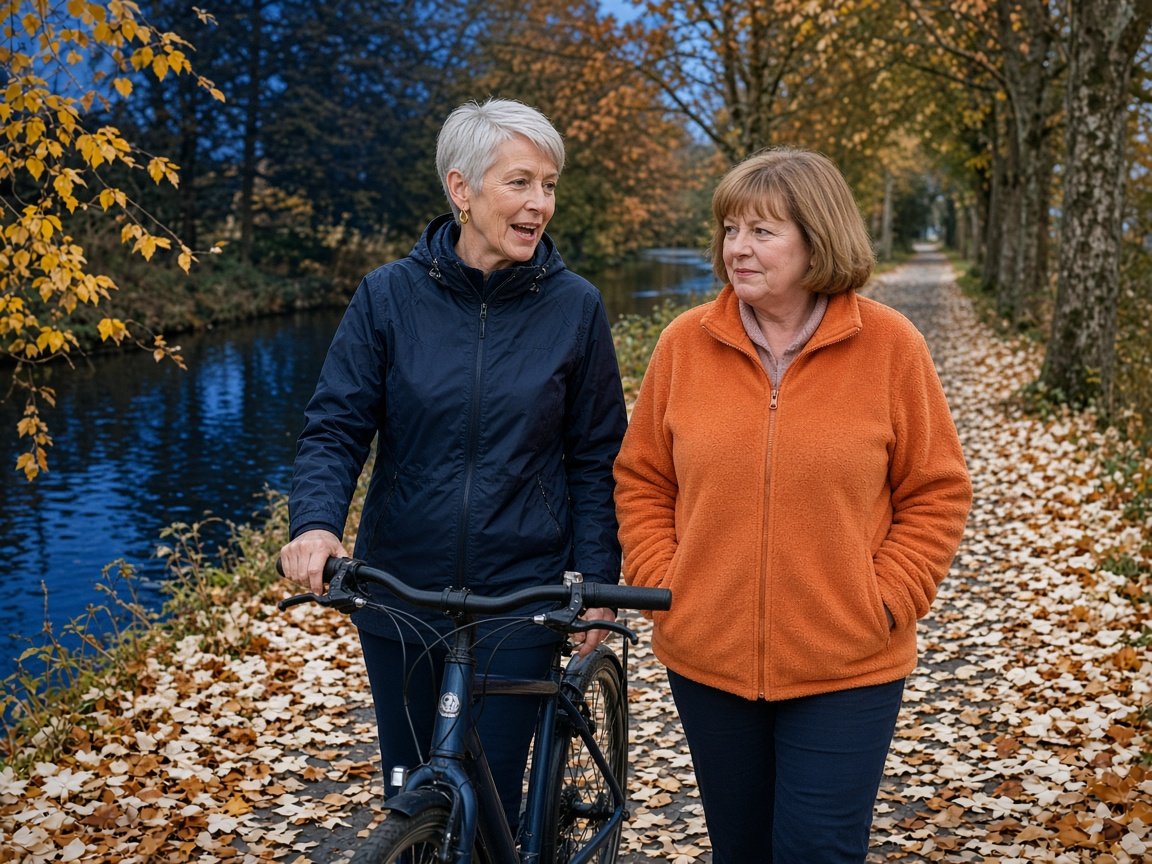
The World Health Organization recommends that adults do 150–300 minutes of moderate or 75–150 minutes of vigorous activity per week, with muscle-strengthening activities on at least 2 days. According to the review, isometric training is still rarely prescribed and is a possible additional tool. Aerobic training is also linked to lower blood pressure in the analysis, so your walks and bike rides remain worthwhile. Easy endurance training in zone 2, a pace at which you can still talk comfortably, is part of that. How much strength training per week the guideline asks for and how to combine cardio and strength is covered in separate articles.
Sources
- Edwards JJ, Deenmamode AHP, Griffiths M, Arnold O, Cooper NJ, Wiles JD, O’Driscoll JM. Exercise training and resting blood pressure: a large-scale pairwise and network meta-analysis of randomised controlled trials. British Journal of Sports Medicine. 2023;57(20):1317-1326.
- Edwards JJ, Coleman DA, Ritti-Dias RM e.a. Isometric Exercise Training and Arterial Hypertension: An Updated Review. Sports Medicine. 2024;54(6):1459-1497.
- Gezondheid en Wetenschap. Hoge bloeddruk. Laatst aangepast op 19 december 2024, geraadpleegd in oktober 2026.
- Bull FC, Al-Ansari SS, Biddle S e.a. World Health Organization 2020 guidelines on physical activity and sedentary behaviour. British Journal of Sports Medicine. 2020;54(24):1451-1462.




One Comment