Burning wood with less fine dust: what you can do as the heating season starts
General information, not medical advice. If you have breathing or heart problems, talk to your GP about burning wood at home.
The heating season is starting and many stoves and fireplaces are being lit again. Burning wood brings warmth and atmosphere, but the smoke ends up in the outdoor air, including your neighbours’. A few adjustments are enough to reduce those emissions.
Why wood smoke matters to your neighbours too
According to the Flanders Environment Agency (VMM, Vlaamse Milieumaatschappij), burning wood releases many harmful substances, such as fine dust and dioxins. Breathing in wood smoke can immediately cause coughing, headaches or stinging eyes. In the longer term, the agency points to cardiovascular disease and certain types of cancer.
PM2.5 is fine dust made up of particles smaller than 2.5 micrometres (0.0025 millimetres). According to the VMM, households account for 48% of PM2.5 emissions in Flanders, mainly from heating with (wood) stoves. Transport accounts for 28%. Within household fine dust emissions, burning wood makes up 85%.
Since 2021, the World Health Organization (WHO) has recommended a PM2.5 level of no more than 5 µg/m³, or 5 micrograms per cubic metre of air, as an annual average, and 15 µg/m³ as a daily average.
Which appliance emits the least?
The VMM compares average PM2.5 emissions in grams per gigajoule, a fixed amount of heat. The lower the figure, the less fine dust for the same amount of heat.
| Appliance | Grams of PM2.5 per gigajoule |
|---|---|
| Open fireplace | 820 |
| Wood stove installed before 2000 | 740 |
| Wood stove installed between 2000 and 2014 | 370 |
| Wood stove installed after 2014 | 93 |
| Pellet stove (compressed wood pellets) | 60 |
| Gas heater in the room itself | 2.2 |
| Central gas boiler | 0.2 |
Even with an efficient appliance, the fuel and the way you burn it strongly affect how much fine dust is released, the VMM stresses: if you burn wood the wrong way, emissions are far higher than in the table. The VMM advises against open fireplaces and stoves without a self-closing door. Their efficiency is very low, they release large amounts of harmful substances and they carry a risk of fire and carbon monoxide (CO) poisoning.
Burning wood more cleanly: what helps
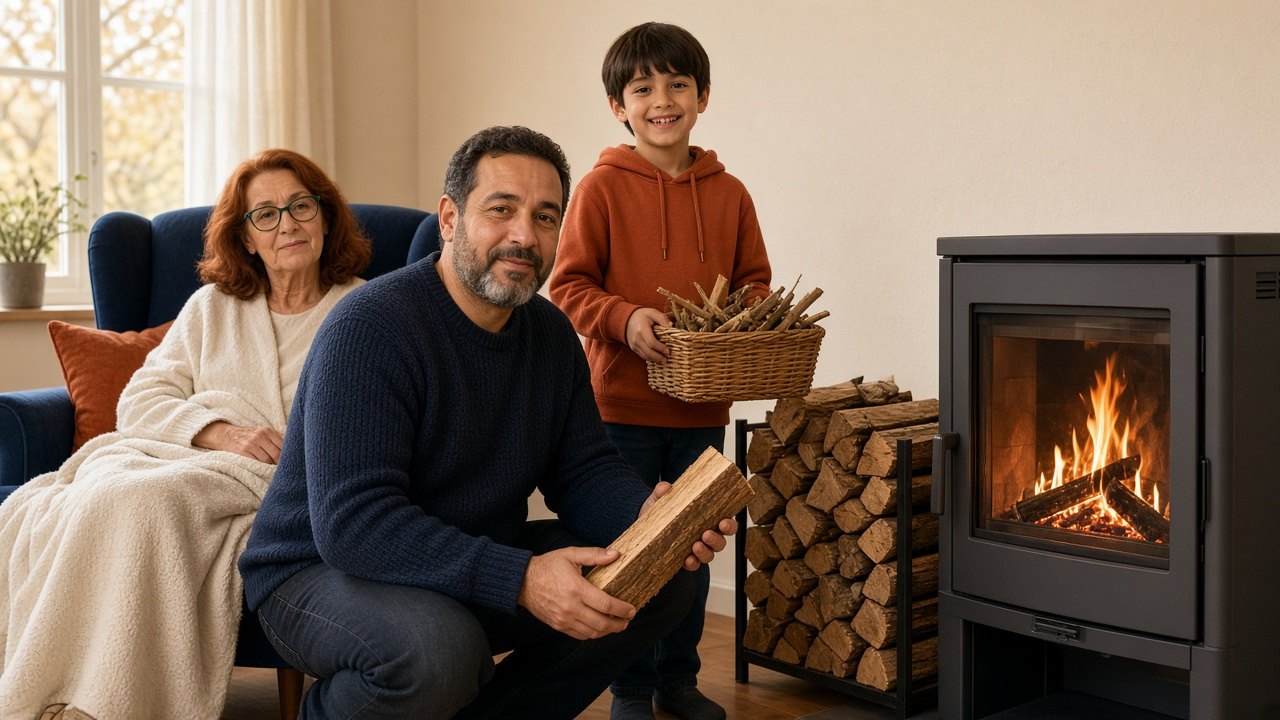
Choose dry wood. Leave split wood to dry for at least 2 years in a dry place. A moisture meter lets you check whether it is dry enough: the VMM mentions a moisture content of 15%.
Use the right wood. Light the fire with softwood such as birch or willow and keep it going with hardwood such as beech, oak or ash. Avoid resinous wood such as conifers, as well as wet or dirty wood. Burning waste or treated or composite wood, such as painted wood, chipboard or plywood, is prohibited.
Light from the top. Put the thick logs at the bottom, thinner ones above them and a few small firelighters on top. Then light the fire from the top, which releases fewer harmful substances while it gets going. Leave newspaper and cardboard aside, because burning ink gives off harmful substances.
Don’t starve the fire of air. Open the air supply fully when lighting and never close it completely, not even to keep the fire going overnight. With too little oxygen, the wood smoulders, the smoke contains more harmful substances and carbon monoxide forms. A stove that is too powerful forces you to cut the air quickly so the room does not overheat, so choose the right output.
When it is better not to light the fire
In fog or still weather, the chimney draws less well and the smoke lingers around the house. It is better not to light the fire then. The same applies when the VMM issues a no-burn advisory because air quality is poor. You can follow air quality through the weather forecast, the VMM or the Belgian Belair app. An advisory is not a ban, but several Flemish municipalities include a temporary burning ban in bad weather in their local police regulations.
Smoke, chimney and ash
White or almost invisible smoke from your chimney is a good sign: it is mostly water vapour. According to the VMM, dark smoke is a warning sign of poor combustion, insufficient draught or burning waste or wet or treated wood.
Have your chimney swept by a professional, preferably once a year. Do not scatter the ash in the garden or put it in the organic waste bin, because wood ash always contains harmful substances such as dioxins. Let it cool outside in a closed, non-combustible container and then put it out with the household waste.
An evening without a fire
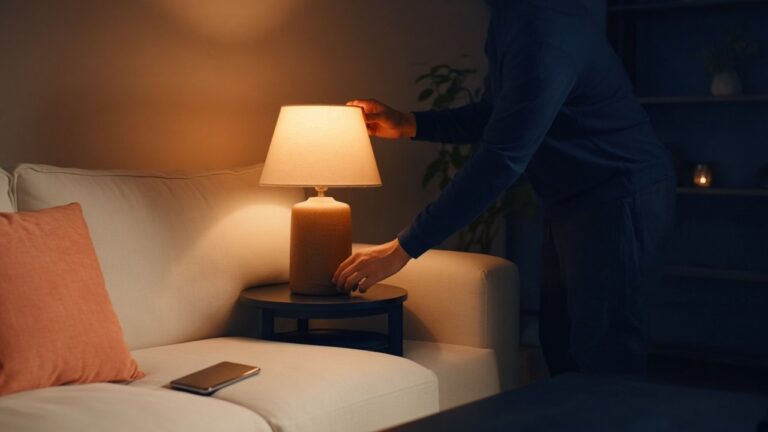
According to the VMM, burning less wood benefits everyone’s health, and a well-insulated home needs less extra heating from wood. Even without flames you can make the evening cosy with warm evening light at home. And if the stove is burning anyway, it is worth keeping your bedroom cool in autumn.
Sources
- Vlaamse Milieumaatschappij (VMM, Flanders Environment Agency). Verwarmen met hout (in Dutch). vmm.vlaanderen.be, accessed 17 October 2026.
- Vlaamse Milieumaatschappij (VMM). Stoken met stukhout (in Dutch). vmm.vlaanderen.be, accessed 17 October 2026.
- Vlaamse Milieumaatschappij (VMM). Meest gestelde vragen over binnen stoken (in Dutch). vmm.vlaanderen.be, accessed 17 October 2026 (emission figures from the EMEP/EEA guidebook, 2023 version).
- Vlaamse Milieumaatschappij (VMM). Uitstoot PM2,5 (in Dutch). Indicator, last updated May 2026.
- Vlaamse Milieumaatschappij (VMM). Uitstoot fijn stof naar lucht door de huishoudens (in Dutch). Indicator, last updated May 2026.
- World Health Organization (WHO). WHO global air quality guidelines: particulate matter (PM2.5 and PM10), ozone, nitrogen dioxide, sulfur dioxide and carbon monoxide. Geneva, 2021.