

Sitting less for long stretches: what the guidelines say
General information, not medical advice.
According to the Flemish Institute Gezond Leven, Flemish people sit on average more than eight hours a day: at home, at school or at work, on the way and in free time. An ordinary day offers many sitting moments: in the car, on the train, behind a screen or on the sofa. The movement triangle is a Gezond Leven scheme that shows how best to divide a day between sitting, standing and moving. Sitting still for long stretches sits in the orange zone of that triangle. That means you had best limit it.
Sitting still is not the same as moving too little
Sedentary behaviour, or sitting still for long stretches, is everything you do while lying or sitting and using very little energy. Sleep does not count. Gezond Leven points out that you can move enough and still sit a lot. You might, for example, cycle thirty minutes to and from work every day, but then sit for hours straight at your desk. Anyone who regularly stands up, stretches their legs and moves a bit breaks up those long sitting blocks.
The same goes for children: a preschooler who moves 60 minutes a day at moderate intensity, such as brisk walking or easy cycling, meets the activity guideline, but still sits a lot if the rest of the day is spent sitting. A healthy mix of sitting, standing and moving remains, according to Gezond Leven, the best advice for young and old.
What the WHO says about sedentary behaviour
The World Health Organization (WHO) defines sedentary behaviour as periods with low energy use while you are awake, such as sitting or lying. More sedentary behaviour in adults goes together with higher mortality, more heart and vessel disease, cancer and type 2 diabetes. The WHO asks all age groups to limit the time they sit still, and states that any amount of movement is better than none.
At least 150 minutes of moderate-intensity activity a week remains the familiar lower bound for movement. In 2022, about 31 per cent of adults worldwide did not meet that bound, some 1.8 billion people. People who are not active enough have, according to the WHO, a 20 to 30 per cent higher risk of dying than people who do move enough. That figure is about too little activity, not about sitting alone. Both themes play at once: move more and limit total sitting time. Whether the length of one sitting block has its own effect on top of that, these sources leave open; the guidelines mainly ask you to sit still less in total.
How do you limit sitting time in practice?
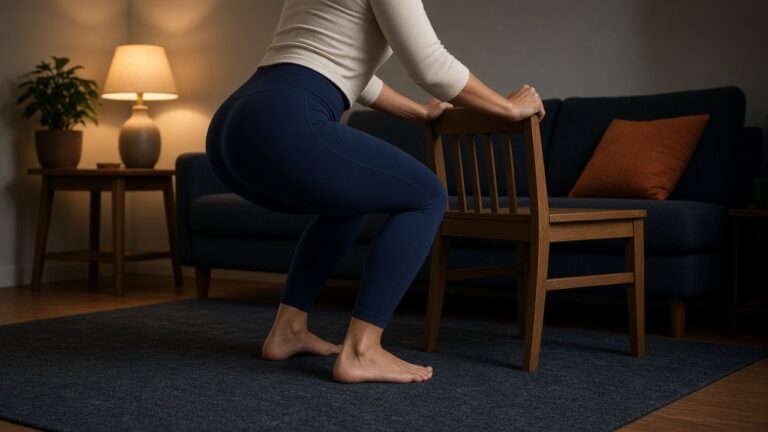
Small breaks help you not to sit for hours in one go. Call or meet standing up once in a while. Put your water carafe a bit further away, so you have to stand. Take the stairs instead of the lift, or plan a short two-minute stair exercise. After a long desk day, calm exercises for stiff neck, shoulders and hips also help. At the weekend, a long walk can add to your activity time.
If you work from home, schedule fixed micro-breaks in your calendar. Stand up after every video call, and walk the stairs up and down after answering your emails. Agree at the office with a colleague to fetch coffee on foot together.
When to see a doctor?
If you have ongoing back, neck or joint complaints from your work posture, or you doubt whether you can safely stand and move, talk to your GP or physiotherapist.
Sources
- Vlaams Instituut Gezond Leven. Bewegingsdriehoek. gezondleven.be, accessed 15 October 2026.
- Vlaams Instituut Gezond Leven. Sedentair gedrag. gezondleven.be, accessed 15 October 2026.
- World Health Organization. Physical activity. Fact sheet, 26 June 2024 (accessed 15 October 2026).




One Comment