
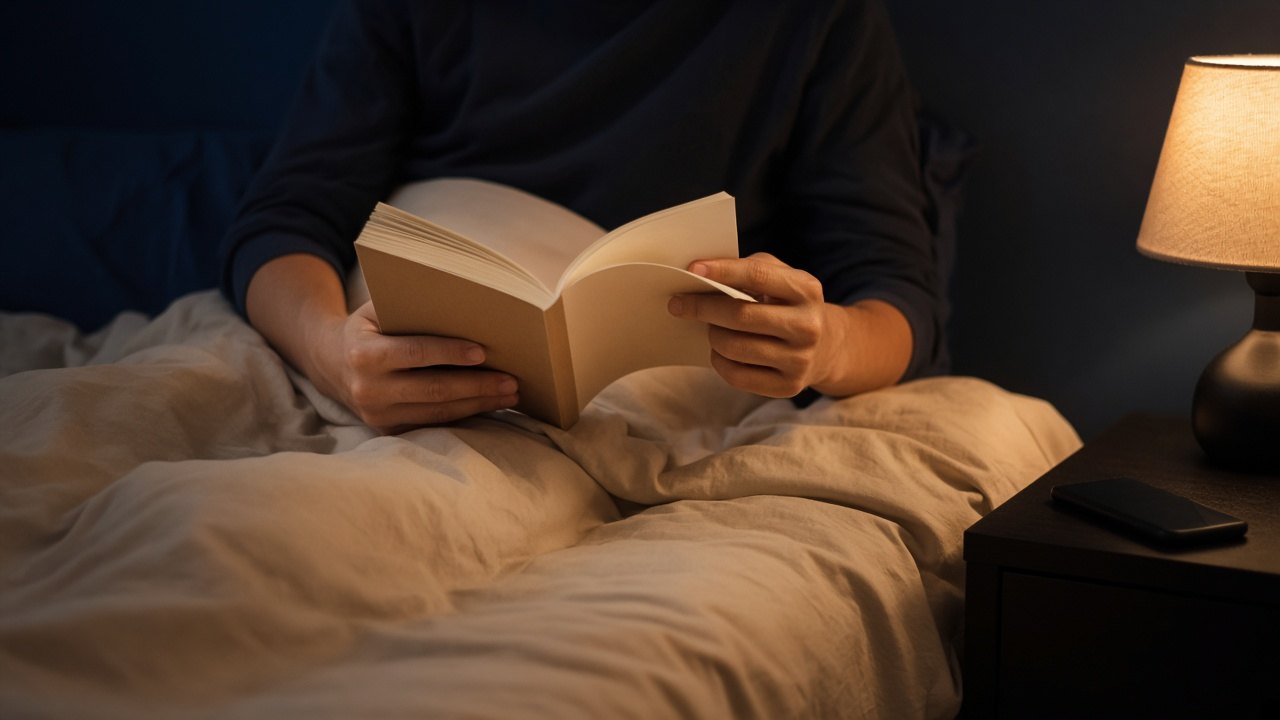
Reading instead of scrolling before sleep: what I notice and what research says
Informational, not medical advice.
TLDR
- I often swap the last 20–30 minutes of scrolling for reading on paper or an e-reader with warm, dimmable light.
- Bright blue-rich screen light in the evening can disturb melatonin production; reviews (including in sleep-medicine literature) point that way, with nuance by person.
- Not everyone sleeps better from reading; some people get more alert from an exciting book.
- This is an evening-routine experiment, not treatment of sleep disorders.
For years my phone was the last thing in my hand before the light went out. I did not fall asleep at once, but I noticed my head still chewing news and messages. When I swapped that half-hour for a book, falling asleep became more predictable — not perfect, but calmer. On screens and recovery I wrote earlier in screen time, sleep and recovery.
What research roughly says
Evening light with a lot of short-wave (“blue”) light can influence the circadian clock and melatonin. Reviews in the sleep literature — including frames discussed by the American Academy of Sleep Medicine (AASM) and European sleep societies — describe that effect, with differences by intensity, duration and person. It is not a law that “every screen breaks sleep”, but a reason to choose the last minutes deliberately.
Reading on paper or on an e-ink reader with a warm frontlight usually produces fewer bright, blue-rich peaks than a phone at full brightness. That is physics and product design, not a miracle formula.
Paper, e-reader or phone in dark mode?
I prefer paper or an e-ink reader with warm light. Dark mode on the phone helps a bit, but notifications and infinite feeds stay a trap. If I still read digitally, I set brightness low, warm filter on, and flight mode or focus mode.
Morning light stays more important for the rhythm than one evening trick — see morning light as a circadian nudge. Evening reading is an add-on, not a replacement for steady bedtimes or a dark bedroom. My broader checklist is in sleep as a recovery checklist.
What I do in practice
- Phone charges outside the bedroom or in a drawer, 30 minutes before bedtime.
- Book or e-reader ready before that cut-off, so I do not “just quickly” open the screen.
- Boring to moderately gripping material in the evening; thrillers I save for the train.
- Stop at a chapter break even if it grips — otherwise bedtime slides.
- Lamp warm and low; bright ceiling light off.
When reading does not help
Some people get alert from text. Others sleep poorly because of rumination, shift work, apnea or medication — a novel does not fix that. Anyone who structurally sleeps badly belongs with a doctor or sleep clinic, not a lifestyle tip.
I do not claim better sleep quality for everyone. I do claim: less scrolling gives my head a clearer end to the day.
This article is informational and not medical advice. With ongoing sleep problems, see a doctor.
Sources (selection)
- Reviews on evening light, melatonin and circadian timing in the sleep literature (AASM frame / European discussions; individual studies differ).
- World Health Organization / general sleep-hygiene context: regularity and light exposure as lifestyle factors, not a treatment protocol.
- Engy. Screen time, sleep and recovery. engy.be/en/screen-time-sleep-recovery/



One Comment