
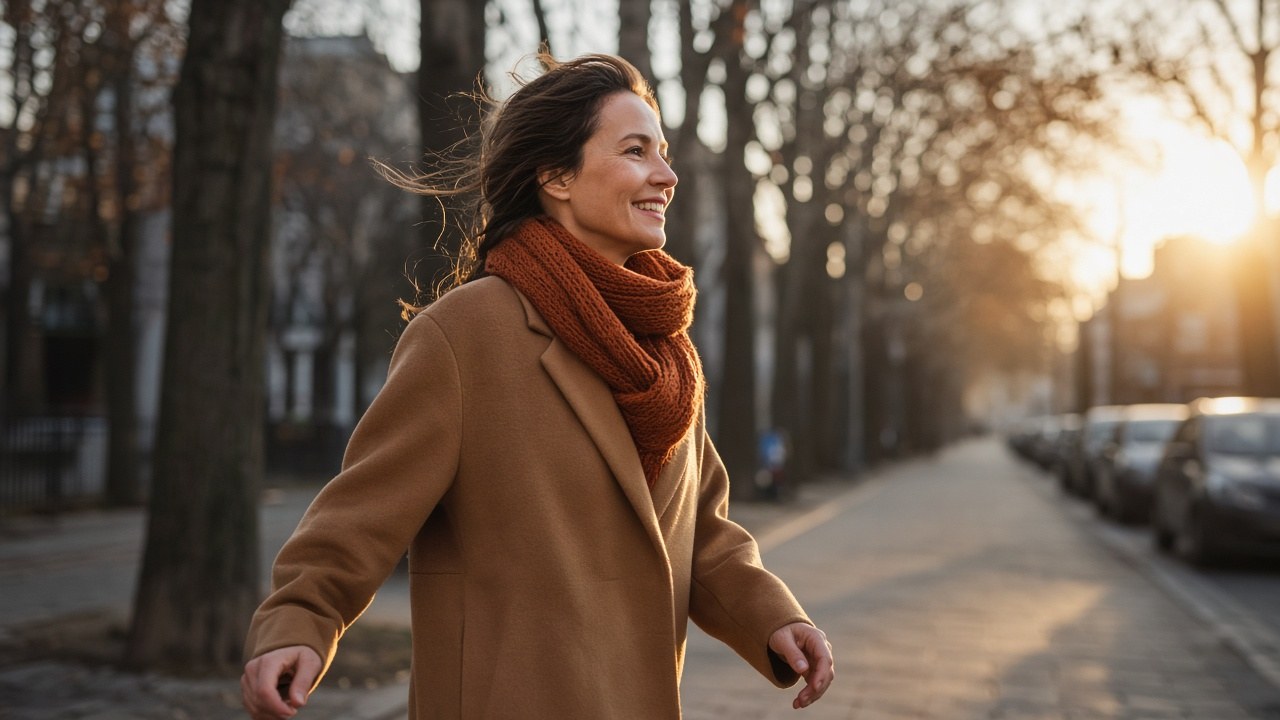
Morning light outdoors: what it does for your body clock and how to fit it in
General information, not medical advice. If you have ongoing sleep problems, discuss them with your GP.
Morning light is the daylight you take in shortly after getting up, ideally outdoors. Your body uses it to tell what time it is. Below you can read what research says about it and how to get more daylight into a working day.
What morning light does for your body clock
Your body clock is the internal rhythm of roughly 24 hours that helps decide when you feel sleepy and when you feel alert. Researchers call it the circadian rhythm. Light is considered the main outside signal that adjusts this clock (Dautovich and colleagues, 2019). Light in the morning shifts your body clock earlier, while light in the evening and at night shifts it later (Blume and colleagues, 2019).
You can see this in melatonin, among other things: the hormone your body makes when it gets dark and that makes you sleepy. In a small study (Wright and colleagues, 2013), eight adults spent a summer week camping in Colorado with only daylight and a campfire. They got more than four times as much light as at home. Afterwards their body clock ran about two hours earlier, and their melatonin started on average around sunset. With eight participants in midsummer, that is no yardstick for a Belgian autumn.
It is far darker inside than outside
The amount of light falling on a spot is measured in lux. Outside, it can reach 100,000 lux in direct sunlight during the day and about 25,000 lux in full daylight, while ordinary office lighting comes to around 500 lux, often less (Blume and colleagues, 2019). Eighteen light and sleep researchers write that lighting inside buildings is usually at least ten times weaker than the light outdoors (Brown and colleagues, 2022).
For daytime they recommend at least 250 lux at eye level, preferably from daylight. This is a special measure, called melanopic, that takes into account how strongly light stimulates your body clock. Ordinary lamps score lower on it than daylight with the same number of lux. The recommendation gives a light level, not a number of minutes.
What research finds on daylight and sleep
A systematic review, which brings together all the research on a single question, pooled 45 studies in healthy adults (Dautovich and colleagues, 2019). Brighter morning light went together with earlier sleep and better self-rated sleep, brighter evening light with later and poorer sleep.
In the UK Biobank, a large British health study, each extra hour spent outdoors during the day was linked to getting up more easily, feeling tired less often and less insomnia (Burns and colleagues, 2021). In a second study, 88,905 participants wore a light sensor for a week: those who got more light during the day had a lower risk of dying in the years that followed (Windred and colleagues, 2024). Both studies show a link, not cause and effect.
How much time outside?
Research does not pin down a number of minutes that is enough. According to Blume and colleagues, your body clock also adds up short moments of bright light. The US National Sleep Foundation, an organisation focused on sleep health, advises stepping outside for at least an hour each morning or afternoon. According to the foundation, your body clock is most sensitive to light about an hour after your usual wake-up time. A few minutes outside is therefore a realistic start, but not a dose that has been shown to work.
Fitting morning light into a working day
Link daylight to something you already do. The National Sleep Foundation suggests drinking your coffee outside when the weather allows. If you walk or cycle to work or school, you get light and movement at the same time, and that trip also counts towards your daily step count.
A fixed wake-up time helps, because you then get light around the same moment every day. Gezond Leven, the Flemish institute for health promotion, advises getting up at the same time as much as possible. You can read more in our article on a regular sleep schedule.
What light does in the evening
In the evening, light works in the opposite direction. Brown and colleagues recommend no more than 10 lux, in that same special measure, from three hours before bedtime. According to them, brighter light earlier in the day can partly soften the unwanted effects of evening light. For your phone and TV, see our article on screens before sleep.
Sources
- Brown TM, Brainard GC, Cajochen C et al. (2022). Recommendations for daytime, evening, and nighttime indoor light exposure to best support physiology, sleep, and wakefulness in healthy adults. PLOS Biology, 20(3), e3001571.
- Blume C, Garbazza C, Spitschan M (2019). Effects of light on human circadian rhythms, sleep and mood. Somnologie, 23(3), 147–156.
- Dautovich ND, Schreiber DR, Imel JL et al. (2019). A systematic review of the amount and timing of light in association with objective and subjective sleep outcomes in community-dwelling adults. Sleep Health, 5(1), 31–48.
- Wright KP Jr, McHill AW, Birks BR et al. (2013). Entrainment of the human circadian clock to the natural light-dark cycle. Current Biology, 23(16), 1554–1558.
- Burns AC, Saxena R, Vetter C et al. (2021). Time spent in outdoor light is associated with mood, sleep, and circadian rhythm-related outcomes: a cross-sectional and longitudinal study in over 400,000 UK Biobank participants. Journal of Affective Disorders, 295, 347–352.
- Windred DP, Burns AC, Lane JM et al. (2024). Brighter nights and darker days predict higher mortality risk: a prospective analysis of personal light exposure in >88,000 individuals. Proceedings of the National Academy of Sciences, 121(43), e2405924121.
- National Sleep Foundation (21 March 2025). Good Light, Bad Light, and Better Sleep.
- Vlaams Instituut Gezond Leven. Je slaap verbeteren (in Dutch, accessed 17 October 2026).



One Comment