Lumbar disc herniation: two in three shrink on their own, and here is how to help your body along
General information, not medical advice or a diagnosis. If in doubt, or if your condition changes, talk to your GP or physiotherapist.
A herniated disc in the lower back sounds like something only a surgeon can fix. For most people that is not true. In a herniated disc, part of the soft core of an intervertebral disc (the cushion between two vertebrae) bulges out and can irritate a nerve. That often causes sciatica: pain radiating from your buttock into your leg. The good news is that the body clears up a lot on its own, and that you can help that process.
Many herniated discs shrink on their own
A 2015 systematic review (an overview that brings together all good studies on a question) pooled 11 studies with repeated scans. In about two out of three people the herniation shrank or disappeared without surgery. Strikingly, the largest, most protruding herniations disappeared most often, and detached fragments even in 96 percent of cases. The immune system clears that tissue away. Many people’s symptoms improve within weeks to months.
Do not wait with these
Go straight to A&E or call 112 if you have: sudden difficulty passing urine or loss of bladder or bowel control, numbness in your buttocks or between your legs (the saddle area), or a leg that is getting visibly weaker, for example a foot that starts to drag. This can point to pressure on the bundle of nerves at the bottom of the spine (cauda equina syndrome), and every hour counts. Fever together with back pain also needs a doctor.
Staying active works better than lying flat
A 2010 Cochrane review compared bed rest with advice to stay active for low back pain and sciatica. Bed rest offered no advantage. The British guideline NICE NG59 recommends continuing your normal activities as much as possible and possibly following an exercise programme. Walking is the easiest start: begin with 10 minutes a few times a day at an easy pace and build up. How walking helps your health is explained in 10,000 steps a day.
Exercises you build up step by step
The rule for every exercise: pain that retreats into your lower back is usually a good sign, pain or tingling shooting further down your leg is a signal to stop or move less far.
- McKenzie extension: lie on your stomach, prop yourself on your elbows and let your lower back relax and sag. Later, press up with straight arms. Ten times, a few times a day. A 2018 meta-analysis found this method gave slightly more short-term pain relief than other exercise therapy, though the difference was small.
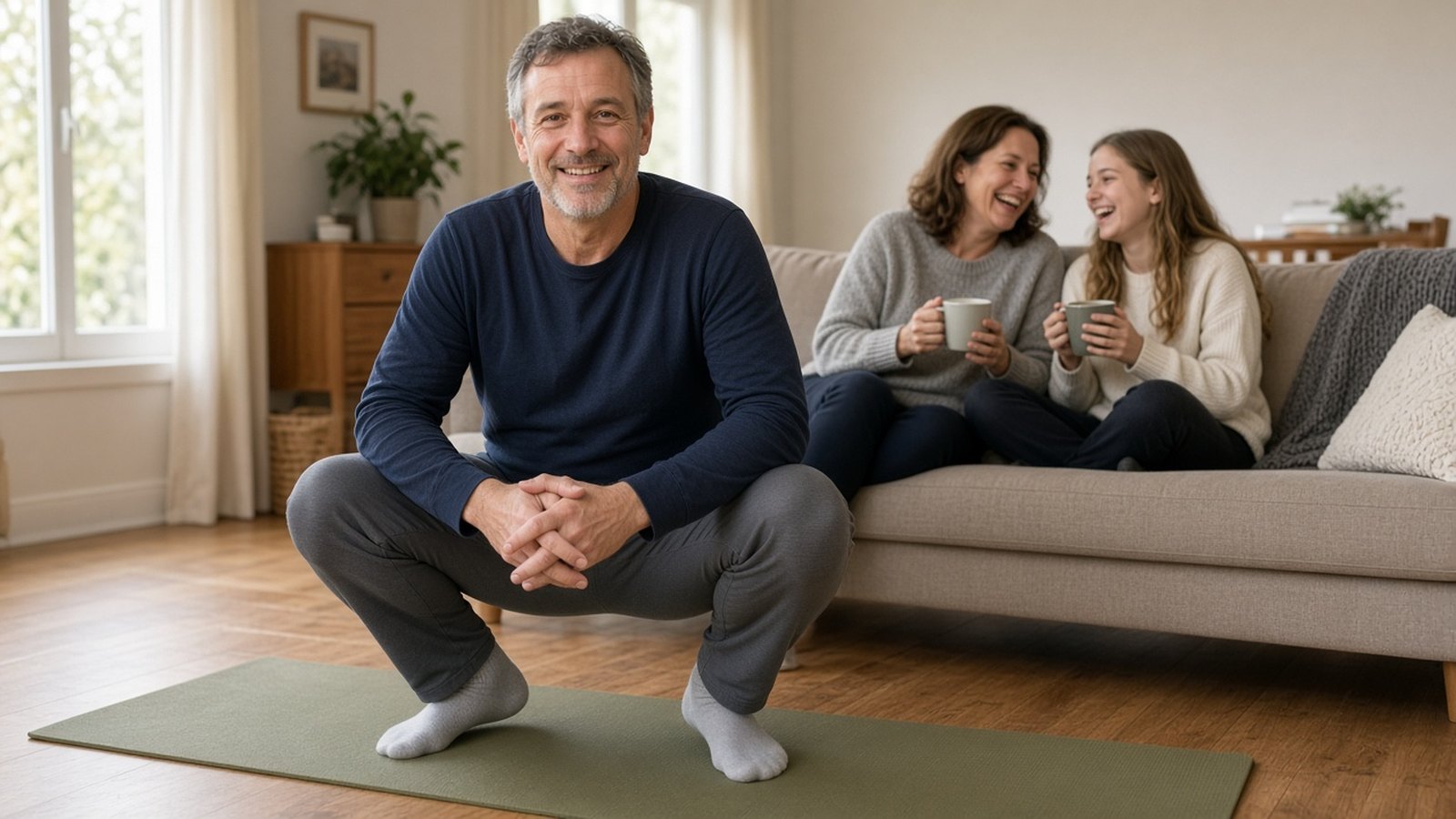
- Deep squat: feet hip-width apart, sink as low as is comfortable, heels on the floor, holding a door handle or table if needed. Start with 20 seconds and build up to a minute. There is no direct research on squatting for disc herniation. It does keep your hips and ankles supple, so your back has to compensate less. If bending deeply triggers leg pain, stay higher.
- Knee to chest from a calf-stretch stance: stand in a long stride with your hands against a wall, back leg straight. Calmly bring that back leg, knee bent, up towards your chest and put it back. Two sets of 8 per side. Here too the evidence is indirect: it trains hip flexion, balance and core control, which support your back.
- Hurdler movements: step sideways or forwards over an imaginary hurdle by lifting your knee and opening your hip, a hand on the wall if needed. Eight times per leg. This falls under hip mobility, which has a place in general exercise programmes for back pain, without specific herniation research.
After a few weeks, add gentle strength work for abdominals, glutes and hips, such as the bridge or side-lying leg raises. See strength training for beginners for a simple progression.
Keeping pain under control
Pain relief is there to help you move, not to rest. NICE lists anti-inflammatories as a possible short-term option for back pain, with attention to stomach, kidneys and heart. For sciatica, NICE advises against nerve pain drugs such as pregabalin. An Australian trial from 2017 found no better result than a placebo (a dummy pill). Ask your pharmacist what suits you. Heat on the lower back feels pleasant to many people.
Sleeping and working
There is no proven ideal sleeping position. Many people are comfortable on their side with a pillow between their knees, or on their back with a pillow under their knees. At work, variation matters most: get up every half hour, alternate sitting and standing and walk during phone calls.
What to avoid
Lying flat for long periods, sitting for long stretches without a break, and heavy lifting with a bent and twisted back in the first weeks. Also avoid the reflex of avoiding every movement: fear of moving often slows recovery.
Sources
- NICE. Low back pain and sciatica in over 16s: assessment and management (NG59). National Institute for Health and Care Excellence, 2016, updated 2020.
- Chiu CC, Chuang TY, Chang KH, et al. The probability of spontaneous regression of lumbar herniated disc: a systematic review. Clinical Rehabilitation, 2015.
- Dahm KT, Brurberg KG, Jamtvedt G, Hagen KB. Advice to rest in bed versus advice to stay active for acute low-back pain and sciatica. Cochrane Database of Systematic Reviews, 2010.
- Lam OT, Strenger DM, Chan-Fee M, et al. Effectiveness of the McKenzie Method of Mechanical Diagnosis and Therapy for Treating Low Back Pain: Literature Review With Meta-analysis. Journal of Orthopaedic and Sports Physical Therapy, 2018.
- Mathieson S, Maher CG, McLachlan AJ, et al. Trial of Pregabalin for Acute and Chronic Sciatica. New England Journal of Medicine, 2017.