

How many steps a day are useful for your health?
General information, not medical advice. If you have symptoms, discuss them with your GP or physiotherapist.
How many steps a day are useful for your health? You often hear 10,000, but large studies give a more nuanced picture. Below you can read what research says about steps and ordinary movement alongside your training.
What NEAT is
NEAT stands for non-exercise activity thermogenesis. The American researcher James Levine described it in 2002 as the energy you spend on everything that is not sleeping, eating or sports-like exercise, such as walking to work, typing or gardening. According to Levine, NEAT explains most of the energy you need on top of your resting expenditure. Steps are a handy measure of part of that movement, but they are not the same as NEAT. The health figures below come from studies that count steps with a measuring device, not from measurements of NEAT.
What the WHO recommends
The World Health Organization (WHO) advises adults to do 150 to 300 minutes of moderate-intensity activity per week, or 75 to 150 minutes of vigorous activity, and to do muscle-strengthening activities that involve all major muscle groups on at least two days a week (Bull and colleagues, 2020). According to Gezond Leven, the Flemish institute for health promotion, brisk walking counts as moderate-intensity activity. How to fill in the strength days is explained in the article on how much strength training per week is useful. The WHO also asks adults to limit time spent sitting and to replace it with physical activity of any intensity.
How many steps a day: what large studies find
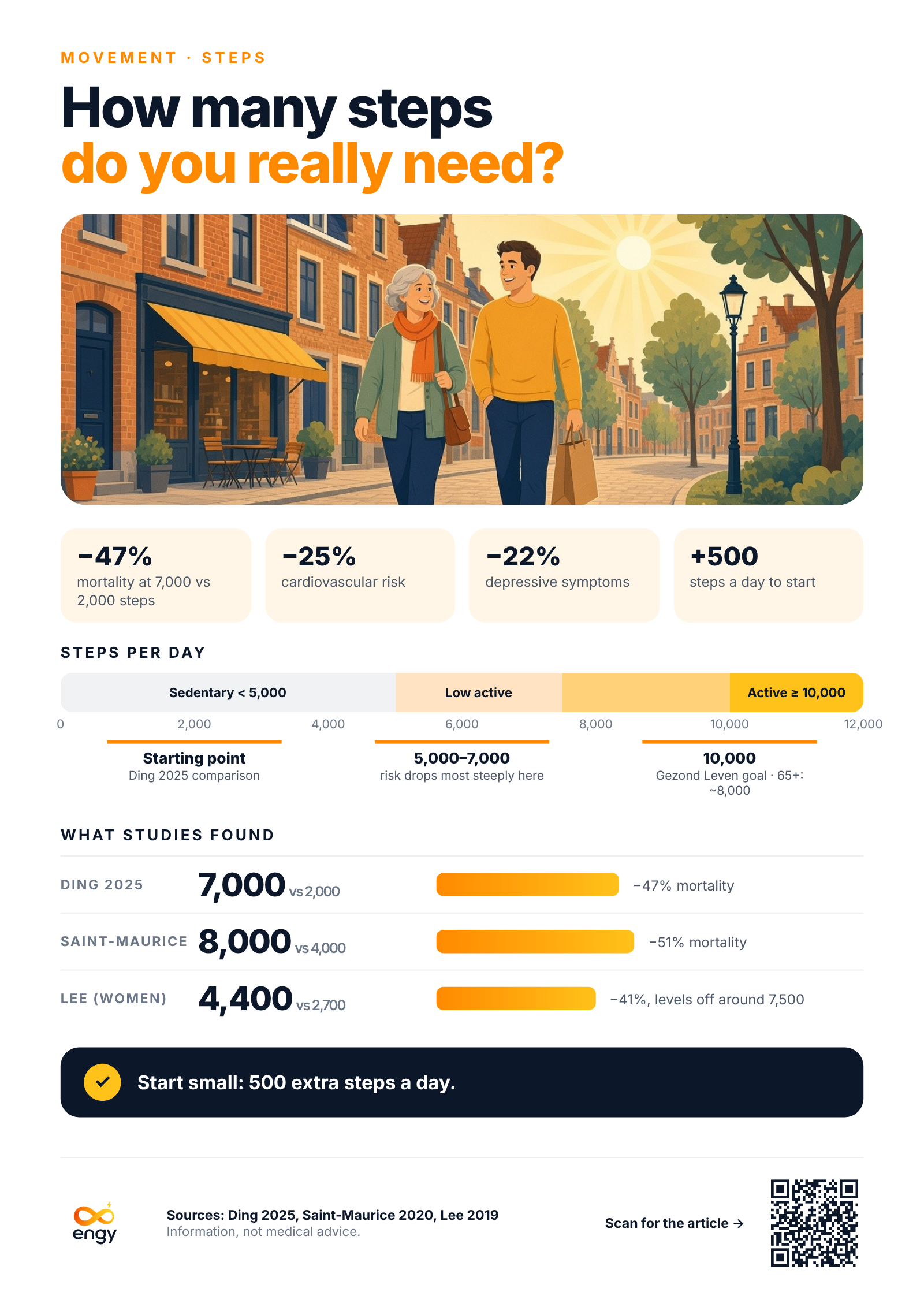
Ding and colleagues (2025) reviewed 57 studies. Compared with 2,000 steps a day, 7,000 steps was associated with a 47 percent lower risk of death, a 25 percent lower risk of cardiovascular disease and 22 percent fewer depressive symptoms. For mortality, risk fell most steeply up to about 5,000 to 7,000 steps, and more slowly above that. The authors say 10,000 steps can still be a good target for people who are more active, but 7,000 is more realistic for some.
Among more than 47,000 adults, the risk of death fell with more steps up to about 6,000 to 8,000 steps a day in people aged 60 and over, and up to about 8,000 to 10,000 in younger adults (Paluch and colleagues, 2022). In Americans aged 40 and over, 8,000 steps was associated with a 51 percent lower risk of death than 4,000 steps (Saint-Maurice and colleagues, 2020). In older women, 72 years old on average, about 4,400 steps was already associated with a 41 percent lower risk than about 2,700 steps, and the decline levelled off at around 7,500 steps (Lee and colleagues, 2019).
These are observational studies: they show an association, not proof that the steps themselves make the difference. Ding and colleagues themselves point to the small number of studies per outcome and possible bias from other factors.
Download the steps overview
What large studies found about steps per day, on one page, also as an A4.
What about 10,000 steps?
Lee and colleagues write that the 10,000-step goal has limited scientific basis. Gezond Leven still keeps it as an inspiring target for adults, and about 8,000 steps for people over 65, with the message that every step counts. A review by Tudor-Locke and colleagues (2011) describes a classification: fewer than 5,000 steps counts as sedentary, 5,000 to 7,499 as low active and 10,000 or more as active.
Can training make up for a day of sitting?
In data from more than a million people, Ekelund and colleagues (2016) found that about 60 to 75 minutes of moderate activity a day seemed to eliminate the higher risk of death linked to sitting a lot. With a lot of television viewing, that risk became smaller but did not disappear. That is well above the WHO minimum. Training and ordinary movement therefore complement each other: planned training, such as strength training or zone 2, an easy endurance pace at which you can still talk comfortably, and on top of that movement throughout the day.
More steps in an ordinary week
Gezond Leven advises measuring your steps for a week first, so you know where you stand. Then choose a goal, for example 500 extra steps a day, keep it up for at least a week and then pick a new one. A lunchtime walk, getting off one stop earlier or combining a walk with an errand all count. After a hard training session a day can be quieter, and a walk to the bakery also fits on a rest day.
Sources
- World Health Organization (2020). WHO guidelines on physical activity and sedentary behaviour. Geneva: WHO.
- Bull FC, Al-Ansari SS, Biddle S et al. (2020). World Health Organization 2020 guidelines on physical activity and sedentary behaviour. British Journal of Sports Medicine, 54(24), 1451–1462.
- Ding D, Nguyen B, Nau T et al. (2025). Daily steps and health outcomes in adults: a systematic review and dose-response meta-analysis. The Lancet Public Health, 10(8), e668–e681.
- Paluch AE, Bajpai S, Bassett DR et al. (2022). Daily steps and all-cause mortality: a meta-analysis of 15 international cohorts. The Lancet Public Health, 7(3), e219–e228.
- Saint-Maurice PF, Troiano RP, Bassett DR et al. (2020). Association of Daily Step Count and Step Intensity With Mortality Among US Adults. JAMA, 323(12), 1151–1160.
- Lee IM, Shiroma EJ, Kamada M et al. (2019). Association of Step Volume and Intensity With All-Cause Mortality in Older Women. JAMA Internal Medicine, 179(8), 1105–1112.
- Tudor-Locke C, Craig CL, Brown WJ et al. (2011). How many steps/day are enough? For adults. International Journal of Behavioral Nutrition and Physical Activity, 8, 79.
- Ekelund U, Steene-Johannessen J, Brown WJ et al. (2016). Does physical activity attenuate, or even eliminate, the detrimental association of sitting time with mortality? A harmonised meta-analysis of data from more than 1 million men and women. The Lancet, 388(10051), 1302–1310.
- Levine JA (2002). Non-exercise activity thermogenesis (NEAT). Best Practice & Research Clinical Endocrinology & Metabolism, 16(4), 679–702.
- Vlaams Instituut Gezond Leven. Waarom 10.000 stappen? In Dutch, accessed 16 October 2026.
- Vlaams Instituut Gezond Leven (2025). Elke stap telt: enkele tips (10.000 stappen leaflet, in Dutch).






5 Comments