
Testing your home for radon: why a small detector is going on my shelf this winter
TLDR
- Radon is a radioactive gas from the ground that you can’t see, smell or taste. In Belgium it is linked to about 7% of lung cancers, making it the second cause after smoking.
- Only a measurement tells you where you stand. During the Radon Campaign (1 October to 31 December) you can order a detector for 20 euros, lab analysis included, via radonactie.be or actionradon.be.
- Leave it for three months in the living room or bedroom on the ground floor. Not in the basement, not in the bathroom.
- Above 300 Bq/m³ you take action; after remediation you aim for below 100 Bq/m³. Simple fixes are often enough.
- Do you smoke? Tobacco and radon amplify each other. Quitting remains the biggest win.
When I picture a healthy home, I think of fresh air, a cool bedroom and a kitchen I actually enjoy cooking in. Radon wasn’t on my list for a long time. Fair enough: you can’t see it, you can’t smell it and you don’t notice a thing. Until you read that in Belgium it’s the leading cause of lung cancer after smoking. Then you do want to know how things stand in your own house. The good news: testing is cheap and simple, and right now is exactly the right time.
What is radon, and how does it get into your home?
Radon forms from uranium in soil and rock. It’s present in the ground everywhere, just in varying amounts. Outdoors it dilutes straight away. Indoors it can build up, especially in a poorly ventilated room.
The gas seeps in through cracks in the floor, joints between walls, cellars and crawl spaces, and gaps around pipes. How airtight your floor slab is and how your house was built make a big difference. Two neighbours on the same street can get very different readings.
Where in Belgium is the risk higher?
On average, the Federal Agency for Nuclear Control (FANC) measures around 46 becquerels per cubic metre (Bq/m³) in Belgian homes. But the gap between north and south is large. In the Ardennes the rock contains more uranium and is more often fractured, so the gas rises more easily. The risk areas lie mainly south of the Sambre and Meuse rivers, in the districts of Verviers, Liège, Neufchâteau, Dinant and Marche, and in Walloon Brabant.
In Flanders, layers of clay and sand hold the gas back better. That’s no guarantee: levels can be higher locally, and every home is its own case. FANC’s interactive map (in Dutch, French and German) shows which risk class your municipality falls into.
What does radon do to your health?
You breathe radon in with ordinary air. Its radiation damages lung tissue, and over the long term that raises the risk of lung cancer. According to FANC, about 7% of lung cancers in Belgium are linked to radon.
The World Health Organization estimates that the risk rises by about 16% for every additional 100 Bq/m³, averaged over a long period. There is no safe threshold: lower is better. Two things count, the concentration and the time you spend indoors. If you work from home a lot, you simply clock up more hours.
Smoking and radon: a bad combination
This is where it gets personal. Tobacco and radon reinforce each other. The WHO estimates that, at the same radon level, smokers face roughly 25 times the risk of non-smokers. If you smoke, quitting is by far the biggest win for your lungs. A radon test is no substitute for that, just a logical second step. Your GP or Belgium’s free quit lines (Tabakstop in Dutch, Tabacstop in French) can help.
The Radon Campaign: how to order a test
Every year FANC runs the Radon Campaign (Radonactie / Action Radon) with regional partners. It runs from 1 October to 31 December, or until stocks run out.
- Ordering: online via radonactie.be (Dutch) or actionradon.be (French).
- Price: 20 euros, including the lab analysis.
- Delivery: the detector comes by post, and can go to a different address from the home you’re testing.
- Too late? If you order outside the campaign, the detector is sent at the start of October the following season.
Last autumn, 5,135 Belgian households ordered a detector, most of them in the provinces of Luxembourg, Liège and Namur. But anyone can take part, Flanders included. Twenty euros for peace of mind seems like a small price to me.
Placing the detector: how I do it
A radon detector is a small plastic case that captures traces of radon. No plug, no battery, and harmless to the people living in the house. Because radon levels swing with the weather and the seasons, you measure for three months during the cold season to get a reliable average. Here’s what FANC recommends:
- Take the detector out of its aluminium pouch. It’s ready to go.
- Put it in the room where you spend the most time, on the ground floor: the living room or the bedroom. If you mostly live upstairs, the most-used room on the first floor works too.
- Not in the basement (unless you actually live there) and not in the bathroom.
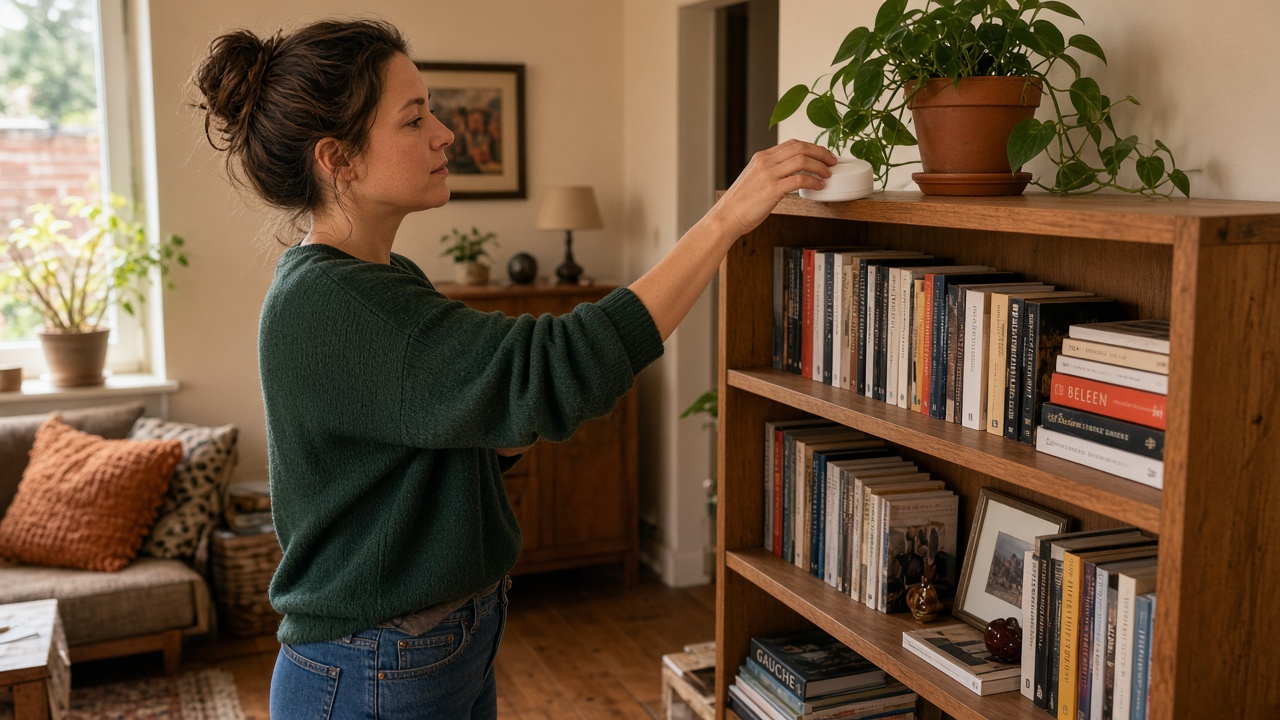
- At 1.5 to 2 metres high, about 20 centimetres from the wall and more than 10 centimetres from other objects. The top of a cabinet or a bookshelf is ideal.
- No draughts, no direct sunlight, and don’t move it for three months.
- Then send it back for analysis.
My tip: write the start date on the pouch and in your calendar, with a reminder to send it back. A detector forgotten behind the books is no use to anyone.
Reading your result
- Below 100 Bq/m³: the target for new builds and after remediation. Not zero risk, but a lower one.
- Between 100 and 300 Bq/m³: below the reference level. Personally, I’d still look at ventilation and cracks, because lower is better.
- Above 300 Bq/m³: the Belgian reference level for existing buildings, based on an EU directive. Time to take measures.
- Above 600 Bq/m³, or still above 300 after simple fixes: have the building properly assessed.
Too high? Here’s what you can do
FANC starts with simple, low-cost measures:
- seal cracks in the floor, joints and pipe entry points;
- make doors between the cellar and living areas close more tightly;
- check your ventilation: closed vents, dirty filters or a broken fan;
- restore the natural ventilation of a crawl space;
- open windows regularly if you have no other system. It helps, but FANC doesn’t see it as a lasting solution, because it depends on people’s habits.
If that isn’t enough, the next step is a building diagnosis and targeted works: sealing the boundary between ground and house more thoroughly, improving ventilation, or putting the space under the floor under slight negative pressure with an extraction system. FANC keeps a list of specialist firms, and in Wallonia the provincial indoor-environment services (SAMI) can advise you. Test again after the works so you know they did the job. Building or doing a major renovation in a risk area? Discuss prevention with your architect: it’s much easier during construction than afterwards.
Why this belongs to longevity for me
On Engy I often write about strength, sleep and food. But the air you sleep and work in counts just as much. Radon sits on the same list as the healthspan vs lifespan levers (article in Dutch): not glamorous, but it pays off over years. It also fits how I think about a cool bedroom (in Dutch): the room where you spend a third of your life deserves to be healthy. Test properly once and you’ll know where you stand for a long time, until you do major renovations. I’m gathering everything about a healthy home in the new Home topic.
My checklist
- This week: order a test via radonactie.be or actionradon.be (possible until 31 December).
- On delivery: place it in the living room or bedroom and note the start date.
- After three months: send it back for analysis.
- Above 300 Bq/m³: simple fixes first, then test again.
- If you smoke: work on quitting, with help from your GP or Tabakstop/Tabacstop.
Sources
- FANC — What is radon? (Dutch; French)
- FANC — How to measure radon at home (Dutch)
- FANC — What is the risk to your health? (Dutch)
- FANC — Radon in Belgium and Risk areas in Belgium (Dutch)
- FANC — Possible solutions (Dutch)
- FANC — Radon Campaign: first results 2025 and outlook 2026-2030 (Dutch)
- Radon Campaign — radonactie.be / actionradon.be (ordering, 1 October – 31 December)
- WHO — Radon and health (fact sheet)


One Comment